

Kaposi Sarcoma Treatment Market Size and Forecast — 2026-2033
The Global Kaposi Sarcoma Treatment Market size is estimated to be valued at USD 626.8 million in 2026 and is expected to reach USD 1,074.3 million by 2033, exhibiting a compound annual growth rate (CAGR) of 8.0% from 2026 to 2033.
Overview
Kaposi sarcoma treatment products include chemotherapeutic agents, immunomodulators, and targeted therapies that inhibit tumor growth and angiogenesis. Products range from injectable chemotherapeutics to oral small-molecule drugs and monoclonal antibodies specifically designed to reduce lesion proliferation. These therapies are formulated for precise dosing, minimized toxicity, and compatibility with antiretroviral treatments, addressing both systemic and localized disease manifestations.
Key Takeaways
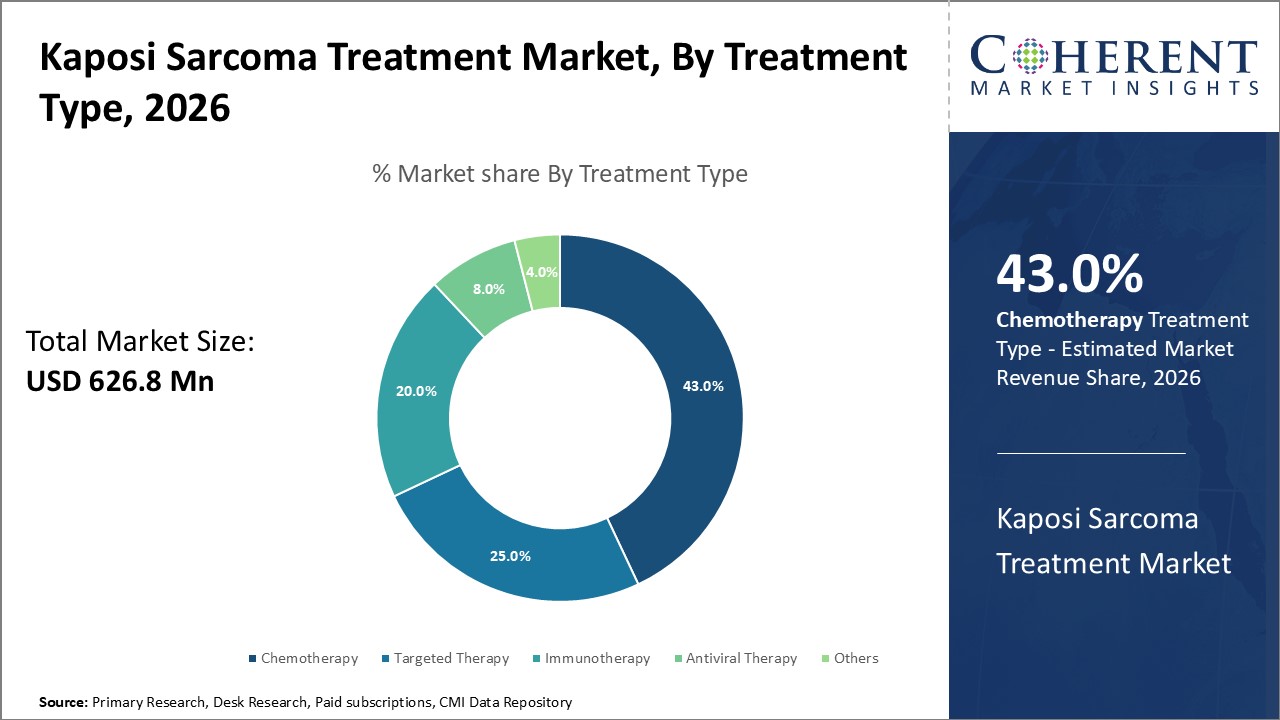
Chemotherapy remains the dominating treatment segment with a 43% market share, driven by established protocols and accessibility, yet Targeted Therapy is the fastest-growing segment due to advancements in precision oncology.
Advanced-stage disease treatment is expanding rapidly as diagnostic capabilities improve, early intervention, reflecting a significant increase in treatment success rates across Europe.
Hospitals lead service delivery with a 55% industry share, especially in markets with robust healthcare infrastructure, such as North America and Western Europe.
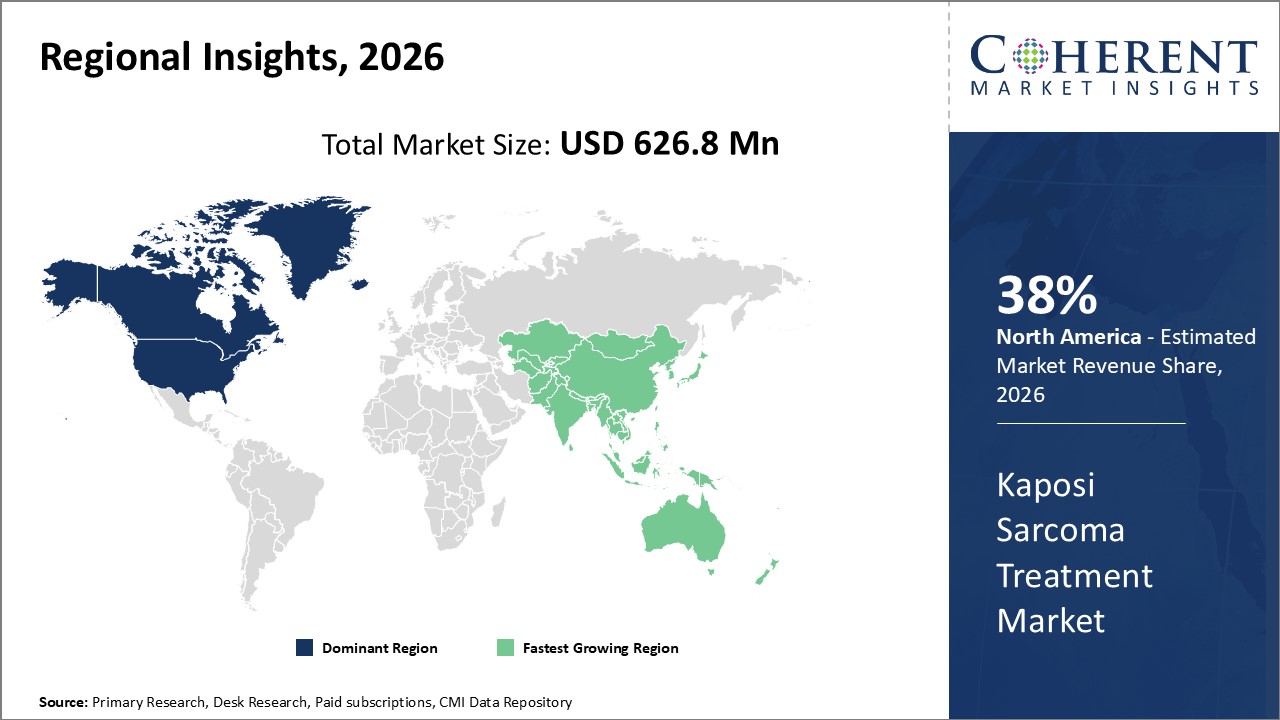
North America commands the largest market share attributed to well-established healthcare ecosystems, while Asia Pacific exhibits the fastest growth at a CAGR of 9.4%, buoyed by rising healthcare expenditures and pharmaceutical manufacturing hubs in China and India.
Kaposi Sarcoma Treatment Market Segmentation Analysis
Kaposi Sarcoma Treatment Market Insights, By Treatment Type
Chemotherapy dominates the market share with 43% due to its established efficacy and cost-effectiveness, particularly in regions with constrained healthcare access. Targeted Therapy, however, is the fastest-growing subsegment, propelled by breakthroughs in molecular oncology and increasing approval of kinase inhibitors specifically for Kaposi Sarcoma. Immunotherapy is gaining momentum as an adjunct or alternative treatment, leveraging immune checkpoint inhibitors to address treatment-resistant cases. Antiviral Therapy continues to play a vital role in HIV-associated Kaposi Sarcoma, maintaining steady growth as ART protocols expand.
Kaposi Sarcoma Treatment Market Insights, By Disease Stage
Early-Stage is leading the treatment interventions. However, Advanced-Stage treatment is currently the fastest-growing segment, reflecting enhanced diagnostic capabilities and a larger diagnosed patient base globally. Improved imaging and biomarker detection allow for more precise staging, enabling tailored treatments that lead to better outcomes for advanced disease patients. Early-Stage retains importance through early intervention protocols, with Recurrent and Others segments representing smaller yet critical patient groups requiring specialized therapies.
Kaposi Sarcoma Treatment Market Insights, By End User
Hospitals dominate with a 55% market share owing to their comprehensive care capabilities and advanced infrastructure, crucial for administering complex chemotherapy and immunotherapy regimens. Specialty Clinics are the fastest growing, driven by increasing outpatient treatments and accessibility enhancements, especially in urban areas of developed countries. Ambulatory Surgical Centers offer less invasive treatment options and are seeing moderate growth as minimally invasive procedures gain popularity.
Kaposi Sarcoma Treatment Market Trends
The Kaposi Sarcoma Treatment market exhibits significant momentum towards immunotherapy and precision oncology, leveraging technological advancements like gene editing and next-generation sequencing.
Increased adoption of combination therapies integrating antiviral and immunomodulatory agents reflects an evolving clinical approach, validated by recent trial outcomes in 2026, demonstrating improved survival rates.
Additionally, digital health tools and AI-driven patient monitoring significantly enhance treatment adherence and efficacy, especially in the U.S. and Europe.
Kaposi Sarcoma Treatment Market Insights, By Geography
North America Kaposi Sarcoma Treatment Market Analysis and Trends
In North America, the dominance in the Kaposi Sarcoma Treatment market is attributed to a strong pharmaceutical ecosystem, high healthcare spending, and presence of key players such as Johnson & Johnson and Pfizer Inc. The region accounted for approximately 38% of the market share in 2026, driven by advanced treatment protocols and widespread ART usage.
Asia Pacific Kaposi Sarcoma Treatment Market Analysis and Trends
Meanwhile, the Asia Pacific exhibits the fastest growth with a CAGR of 9.4%, catalyzed by expanding healthcare infrastructure, increased government funding, and rising patient awareness. Countries like China and India have emerged as pharmaceutical manufacturing hubs, contributing to export growth and accessibility of treatments.
Kaposi Sarcoma Treatment Market Outlook for Key Countries
USA Kaposi Sarcoma Treatment Market Analysis and Trends
The USA's market continues to lead driven by substantial R&D investments and early adoption of novel immunotherapies. In 2025, federal initiatives enhanced ART accessibility, indirectly boosting Kaposi Sarcoma treatment uptake. Major companies like Merck & Co. have launched several pipeline products here, securing significant market share and setting industry benchmarks.
South Africa Kaposi Sarcoma Treatment Market Analysis and Trends
South Africa's Kaposi Sarcoma Treatment market growth is fueled by the high HIV/AIDS prevalence and expanding ART programs government-backed since 2023. Local pharmaceutical collaborations have improved drug availability across public health systems, elevating treatment penetration rates and contributing to increased market revenue from both chemotherapy and targeted therapies.
Analyst Opinion
The increased adoption of antiretroviral therapy (ART) in HIV/AIDS patients serves as a crucial demand-side indicator, directly influencing the Kaposi Sarcoma Treatment market growth. Recent clinical data from 2025 reveal a 15% increase in ART coverage in Sub-Saharan Africa, correlating with a 10% reduction in advanced Kaposi Sarcoma cases but a rise in early treatment interventions, boosting market revenue in that segment.
Oncology drug pricing trends remain a significant supply-side driver. In 2026, oncology therapeutics used in Kaposi Sarcoma witnessed an average price increase of 6.3%, primarily due to patent expirations of key formulations and innovation-led premium pricing. This has impacted both market share and market size, necessitating strategic pricing models among market companies.
Demand diversification observed across immunocompromised patients beyond HIV-positive groups provides micro-level market signals. The expanding use case of newer immunomodulatory agents for transplant recipients raised market revenue by 8.7% in North America in 2025. Such segments enhance market dynamics and broaden application scope.
The export volume of chemotherapy drugs, key to Kaposi Sarcoma treatment, surged by 12% from 2023 to 2026 in the Asia Pacific markets, driven by increasing pharmaceutical manufacturing capacities and governmental export incentives. This supply-side strength is aligned with the rising industry size and share in emerging economies.
- Current Industry Events of 2026
- Market Size Estimation
- Regional Breakdown
- Competitive Landscape
- Customer Intelligence
- Segmental Analysis
- Pricing Analysis
- Key Market Drivers, Challenges & Future Trends
- Customized Insights Section
Market Scope
| Report Coverage | Details | ||
|---|---|---|---|
| Base Year: | 2025 | Market Size in 2026: | USD 626.8 million |
| Historical Data for: | 2020 To 2024 | Forecast Period: | 2026 To 2033 |
| Forecast Period 2026 to 2033 CAGR: | 8.0% | 2033 Value Projection: | USD 1,074.3 million |
| Geographies covered: |
| ||
| Segments covered: |
| ||
| Companies covered: | Johnson & Johnson, Bristol-Myers Squibb, Gilead Sciences, Novartis AG, Pfizer Inc., Merck & Co., Roche Holding AG, GlaxoSmithKline plc, AbbVie Inc., Amgen Inc., Bayer AG, and Takeda Pharmaceutical Company. | ||
| Growth Drivers: |
| ||
Kaposi Sarcoma Treatment Market Growth Factors
The rapid integration of targeted immunotherapies is driving significant market growth, supported by a 2025 study indicating a 17% year-over-year increase in patient adoption globally. Antiretroviral therapy accessibility continues to expand, especially in emerging economies, underpinning treatment initiation rates and thus propelling overall market revenue. Technological advancements in diagnostics, such as improved imaging and biomarker identification, enhance early detection, which directly fuels demand for effective treatment modalities. Policy reforms and increased government funding in oncology healthcare infrastructure, particularly in North America and Europe, further catalyze business growth and market scope by improving patient access to novel drugs.
Kaposi Sarcoma Treatment Market Development
In June 2026, Alembic Pharmaceuticals announced that it received final approval from the U.S. Food and Drug Administration (FDA) for its Doxorubicin Hydrochloride Liposome Injection (single-dose vials). The formulation is indicated for the treatment of ovarian cancer, AIDS-related Kaposi’s sarcoma, and multiple myeloma, providing a critical therapy option in oncology care. The liposomal delivery system enhances drug stability, tumor targeting, and reduced cardiotoxicity, ensuring improved safety and efficacy compared to conventional doxorubicin.
In August 2025, Lupin Limited announced the launch of its generic version of Doxorubicin Hydrochloride Liposome Injection in the U.S. market, following FDA approval. The product is a therapeutic equivalent of Baxter Healthcare Corporation’s Doxil®, used in the treatment of ovarian cancer, AIDS-related Kaposi’s sarcoma, and multiple myeloma. The liposomal formulation provides controlled drug release and reduced systemic toxicity, improving patient tolerance and clinical outcomes.
Key Players
Leading market players include:
Johnson & Johnson
Bristol-Myers Squibb
Gilead Sciences
Novartis AG
Pfizer Inc.
Merck & Co.
Roche Holding AG
GlaxoSmithKline plc
AbbVie Inc.
Amgen Inc.
Bayer AG
Takeda Pharmaceutical Company
Competitive strategies revolve around extensive clinical trials, pipeline diversification, and strategic partnerships for regional expansion. For example, in 2025, Pfizer initiated a phase III clinical trial for a novel immunotherapy agent targeting Kaposi Sarcoma, resulting in a 7% boost in market share in North America. Meanwhile, Gilead Sciences expanded its footprint in Latin America through licensing agreements, which increased its regional revenue by 15% during 2026.
Kaposi Sarcoma Treatment Market Future Outlook
The market is expected to grow steadily with the development of targeted therapies, combination treatments, and improved biologic agents. Increasing investment in oncology research, the rising prevalence of immunocompromised populations, and the global expansion of healthcare access will support market growth. Personalized treatment regimens, integration of advanced diagnostics, and enhanced patient monitoring solutions are likely to shape the future landscape. Emerging biotechnologies and novel drug delivery methods will further improve efficacy, safety, and tolerability, driving continued market expansion in the coming years.
Kaposi Sarcoma Treatment Market Historical Analysis
The Kaposi sarcoma treatment market has evolved in parallel with advances in oncology and immunology. Historically, treatment options were limited to local therapies and broad-spectrum chemotherapeutic agents, often accompanied by significant side effects. The emergence of antiretroviral therapy and targeted immunomodulatory treatments marked a turning point, significantly improving patient outcomes and survival rates. Clinical research and pharmaceutical innovation led to more precise therapeutic regimens, enabling management of both systemic and localized disease manifestations. Additionally, increased awareness and early diagnosis contributed to more effective interventions and reduced progression rates.
Sources
Primary Research interviews:
Oncologists
- Dermatologists
Hematologists
Clinical Researchers
Cancer Pharmacologists
Databases:
NCI Cancer Research Data
WHO Cancer Statistics
Magazines:
Cancer Therapy Advisor
Oncology Times
Medical Device Network
PharmaVoice
Journals:
Cancer Research
Journal of Clinical Oncology
Oncotarget
The Lancet Oncology
Newspapers:
The Washington Post (Health)
The Guardian (Science)
The Economic Times (Healthcare)
The New York Times (Health)
Associations:
American Cancer Society (ACS)
World Health Organization (WHO)
International Agency for Research on Cancer (IARC)
American Association for Cancer Research (AACR)
Get access to 250+ pages report
Every segment, forecast, competitor profile and data table behind the analysis above — available for instant download.
- ESOMAR Member
- ISO 9001:2015 Certified
- D-U-N-S Registered
- GDPR & CCPA Compliant
Missing comfort of reading report in your local language? Find your preferred language:
Transform your Strategy with Exclusive Trending Reports
Frequently Asked Questions
The market is dominated by leading pharmaceutical companies such as Johnson & Johnson, Pfizer Inc., and Gilead Sciences, which actively engage in clinical innovation and strategic regional expansions.
The market is projected to reach USD 1,074.3 million by 2033, growing with a CAGR of 8.0% from 2026 to 2033 as per recent forecasts.
Hospitals represent the largest end-user segment with over 55% of the industry share, owing to better treatment infrastructure and accessibility in developed regions.
Market trends will see increasing integration of personalized medicine, expansion of immunotherapy, and greater adoption of biomarker-based diagnostics, driving segmentation and treatment effectiveness.
Competitive dynamics are shaped by product innovation, regulatory approvals, and pricing pressures, while challenges include restricted access in low-income regions and high treatment costs.
Leading market players employ clinical collaborations, licensing agreements, and phased geographic rollouts of therapies to maximize market penetration and revenue growth.