

Sjogren’s Syndrome Market Size and Share Analysis: 2026 - 2033
The global Sjogren’s syndrome market size is expected to be valued at USD 266 Mn in 2026 and is projected to grow at a compound annual growth rate (CAGR) of 3.2% during the forecast period (2026-2033), reaching nearly USD 331 Mn by 2033.
Key Takeaways from the Sjogren’s Syndrome Market Report
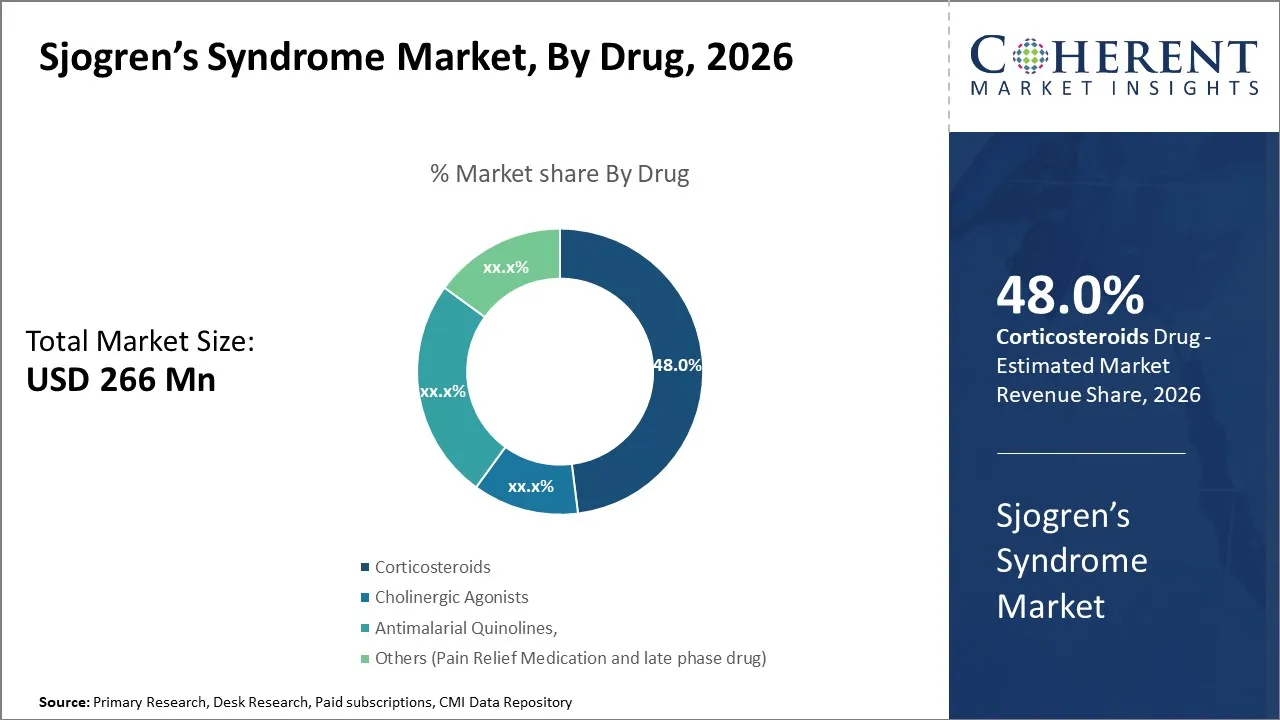
- Corticosteroids are likely to remain the leading drug for Sjogren’s syndrome treatment, accounting for approximately 48% of market revenue in 2026.
- Primary Sjogren’s syndrome segment is slated to dominate the market, accounting for approximately 60% of the market share in 2026, because of the rising prevalence of the disease.
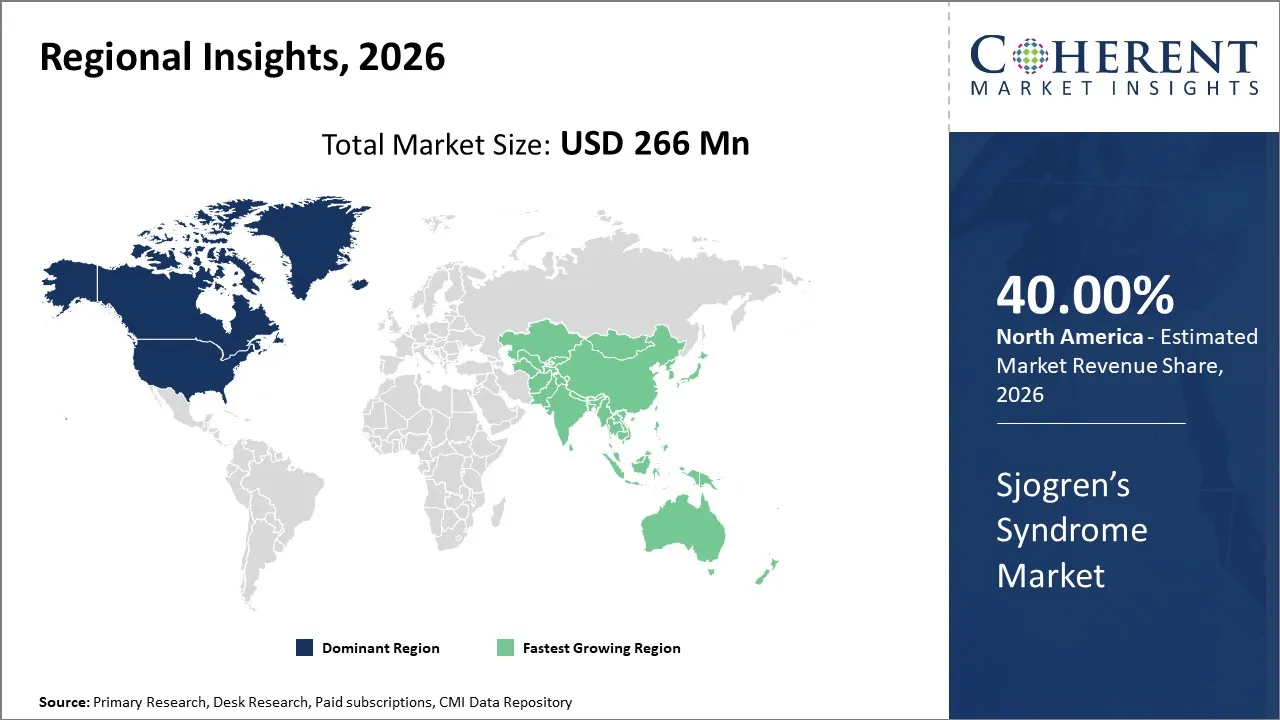
- North America is expected to lead the global Sjögren’s syndrome industry in 2026, holding around 40% of the market, thanks to its advanced healthcare system and strong focus on autoimmune disease care.
- Asia Pacific, with a share of over 20% in 2026, is poised to emerge as the fastest growing market for Sjogren’s syndrome drugs during the forecast period.
Sjogren’s Syndrome Market Overview
The global Sjogren’s syndrome market is projected to grow steadily during the assessment period. This is attributable to increasing prevalence of autoimmune disorders, rising awareness about Sjogren’s syndrome among healthcare professionals and patients, and advancements in targeted therapies.
Rising adoption of disease-modifying drugs, especially antimalarial quinolines and corticosteroids, is expected to boost Sjogren’s syndrome market growth during the forecast period. Similarly, expanding pipeline of late-phase drugs aimed at symptom management and immune modulation will bode well for the target market in the coming years.
For example, hydroxychloroquine, an antimalarial drug, is widely prescribed for Sjögren’s syndrome and recommended in clinical practice. It plays an immunomodulatory and anti‑inflammatory role and is included in many treatment guidelines for managing systemic symptoms.
Current Events and Their Impact on the Sjogren’s Syndrome Market
Current Event | Description and its Impact |
Regulatory Harmonization and Fast-Track Approvals |
|
Artificial Intelligence and Digital Health Integration |
|
Segmental Insights
- Current Industry Events of 2026
- Market Size Estimation
- Regional Breakdown
- Competitive Landscape
- Customer Intelligence
- Segmental Analysis
- Pricing Analysis
- Key Market Drivers, Challenges & Future Trends
- Customized Insights Section
Sjogren’s Syndrome Market Insights, By Drug - Corticosteroids Remain the Most Commonly Used Drug for Sjogren’s Syndrome
Based on drug, corticosteroids segment is projected to lead the market with a revenue share of 48% in 2026. This is primarily due to their rapid anti-inflammatory effects, ability to alleviate systemic symptoms such as joint pain and swelling, and widespread clinician familiarity. Corticosteroids are often given in moderate doses to treat acute flares or moderate-to-severe systemic symptoms of Sjögren’s syndrome. Ongoing research on corticosteroid formulations and combination therapies continues to support their use for specific patient groups.
Current clinical practice guidelines note that corticosteroids (e.g., prednisolone) are often used in short courses to control specific systemic manifestations of Sjögren’s syndrome, such as pulmonary involvement or cytopaenias. They may help improve symptoms when used at moderate doses. As a result, the corticosteroids segment remains the dominant contributor to the Sjögren’s Syndrome market.
Sjogren’s Syndrome Market Insights, By Type - Primary Sjogren’s Syndrome Holds Largest Market Share
Based on type, primary Sjogren’s syndrome segment is expected to dominate the market with a share of about 60% in 2026. This is mostly due to its higher prevalence compared to secondary Sjogren’s syndrome and the growing awareness about early diagnosis and management of autoimmune disorders.
Primary Sjogren’s syndrome occurs independently, without association with other autoimmune diseases, which contributes to a larger patient population. Moreover, advancements in diagnostic technologies, such as salivary gland imaging and specific autoantibody testing, have improved detection rates, further supporting the dominance of this segment.
Epidemiological studies estimate that pSS affects roughly tens to low hundreds per 100,000 adults, with higher incidence in females and older age groups. This disease incidence is expected to fuel demand for Sjogren’s syndrome treatments during the forecast period, thereby boosting growth of the target segment.
Regional Insights
North America Dominates the Global Sjogren’s Syndrome Market
North America is expected to lead the global Sjogren’s syndrome industry with a share of 40% in 2026. This is attributable to advanced research in autoimmune therapies and high adoption of biologic treatments. Presence of leading pharmaceutical companies and ongoing clinical trials are accelerating the development of new therapies for Sjogren’s Syndrome. Moreover, growing patient support programs and awareness campaigns are helping in early diagnosis and treatment adherence, contributing to the market’s steady expansion in the region.
Asia Pacific to Emerge as a Central Hub for Sjogren’s Syndrome Drug Manufacturers
Asia Pacific is projected to account for more than 20% of the global Sjogren’s syndrome market share in 2026. This is mostly due to increasing awareness of autoimmune diseases and rising healthcare expenditure in countries like China, India, and Japan. Expansion of specialized clinics and the availability of advanced diagnostic tools are also boosting early detection and treatment of Sjogren’s Syndrome. In addition, government initiatives to improve healthcare access and insurance coverage are helping more patients receive timely treatment, further supporting market growth in the region.
Sjogren’s Syndrome Market Outlook – Country-wise
U.S. Sjogren’s Syndrome Market Trends
The United States remains the largest market for Sjögren’s syndrome treatments. This is mainly due to a high number of diagnosed cases, advanced healthcare infrastructure, and strong R&D investment in new biologics and targeted therapies. Development of targeted therapies and faster regulatory processes is supporting market expansion. For example, nipocalimab, an immunotherapy drug, has received Breakthrough Therapy and Fast Track designations from the U.S. FDA, speeding up its development for moderate to severe Sjögren’s disease.
In addition, clinical research and trials for next-generation biologics and immune-modulating treatments are growing in the U.S., supported by strong R&D investment and collaboration between academic centers and pharmaceutical companies. This environment helps bring innovative treatment options closer to patients.
China Sjogren’s Syndrome Market Forecast
The Sjogren’s syndrome market in China is poised to record the fastest growth during the assessment period. This can be attributed to rising awareness of autoimmune disorders, increased healthcare expenditure, and expanding access to advanced diagnostic tools and therapies. Furthermore, government’s initiatives to enhance healthcare infrastructure and support rare disease management are driving the adoption of novel treatments.
China’s market for Sjogren’s Syndrome is gaining momentum as diagnostic capabilities improve and clinical research expands. Healthcare providers in China are increasingly adopting advanced imaging and biomarker diagnostics to detect the disease earlier and more accurately than before.
A key development in China is progress in Phase III clinical trials of telitacicept, which has shown significant improvements in disease activity compared to placebo. This is one of the most promising investigational therapies coming from clinical research in the country.
Sjogren’s Syndrome Industry News
- In January 2026, the U.S. FDA gave Novartis’ ianalumab Breakthrough Therapy status for treating Sjögren’s disease. This was based on Phase III trial results showing the drug helps patients by improving disease activity.
- In March 2025, the U.S. FDA gave Johnson & Johnson’s investigational drug nipocalimab Fast Track status for adults with moderate-to-severe Sjögren’s disease.
- In November 2024, Johnson & Johnson’s nipocalimab received FDA Breakthrough Therapy designation for adults with moderate-to-severe Sjögren’s disease. It is the first and only therapy to receive this designation for the condition.
Market Report Scope
Sjogren’s Syndrome Market Report Coverage
| Report Coverage | Details | ||
|---|---|---|---|
| Base Year: | 2025 | Market Size in 2026: | USD 266 Mn |
| Historical Data for: | 2020 To 2024 | Forecast Period: | 2026 To 2033 |
| Forecast Period 2026 to 2033 CAGR: | 3.2% | 2033 Value Projection: | USD 331 Mn |
| Geographies covered: |
| ||
| Segments covered: |
| ||
| Companies covered: | ADVANZ Pharma, Bristol Myers Squibb, Daiichi Sankyo, GlaxoSmithKline, Novartis, MorphoSys, RemeGen, Resolve Therapeutics, Tear Solutions, VIELABIO, Otsuka Pharmaceutical Co., Ltd., and Bridge Pharma Inc. | ||
| Growth Drivers: |
| ||
| Restraints & Challenges: |
| ||
Sjogren’s Syndrome Market Drivers
Rising Incidence of Sjogren’s Syndrome and Other Autoimmune Disorders
Growing prevalence of autoimmune disorders like Sjögren’s syndrome is a major factor driving market growth. Sjögren’s syndrome affects larger patient populations globally, especially women, increasing demand for diagnosis and treatment solutions. Most clinical references estimate that Sjögren’s syndrome affects roughly 5–10 per 1,000 people worldwide. This high burden is fueling demand for therapies for Sjögren’s syndrome. Likewise, increased awareness among clinicians and patients leads to more early diagnoses and treatment initiation, expanding the pool of treated individuals.
Therapeutic Innovation and Novel Drug Development
Advancements in biologics and targeted therapies, including B‑cell–directed drugs, JAK inhibitors, and other immunomodulators, are creating more precise and potentially disease-modifying treatment options compared with traditional symptomatic therapies. Strong clinical trial activity and a robust pipeline are expanding the number of potential therapeutics under development. For example, Novartis’ ianalumab received Breakthrough Therapy designation from the U.S. FDA for the treatment of Sjögren’s disease, highlighting its potential to significantly improve outcomes for patients.
Sjogren’s Syndrome Market Trends
Shift Towards Combination Therapies
Rising popularity of combination therapies is a key growth-shaping trend in the Sjögren's Syndrome market. This approach involves pairing standard treatments, such as corticosteroids or immunosuppressants, with emerging biologic or targeted therapies to enhance efficacy and address multiple disease pathways simultaneously. While still largely in clinical development, these combination strategies reflect a shift toward more personalized and comprehensive care, aiming to improve patient outcomes and meet the unmet needs of those with systemic manifestations of the disease.
Increasing Adoption of Personalized Medicine
Growing adoption of personalized medicine is emerging as a key trend in the Sjögren’s Syndrome market. This approach focuses on tailoring treatments based on a patient’s individual characteristics, such as genetic profile, biomarkers, or disease severity. By selecting therapies that are more precisely suited to each patient, personalized medicine aims to improve treatment effectiveness, reduce side effects, and enhance overall patient outcomes. Ongoing research and development of biomarker-driven diagnostics and targeted therapies are driving this shift toward more customized and patient-centric care.
Sjogren’s Syndrome Market Opportunities
Advancements in Sjogren’s Syndrome Diagnostics
Better diagnostic tools and technologies, such as salivary gland ultrasonography, molecular assays, and emerging AI‑assisted diagnostics, are enhancing early recognition and monitoring of the disease. Likewise, use of biomarkers and molecular profiling helps identify patient subgroups, supporting personalized care strategies. These diagnostic advancements are expected to create growth opportunities for Sjogren’s syndrome market during the forecast period.
Sjogren’s Syndrome Market — Key Pipeline Drugs / Recent Therapeutic Developments
Drug / Developer | Development Status / Key Data |
Nipocalimab (Johnson & Johnson) | Phase 2: improved ClinESSDAIa scores, response noted from Week 4-24 (2024) |
Abiprubart (Kiniksa Pharmaceuticals) | Phase 2b initiation (2024) |
Efgartigimod (argenx SE) | Moving to Phase 3 after Phase 2 topline data (2024) |
Dazodalibep (Amgen) | Phase 2 data at ACR Convergence 2023 showed systemic and symptomatic improvement |
Analyst Opinion (Expert Opinion)
- Symptom focused treatments dominate despite clear dissatisfaction. Real world patient surveys show that although 78% of adults with Sjögren’s take prescribed therapies, 94% report they are not fully satisfied and over half believe current treatments only mask symptoms and fail to address underlying disease mechanisms — a stark signal that symptomatic relief isn’t translating to perceived value in the market.
- Biologic therapies are used out of necessity, not confidence. Rituximab remains the most frequently used biologic in clinical practice despite mixed evidence. Meta analyses show it can significantly reduce serum IgG and B cell levels and improve certain symptom scores, yet it fails to consistently improve core disease metrics like glandular function. This disconnect between mechanistic promise and clinical impact highlights why adoption is cautious and clinician confidence is conditional.
- Clinical trial outcomes have tempered enthusiasm for current advanced therapies. Rigorous randomized controlled studies largely fail to meet primary endpoints for fatigue and dryness relief, even when secondary measures improve. This has created a market where innovation is technically present but clinically under validated, forcing clinicians and payers alike to treat Sjögren’s as an off label, experiment driven area instead of a predictable therapeutic category.
- Untargeted approaches and patient heterogeneity suppress product differentiation. More than 90% of clinical trials use standard disease activity measures, and most patients have varied immune profiles. Because of this, products cannot clearly show better effectiveness across different patient groups. The variability in patients has slowed the identification of clear leaders and weakened the adoption of new treatment mechanisms.
Speak to the analyst
Want personalized insights?
Take the findings above to one of our principal consultants, or have the report rebuilt around the segments, geographies and competitors you actually track.
Sjogren’s Syndrome Market Segmentation
- By Drug Insights ( Revenue, USD Mn, 2020 - 2033)
- Antimalarial Quinolines
- Cholinergic Agonists
- Corticosteroids
- Others (Pain Relief Medication and late phase drug)
- By Type Insights ( Revenue, USD Mn, 2020 - 2033)
- Primary
- Secondary
- By Distribution Channel Insights ( Revenue, USD Mn, 2020 - 2033)
- Hospital Pharmacy
- Retail Pharmacy
- Online Pharmacy
- By Region Insights ( Revenue, USD Mn, 2020 - 2033)
- North America
- U.S.
- Canada
- Latin America
- Brazil
- Argentina
- Mexico
- Rest of Latin America
- Europe
- Germany
- U.K.
- Spain
- France
- Italy
- Russia
- Rest of Europe
- Asia Pacific
- China
- India
- Japan
- Australia
- South Korea
- ASEAN
- Rest of Asia Pacific
- Middle East & Africa
- GCC Countries
- Israel
- Rest of Middle East & Africa
- North America
- Key Players in the Sjogren’s Syndrome Market
- ADVANZ Pharma
- Bristol Myers Squibb
- Daiichi Sankyo
- GlaxoSmithKline
- Novartis
- MorphoSys
- RemeGen
- Resolve Therapeutics
- Tear Solutions
- VIELABIO
- Otsuka Pharmaceutical Co., Ltd.
- Bridge Pharma Inc.
Sources
Primary Research interviews
- Healthcare professionals specializing in autoimmune disorders
- Rheumatologists and clinical immunologists
- Hospital administrators and care providers managing Sjögren’s syndrome patients
- Patient advocacy group representatives
- Pharmaceutical/biotech researchers focused on autoimmune therapeutics
Databases
- PubMed / MEDLINE database
- ClinicalTrials.gov database
- World Health Organization (WHO) Global Health Observatory
- U.S. National Library of Medicine databases
- EMBASE medical database
- Scopus scientific abstracts and indexing
Magazines
- Autoimmune Review
- Health Affairs Magazine
- Patient Care & Health Magazine
- Clinical Oncology News Magazine
- Pharmaceutical Executive
Journals’:
- The Journal of Rheumatology
- Arthritis & Rheumatology
- Clinical Rheumatology
- Autoimmunity Reviews
- Journal of Clinical Immunology
- Lupus Science & Medicine
Newspapers
- The New York Times (Health Section)
- The Guardian (Health & Science)
- The Washington Post (Health)
- Hindustan Times (Health & Wellness)
- The Times of India (Health)
Associations
- American College of Rheumatology (ACR)
- European League Against Rheumatism (EULAR)
- Sjögren’s Syndrome Foundation (SSF)
- National Institutes of Health (NIH)
- World Health Organization (WHO)
- Indian Rheumatology Association (IRA)
Public Domain sources
- World Health Organization (WHO) published reports and fact sheets
- Centers for Disease Control and Prevention (CDC) public health data
- U.S. Food and Drug Administration (FDA) drug approvals and safety databases
- National Health Service (NHS UK) informational resources
- OpenFDA public label and adverse event data
Proprietary Elements
- CMI Data Analytics Tool
- Proprietary CMI Existing Repository of information for last 8 years
Get access to 250+ pages report
Every segment, forecast, competitor profile and data table behind the analysis above — available for instant download.
- ESOMAR Member
- ISO 9001:2015 Certified
- D-U-N-S Registered
- GDPR & CCPA Compliant
Missing comfort of reading report in your local language? Find your preferred language:
Transform your Strategy with Exclusive Trending Reports
Frequently Asked Questions
The global market is estimated to be valued at USD 266 Mn in 2026.
The global Sjogren’s Syndrome Market value is expected to reach USD 331 Mn by 2033.
The global market is poised to exhibit a CAGR of 3.2% from 2026 to 2033.
Major growth factors include increasing diagnosed cases and development of new drugs for the treatment of sjogren’s syndrome
Lack of permanent treatments for Sjogren’s syndrome.
Some major companies in the Sjogren’s Syndrome Market include ADVANZ Pharma, Bristol Myers Squibb, Daiichi Sankyo, GlaxoSmithKline, Novartis, MorphoSys, RemeGen, Resolve Therapeutics, Tear Solutions, VIELABIO, Otsuka Pharmaceutical Co., Ltd., and Bridge Pharma Inc.
North America, with 40% share in 2026, is expected to lead the market during the forecast period.