

Sodium Selenite Market Size and Share Analysis - Growth Trends and Forecast (2026 - 2033)
The global sodium selenite market size is estimated to be valued at USD 72.3 Mn in 2026 and is projected to grow at a compound annual growth rate (CAGR) of 9.4% during the forecast period (2026-2033), reaching USD 135.3 Mn by 2033. This is attributable to increasing demand for selenium-enriched products in the pharmaceutical and nutraceutical industries.
Key Takeaways from the Sodium Selenite Market Report
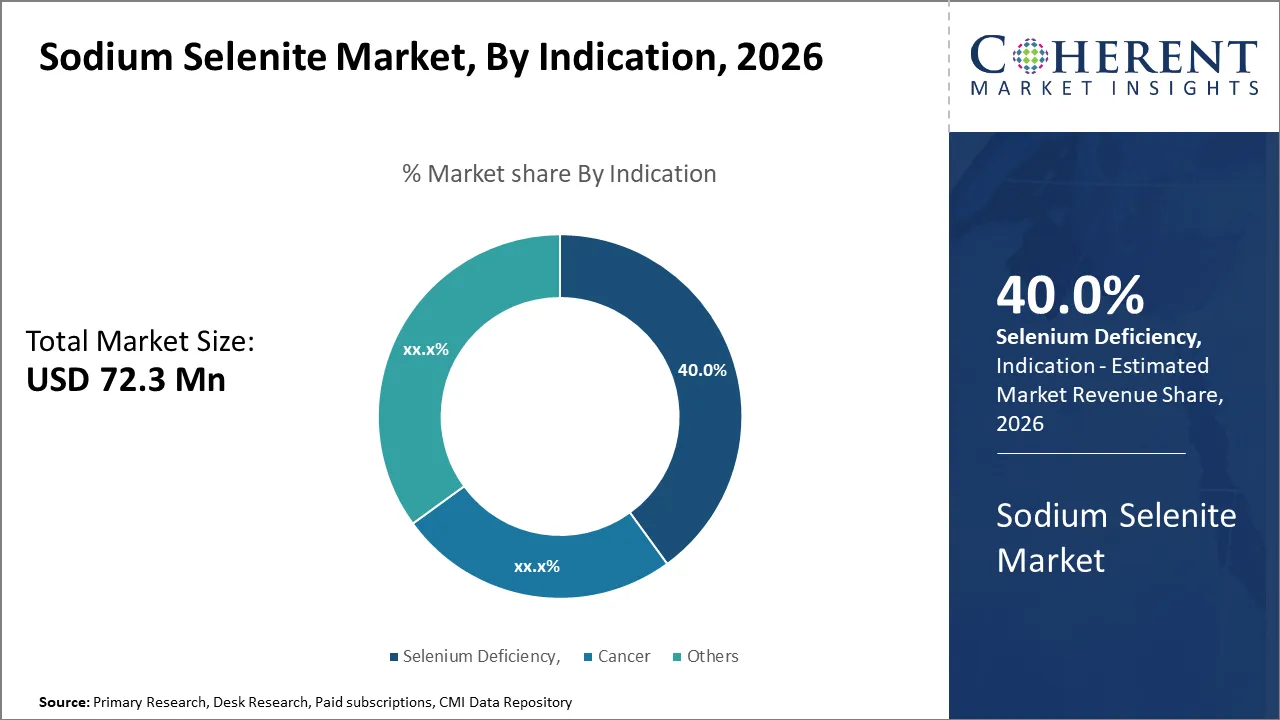
- Based on indication, selenium deficiency segment is expected to lead the market with a share of about 40% in 2026 due to increasing adoption of sodium selenite in therapeutic and dietary supplementation
- Retail pharmacies are likely to account for 42% of the global sodium selenite market share in 2026, thanks to their wide accessibility, strong consumer trust, and growing demand for over-the-counter selenium supplements.
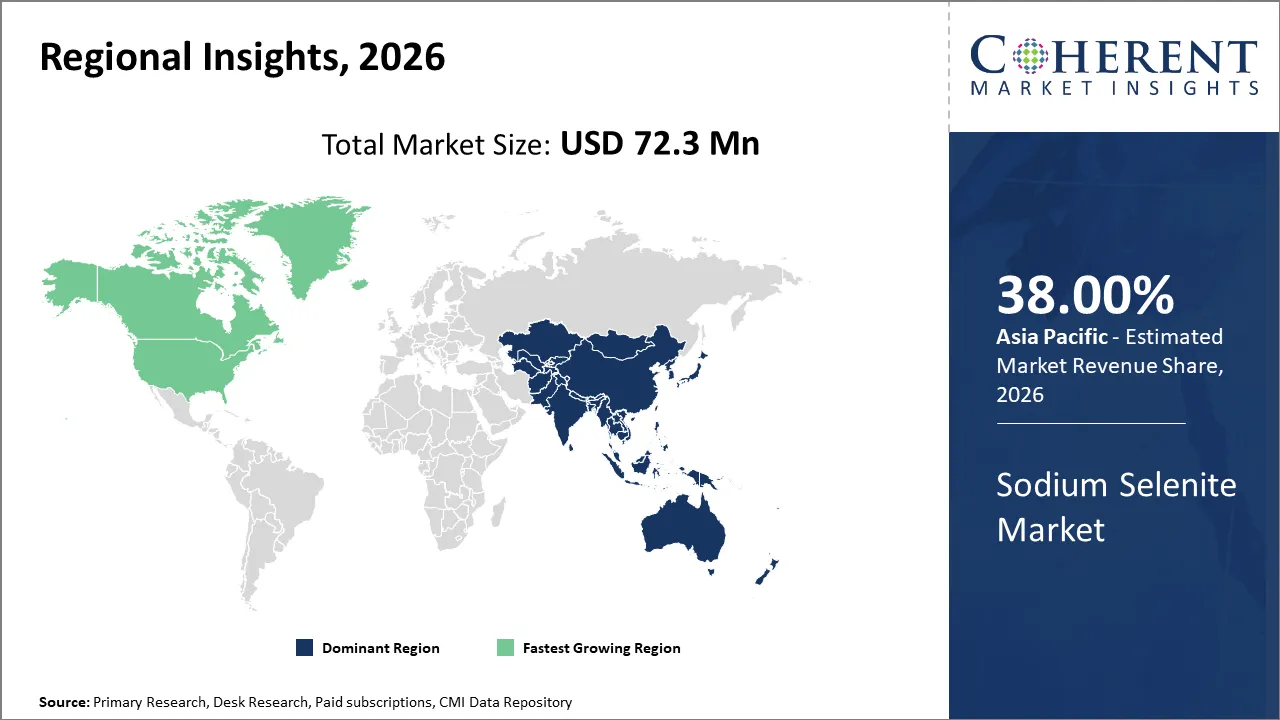
- Asia Pacific is expected to dominate the global sodium selenite industry, capturing a 38% share in 2026 as a result of rising demand in animal feed, industrial applications, and growing human supplement markets in China and India.
- North America, with a share of 28% in 2026, is anticipated to emerge as a highly lucrative market for sodium selenite manufacturers during the forecast period, owing to rising health awareness and increasing prevalence of micronutrient deficiencies.
Market Overview
The global sodium selenite market is projected to grow rapidly during the forecast period. This is mostly due to increasing awareness of selenium’s essential role in human and animal health, rising application in dietary supplements, animal feed, and pharmaceutical formulations, and growing demand for functional foods and nutraceuticals, which incorporate selenium for its antioxidant and immune-boosting properties.
Sodium selenite (Na₂SeO₃) is a common source of selenium in biological research because selenium is an essential trace element usually provided through serum or diet. Selenium is used to make selenoproteins, such as glutathione peroxidase and thioredoxin reductase, in the form of selenocysteine, which is the selenium version of cysteine. Glutathione peroxidase helps remove peroxides, playing an important role in detoxification and protecting the body against oxidative stress.
In cell culture, sodium selenite is included as a trace element in various media and supplements. It has been widely used in studies of cell proliferation, cancer biology, and gene expression, including experiments modifying HepG2 cell gene expression as measured by cDNA microarrays. Ongoing research highlighting selenium’s potential in disease prevention and cancer therapy is likely to open new avenues for the growth of sodium selenite market during the forecast period.
Demand for sodium selenite is increasing in pharmaceutical formulations, feed additives, and nutritional supplements because it helps support health and prevent selenium deficiency. Expansion of these industries is expected to boost sodium selenite sales during the forecast period. Industrial uses also add to the overall sodium selenite market demand. Sodium selenite is used in glass manufacturing to decolorize and refine glass by removing iron impurities. It is also used in ceramics, chemical processes, and some specific applications in pesticides, making it valuable in various industries.
Current Events and Their Impact on the Sodium Selenite Market
Current Event | Description and its Impact |
Rising Global Health Consciousness and Nutritional Awareness |
|
Technological Advancements in Manufacturing and Bioavailability |
|
Segmental Insights
- Current Industry Events of 2026
- Market Size Estimation
- Regional Breakdown
- Competitive Landscape
- Customer Intelligence
- Segmental Analysis
- Pricing Analysis
- Key Market Drivers, Challenges & Future Trends
- Customized Insights Section
Which Indication Segment Tops the Sodium Selenite Market ?
Selenium Deficiency Leads the Market with Nearly 40% Share in 2026
According to Coherent Market Insights, selenium deficiency segment is expected to dominate the market, accounting for 40% of the total revenue share in 2026. This is mostly due to the rising prevalence of selenium deficiency-related disorders, growing awareness of selenium’s role in human health, and increasing adoption of sodium selenite as a dietary supplement to address deficiencies. In addition, the expanding geriatric population and rising demand for fortified foods and nutraceuticals are further driving the growth of this segment.
Which Distribution Channel Rules the Sodium Selenite Industry?
Retail Pharmacies Dominate the Market for Their Accessibility and Wide Reach
Based on distribution channel, retail pharmacies are expected to dominate the global sodium selenite market, accounting for a share of 42% in 2026. This is due to their widespread presence, easy accessibility for consumers, and strong trust among end-users seeking dietary supplements and pharmaceutical-grade minerals.
Furthermore, retail pharmacies often provide personalized guidance, ensuring proper usage, which also strengthens their position as the preferred distribution channel for sodium selenite products. On the other hand, online pharmacies segment is poised to grow at a higher CAGR during the assessment period, owing to digital penetration and consumer preference.
Regional Insights
Agriculture Boom and Food Fortification Driving Growth in Asia Pacific
Asia Pacific is projected to dominate the global sodium selenite market with a share of 38% in 2026. This dominance is mostly due to increasing livestock production, where sodium selenite is used as a feed additive to enhance animal health as well as productivity, and growing focus on food fortification programs by governments to address selenium deficiencies in the population.
Nations like China and India are witnessing rising awareness about micronutrient deficiencies, prompting both public and private sectors to invest in fortified foods and supplements. This not only boosts demand for sodium selenite in the food and nutraceutical industries but also encourages manufacturers to expand production capacity and distribution networks.
Nutraceutical and Pharmaceutical Demand Boosting Growth in North America
The sodium selenite market in North America is growing rapidly as a result of rising demand for dietary supplements and fortified foods enriched with selenium, as consumers increasingly focus on immunity and preventive healthcare. As per the latest sodium selenite market analysis, North America will likely hold 28% of the global market share in 2026.
The pharmaceutical industry also contributes substantially to sodium selenite market expansion in North America. Sodium selenite is widely used in antioxidant formulations, oncology supplements, and supportive therapy for chronic conditions, which is driving steady adoption among healthcare providers. In addition, regulatory frameworks ensuring the safety and efficacy of selenium-based products are creating a favorable environment for manufacturers to expand their offerings in the region.
Sodium Selenite Market Outlook – Country-wise
China Sodium Selenite Market Forecast
China is anticipated to remain a highly lucrative market for manufacturers of sodium selenite during the forecast period. This is due to rising livestock production and feed supplementation practices. Sodium selenite is increasingly used as a feed additive to improve animal health and productivity, which is driving demand in the agricultural sector. At the same time, government-led food fortification programs to address selenium deficiency in the population are expanding opportunities in the nutraceutical and functional food industries.
U.S. Sodium Selenite Market Trends
The U.S. sodium selenite market is poised to exhibit strong growth over the forecast period due to increasing demand for nutritional supplements and fortified foods targeting immunity and antioxidant support. Expansion of pharmaceutical sector is also fueling demand for sodium selenite in the nation. This is because sodium selenite is being widely used in oncology and chronic disease formulations. In addition, rising awareness about selenium deficiency and government initiatives promoting dietary supplementation are encouraging manufacturers to expand product offerings.
Sodium Selenite Industry News
- In March 2026, HiMedia Laboratories Pvt. Ltd. received the “GS1 India Excellence Award 2026” at the GS1 India Forum in Mumbai. The award recognized HiMedia for using barcodes and RFID systems to improve supply‑chain tracking and batch‑level traceability.
- In November 2023, American Elements partnered with a leading European nutraceutical company to co-develop high-purity sodium selenite for dietary supplements. The collaboration aims to expand global availability of pharmaceutical-grade products and strengthen their nutraceutical segment.
Market Report Scope
Sodium Selenite Market Report Coverage
| Report Coverage | Details | ||
|---|---|---|---|
| Base Year: | 2025 | Market Size in 2026: | USD 72.3 Mn |
| Historical Data for: | 2020 To 2024 | Forecast Period: | 2026 To 2033 |
| Forecast Period 2026 to 2033 CAGR: | 9.4% | 2033 Value Projection: | USD 135.3 Mn |
| Geographies covered: |
| ||
| Segments covered: |
| ||
| Companies covered: | MP Biomedicals, Otto Chemie Pvt. Ltd., American Elements, Global Calcium PVT LTD, Sisco Research Laboratories Pvt. Ltd., HiMedia Laboratories., Research-Lab Fine Chem Industries, Omkar Speciality Chemicals Ltd., Vital Materials Co., Limited., Spectrum Laboratory Products, Inc., Estechpharma Co., Ltd., Quality Chemicals, SL, and Salvi Chemical Industries Ltd. | ||
| Growth Drivers: |
| ||
| Restraints & Challenges: |
| ||
Sodium Selenite Market Drivers
Rising Incidence of Selenium Deficiency
Selenium deficiency has become a major global nutrition problem. For example, insufficient selenium intake has been estimated to affect up to 1 billion people worldwide. This is prompting individuals to consume dietary supplements, leading to higher demand for sodium selenite. Thus, the rising burden of selenium deficiency, along with growing demand for dietary selenium, is expected to provide a strong impetus for the growth of the sodium selenite market during the forecast period.
Growing Demand in Animal Nutrition and Feed Additives
Sodium selenite is being widely used as an essential micronutrient in animal feed to improve immune function, growth, reproduction, and overall livestock health. This makes it a staple feed additive worldwide. The expanding livestock industry, coupled with rising global consumption of meat, dairy, and animal protein, drives higher demand for fortified feeds. To meet this demand, the animal feed sector increasingly incorporates trace minerals like selenium, boosting sodium selenite consumption as well as market growth.
Sodium Selenite Market Trends
Rising Food Fortification and Functional Food Demand
Rising consumer interest in foods fortified with essential micronutrients, including selenium, is a major trend shaping the sodium selenite market. More consumers are choosing fortified foods and dietary supplements to support immune health, improve overall wellness, and prevent nutrient deficiencies. This is motivating manufacturers to add sodium selenite to cereals, dairy products, beverages, and nutritional supplements, boosting market demand.
Sodium Selenite Market Opportunities
Increasing Consumer Health Awareness
Growing awareness of selenium’s role in supporting antioxidant activity, thyroid function, and immune health is boosting demand for selenium-containing products. Sodium selenite, a commonly used form of selenium, is increasingly added to dietary supplements and some fortified foods to help prevent selenium deficiencies in specific populations. These growing uses in health-focused products and functional foods are expected to create new growth opportunities for the sodium selenite market during the forecast period.
Research into Sodium Selenite’s Potential Role in Cancer Management
Scientific studies indicate that sodium selenite can induce apoptosis and inhibit proliferation in various These research findings highlight emerging scientific interest and potential opportunities for future therapeutic development.
Analyst Opinion (Expert Opinion)
- More than 40–50% of global consumption stems from animal nutrition, driven by measurable production outcomes in livestock performance — fertility, immunity, and growth improvements documented across major farming geographies. This isn’t just demand; it’s value‑added formulation economics that feed producers can quantify. Manufacturers who are reluctant to invest in precision dosing (given the 2–3 ppm safety window) are already losing share to competitors with better quality control systems.
- Regulatory authorities in major markets enforce tight selenium inclusion limits (e.g., max ~0.3–0.5 mg/kg in feed/food), and that has fundamentally changed how producers formulate and price products. In the EU and North America, compliance costs and labeling complexity have cut into profitability and encouraged some premium customers to shift toward organic selenium forms despite higher unit costs, signaling a structural shift in buyer preferences.
- Sodium selenite’s reliance on selenium as a by‑product of copper refining means its raw material isn’t driven by selenium demand but by copper market cycles. Volatility in selenium pricing (historically swinging significantly per kg) directly impacts not just producers’ margins but feed manufacturers’ risk models. The market isn’t just reacting to demand — it’s reacting to supply unpredictability that few strategists are adequately pricing in.
- Despite the narrative that sodium selenite is “primarily a feed additive,” industrial uses — especially in glass decolorizing and pigment/ceramic applications — account for a meaningful share (often ~15–20%+ in diversified regions) and provide revenue resilience against cyclical feed market swings. In mature industrial hubs, this segment underwrites baseline demand even when agricultural demand fluctuates.
Speak to the analyst
Want personalized insights?
Take the findings above to one of our principal consultants, or have the report rebuilt around the segments, geographies and competitors you actually track.
Market Segmentation
- By Indication Insights ( Revenue, USD Mn, 2020 - 2033)
- Selenium Deficiency
- Cancer
- Others (digestive support, dental amalgam removal, etc.)
- By Distribution Channel Insights ( Revenue, USD Mn, 2020 - 2033)
- Hospital Pharmacies
- Retail Pharmacies
- Online Pharmacies
- By Region Insights ( Revenue, USD Mn, 2020 - 2033)
- North America
- U.S.
- Canada
- Latin America
- Brazil
- Argentina
- Mexico
- Rest of Latin America
- Europe
- Germany
- U.K.
- Spain
- France
- Italy
- Russia
- Rest of Europe
- Asia Pacific
- China
- India
- Japan
- Australia
- South Korea
- ASEAN
- Rest of Asia Pacific
- Middle East
- GCC Countries
- Israel
- Rest of Middle East
- Africa
- South Africa
- North Africa
- Central Africa
- North America
- Sodium Selenite Market Key Players
- MP Biomedicals
- Otto Chemie Pvt. Ltd.
- American Elements
- Global Calcium PVT LTD
- Sisco Research Laboratories Pvt. Ltd.
- HiMedia Laboratories.
- Research-Lab Fine Chem Industries
- Omkar Speciality Chemicals Ltd.
- Vital Materials Co., Limited.
- Spectrum Laboratory Products, Inc.
- Estechpharma Co., Ltd.
- Quality Chemicals
- Salvi Chemical Industries Ltd.
Sources
Primary Research interviews
- Industry experts in chemical manufacturing and selenium compounds
- Technical managers in pharmaceutical, nutraceutical, and agricultural applications
- Procurement and supply chain professionals from sodium selenite manufacturing plants
Databases
- PubChem
- ScienceDirect
- SpringerLink
- ChemSpider
Magazines
- Chemical & Engineering News
- ICIS Chemical Business
- Pharmaceutical Technology
Journals
- Journal of Trace Elements in Medicine and Biology
- Journal of Agricultural and Food Chemistry
- Toxicology Reports
Newspapers
- The Chemical Engineer
- The Wall Street Journal
- Financial Times
Associations
- International Selenium Association
- American Chemical Society
- World Health Organization
Public Domain sources
- United States Pharmacopeia (USP)
- FAO/WHO Codex Alimentarius
- U.S. Environmental Protection Agency (EPA) reports
Proprietary Elements
- CMI Data Analytics Tool
- Proprietary CMI Existing Repository of information for last 8 years
Get access to 250+ pages report
Every segment, forecast, competitor profile and data table behind the analysis above — available for instant download.
- ESOMAR Member
- ISO 9001:2015 Certified
- D-U-N-S Registered
- GDPR & CCPA Compliant
Missing comfort of reading report in your local language? Find your preferred language:
Transform your Strategy with Exclusive Trending Reports
Frequently Asked Questions
The global market is estimated to be valued at USD 72.3 Mn in 2026.
The global Sodium Selenite Market value is expected to reach USD 135.3 Mn by 2033.
The global market is poised to exhibit a CAGR of 9.4% from 2026 to 2033.
Major growth factors include heightened health awareness among consumers and growing applications in the food & beverage, animal nutrition, and pharmaceutical industries.
Stringent regulations and raw material price volatility are slowing down market growth.
Selenium deficiency segment, with about 40% market share in 2026, dominates the market.
Some major companies in the Sodium Selenite Market include MP Biomedicals, Otto Chemie Pvt. Ltd., American Elements, Global Calcium PVT LTD, Sisco Research Laboratories Pvt. Ltd., HiMedia Laboratories., Research-Lab Fine Chem Industries, Omkar Speciality Chemicals Ltd., Vital Materials Co., Limited., Spectrum Laboratory Products, Inc., Estechpharma Co., Ltd., Quality Chemicals, SL, and Salvi Chemical Industries Ltd.