

Surgical Staplers Market Size and Trends - 2026 to 2033
The Surgical Staplers Market is estimated to be valued at USD 6.2 Bn in 2026 and is expected to reach USD 9.55 Bn by 2033, growing at a compound annual growth rate (CAGR) of 6.4% from 2026 to 2033.
Key Takeaways
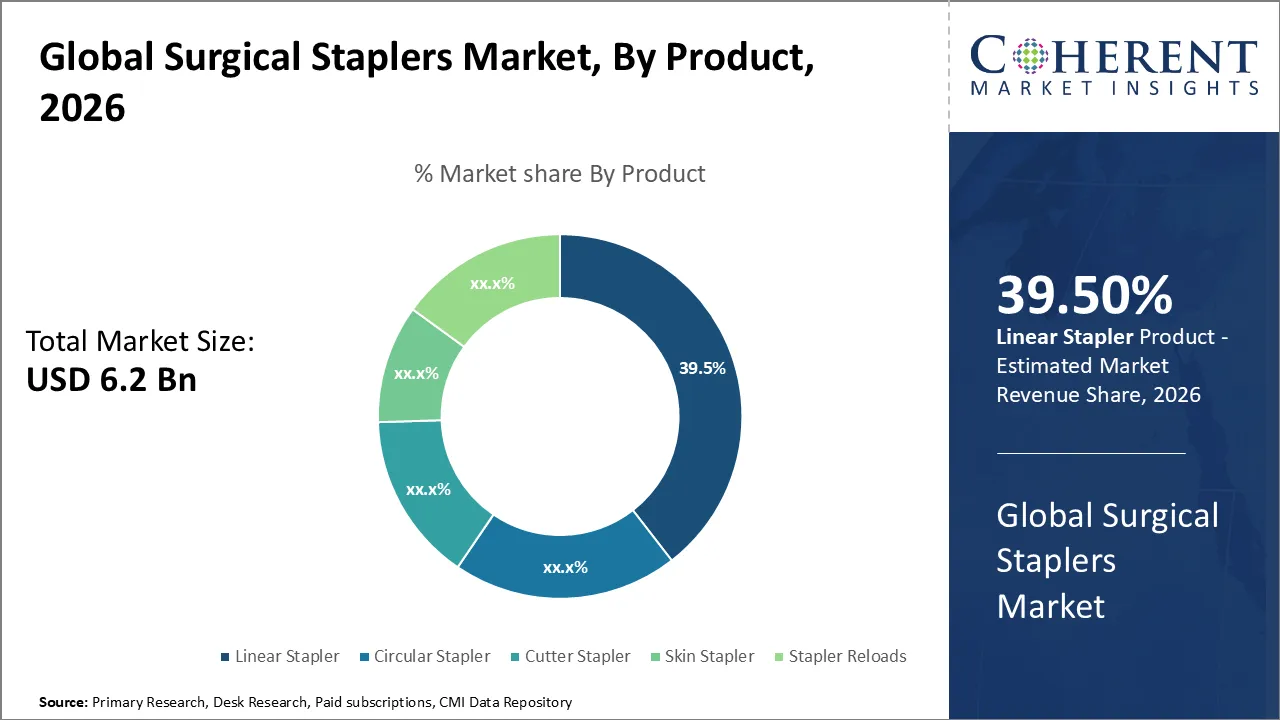
- Based on Product, the Linear Stapler segment is expected to lead the market with 39.50% share in 2026, due to their versatility and widespread use in surgeries.
- Based on Application, the Abdominal Surgery segment is expected to lead the market with 41.80% share in 2026, due to high volume of routine abdominal procedures.
- Based on Mechanism, the Manual Surgical Stapler segment is expected to lead the market with 61.20% share in 2026, due to their established clinical familiarity, lower cost, and utility across a wide range of basic and routine surgeries.
- Based on Usability, the Disposable Surgical Stapler segment is expected to lead the market with 69.40% share in 2026, because of their single‑use sterility advantage, reduced cross‑contamination risk, and workflow convenience in both hospitals and outpatient settings.
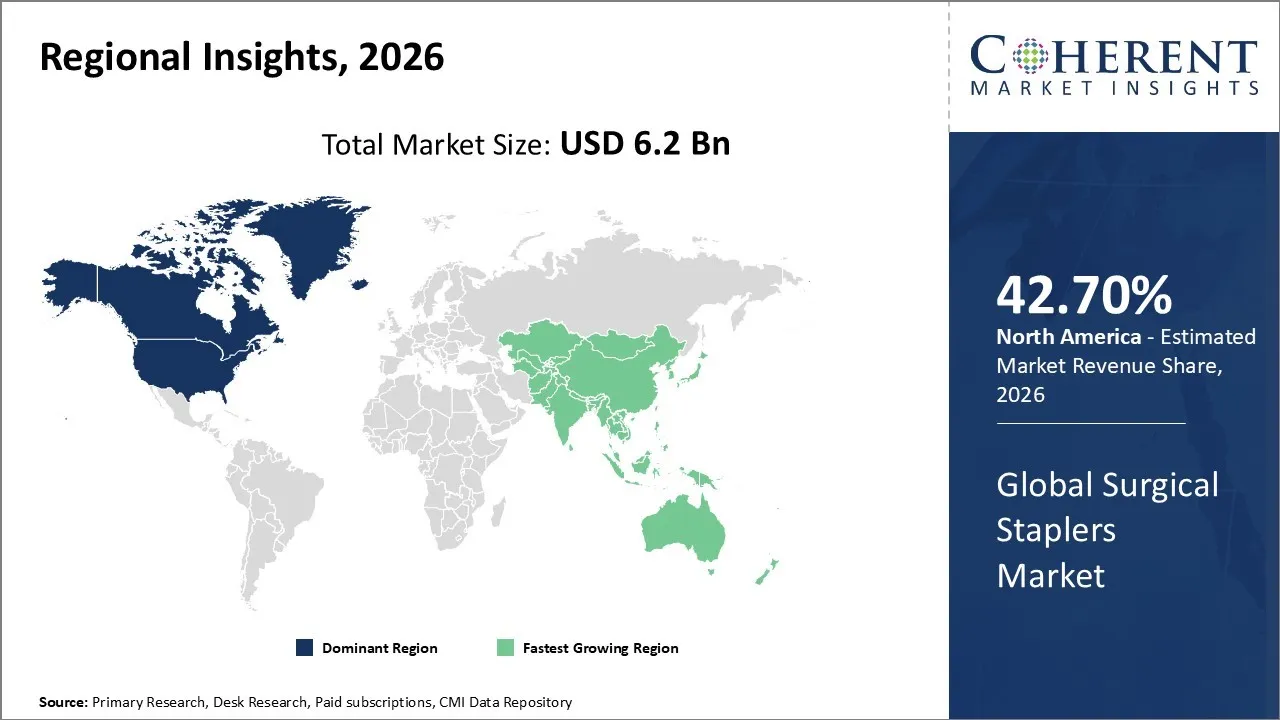
- Based on Region, North America is set to lead the market with 42.70% share in 2026. While, Asia Pacific is anticipated to be the fastest growing region.
Market Overview
The surgical staplers market is advancing significantly with the rising demand for minimally invasive procedures and powered stapling systems in the gastrointestinal, thoracic, and gynecological sectors. The growing surgeon awareness regarding procedural efficiency and a strategic shift away from traditional manual suturing are expected to propel market growth over the forecast period. Surgical Staplers are primarily utilized for rapid tissue approximation and the creation of secure anastomoses. They serve as a high performance alternative to hand-sewn closures, thereby offering superior consistency and reduced operative time.
The industry is entering a transformative period owing to the use of advanced electronic firing technologies, a surge in robot-assisted surgeries, and the integration of smart sensors that provide real-time feedback on tissue thickness. These advancements enhance the precision, safety, and ergonomics of single-use and articulating staplers. As a result, the healthcare providers can replace manual techniques with automated botanical-compatible or titanium-based solutions that assist in catering to the growing global regulatory standards for patient safety and clinical transparency.
Current Events and Its Impacts on the Surgical Staplers Market
Current Event | Description and the Impact |
Technological Innovations and Advancements |
|
Regional Healthcare Infrastructure Developments
|
|
Strategic Industry Movements |
|
Segmental Insights
- Current Industry Events of 2026
- Market Size Estimation
- Regional Breakdown
- Competitive Landscape
- Customer Intelligence
- Segmental Analysis
- Pricing Analysis
- Key Market Drivers, Challenges & Future Trends
- Customized Insights Section
Surgical Staplers Market Insights, By Product– Linear Stapler Leads Due to Versatility and Widespread Use in Surgeries
In terms of product, the linear stapler segment contributes the highest share of 39.50% in 2026 of the market. The growth is owing to its versatility and its effectiveness in open as well as minimally invasive surgeries. These devices are primarily used for tissue resection and transection, delivering consistent straight staple lines that support secure closure and reduce the risk of leaks. The growth of linear staplers is due to their broad applicability in gastrointestinal, thoracic, and bariatric procedures. Furthermore, the development of linear cutter staplers, which can simultaneously staple and divide tissue, has significantly improved surgical efficiency and patient safety. The increasing volume of complex internal surgeries worldwide highlights the precision and reliability of linear staplers, which are favored by surgeons seeking to reduce operative time and postoperative complications.
Surgical Staplers Market Insights, By Application – Abdominal Surgery Leads Due to High Volume of Routine Abdominal Procedures
In terms of application, the abdominal surgery segment contributes the highest share of 41.80% in 2026 of the market. The growth of this sector can be mainly attributed to the high prevalence of gastrointestinal disorders and colorectal cancers as well as the rising demand for bariatric and weight loss surgeries. The surgical staplers in abdominal procedures is owing to their capability to provide faster and more reliable outcomes compared to hand suturing, especially when creating complex bowel anastomoses. The increasing use of laparoscopic abdominal techniques has also boosted growth, resulting in higher utilization of specialized staplers designed for minimally invasive access. The implementation of enhanced recovery protocols aims to reduce hospital stays and minimize the risk of infections. This strategy is promoting the increased use of staplers in high-volume abdominal surgical settings around the globe.
Surgical Staplers Market Insights, By Mechanism – Manual Surgical Stapler Leads Due to its Established Clinical Familiarity
In terms of mechanism, the manual surgical stapler segment contributes the highest share of 61.20% in 2026 of the market. The growth is due to its cost-effectiveness and widespread availability, especially in healthcare systems with budget constraints and in emerging economies. The preference surgeons show for manual staplers is owing to the tactile feedback these devices provide, which enables real-time assessment of tissue thickness and procedural control. These devices play a pivotal role in routine surgical procedures owing to their simple design, absence of electronic components, and well-established safety profile. The manual staplers continue to play a central and indispensable role in general surgery.
Regional Insights
North America Surgical Staplers Market Analysis & Trends
North America has remained the dominant region with 42.70% in 2026 of the global surgical staplers market over the forecast period. The growth is owing to the substantial public health investments and a strong healthcare infrastructure that enables prompt diagnosis. The implementation of early screening programs like Early Hearing Detection and Intervention (EHDI) is also constituting to the growth of the market in the region. The technological breakthroughs serves as a vital catalyst for growth, particularly through the rising adoption of minimally invasive surgical (MIS) techniques, robotic-assisted navigation systems, and AI-powered diagnostic tools that improve precision and reduce recovery times.
For instance, in June 2025, Johnson & Johnson MedTech announced that the ETHICON™ 4000 Stapler will soon be available in the US. This cutting-edge surgical stapler is made to handle tissue complexity and provide outstanding staple line integrity.
Asia Pacific Surgical Staplers Market Analysis & Trends
The Asia Pacific region is the fastest growing market for surgical staplers. The growth is owing to an increase in minimally invasive surgeries (MIS) and the increasing aging population in countries like Japan, China, and South Korea. India is experiencing growth owing to the rapid expansion of private multi-specialty hospitals and a thriving medical tourism sector. This sector attracts international patients in search of cost-effective bariatric and cardiac procedures. The competitive landscape encompasses both established global firms as well as emerging local businesses. The top companies like Medtronic, Johnson & Johnson (Ethicon), and Intuitive Surgical are incorporating advanced technologies like real-time tissue-sensing algorithms and powered firing mechanisms to improve procedural accuracy.
For instance, in January, 2025, Genesis Medtech has announced that the iReach Omnia has obtained clearance for market release in China from the National Medical Products Administration (NMPA). This is the first powered stapler that features the ability to articulate at a 90° angle.
Surgical Staplers Market Outlook Country-Wise
The US Surgical Staplers Market Trends
The U.S. surgical staplers market is a highly mature sector defined by the widespread use of advanced medical technologies and a robust healthcare infrastructure. The market is currently undergoing a major transition toward powered and electronic stapling systems that integrate smart sensors to monitor tissue thickness during complex procedures. This surge is primarily due to the high prevalence of obesity and chronic diseases, which has resulted in a substantial volume of bariatric and thoracic surgeries. In addition, the rapid expansion of robot-assisted surgery across American hospitals necessitates specialized articulating staplers designed for precision. The stringent safety regulations and a strong emphasis on reducing operating room time are encouraging the use of high-quality, disposable instruments.
For instance, in June 2022, Ethicon, a division of Johnson & Johnson MedTech, has announced the availability of the ECHELON 3000 Stapler in the U.S. Surgeons can tailor simple, one-handed powered articulation to meet the specific needs of each patient using this digitally enabled tool.
India Surgical Staplers Market Trends
The Indian surgical staplers market is characterized by rapid expansion and a diversifying landscape that balances cost-sensitivity with a demand for modern technology. Although traditional manual staplers remain a staple in many public healthcare facilities due to their affordability, there is an accelerating trend toward minimally invasive techniques in urban private hospitals. A growing middle class, an increase in elective surgeries, and India's status as a global hub for medical tourism are the main factors driving the market. The government initiatives aimed at expanding surgical coverage have also increased the penetration of specialized wound closure tools in secondary cities.
Market Report Scope
Surgical Staplers Market Report Coverage
| Report Coverage | Details | ||
|---|---|---|---|
| Base Year: | 2025 | Market Size in 2026: | USD 6.2 Bn |
| Historical Data for: | 2020 To 2024 | Forecast Period: | 2026 To 2033 |
| Forecast Period 2026 to 2033 CAGR: | 6.4% | 2033 Value Projection: | USD 9.55 Bn |
| Geographies covered: |
| ||
| Segments covered: |
| ||
| Companies covered: | Grena Ltd., 3M Company, Smith & Nephew, Purple Surgical Inc., Meril Life Science Pvt. Ltd., Medtronic PLC, Intuitive Surgical Inc., B. Braun Melsungen AG, CONMED Corporation, Frankenman International Limited, and Ethicon Inc. (Johnson & Johnson), among others | ||
| Growth Drivers: |
| ||
| Restraints & Challenges: |
| ||
Surgical Staplers Market Drivers
Rising adoption of minimally invasive surgeries
The global shift toward minimally invasive surgery (MIS) has become the primary catalyst for the surgical staplers market, fundamentally transforming how surgeons manage wound closure and tissue handling. MIS techniques such as laparoscopy and thoracoscopy rely on small entry points that necessitate highly specialized instruments. In these limited spaces, traditional hand-suturing often proves to be technically challenging and time-consuming. As a result, surgical staplers have surfaced as the preferred option, providing a mechanical solution that ensures rapid, consistent, and secure closure of internal tissues and vessels through narrow trocars.
An increasing amount of clinical evidence supports the use of these procedures because they lead to better patient outcomes, such as less pain after surgery, shorter hospital stays, and faster returns to normal activities. As healthcare systems worldwide shift toward value-based care, the efficiency that staplers offer becomes essential. They substantially reduce operating room time, consequently lowering the overall cost per procedure. The growth of robotic-assisted surgery, exemplified by systems such as Intuitive Surgical's da Vinci platform, has integrated advanced stapling technology into robotic arms. These sophisticated staplers utilize powered firing systems and tissue-sensing technology to ensure that staples are applied with the appropriate amount of pressure.
Analyst Opinion (Expert Opinion)
The global Surgical Staplers Market is experiencing sustained growth driven by increasing surgical procedure volumes, particularly in gastrointestinal, bariatric, and thoracic domains, where staplers improve efficiency and consistency compared with traditional suturing. Disposable staplers account for a significant share of usage, often cited at 60–65%, due to sterility considerations and ease of operation, while powered staplers are witnessing faster adoption owing to enhanced precision and control. Hospitals remain the largest end-user segment, representing approximately 70–75% of demand, as a result of high procedural volumes and complex surgeries.
Regionally, North America is the leading market, supported by advanced healthcare infrastructure and high adoption of minimally invasive techniques. In contrast, the Asia-Pacific region is the fastest-growing, fueled by expanding hospital networks, rising surgical procedure volumes, and increasing healthcare accessibility.
Technological innovations are shaping market dynamics, including smart stapling systems providing real-time feedback, ergonomic designs, and integration with robotic surgical platforms. Outpatient and ambulatory surgical centers are also increasingly adopting staplers to enhance procedural efficiency.
Overall, market expansion is underpinned by strong clinical demand, continuous technological advancements, and the growing global emphasis on surgical precision and operational efficiency, positioning surgical staplers as indispensable tools in modern surgical practice.
Speak to the analyst
Want personalized insights?
Take the findings above to one of our principal consultants, or have the report rebuilt around the segments, geographies and competitors you actually track.
Surgical Staplers Industry News
- In November 2025, Medtronic plc has announced a limited availability of the Signia™ Circular Stapler, featuring Tri-Staple™ technology. This innovative system provides surgeons with the first smart circular stapling option for the entire digestive tract. The system enables the creation of end-to-end, end-to-side, and side-to-side anastomoses for both open as well as laparoscopic surgical procedures.
- In May 2025, The LINKT compression staple system from Trax Surgical has received 510(k) clearance from the US Food and Drug Administration (FDA) for use in orthopedic applications.
- In April 2025, Intuitive announced that it has received clearance from the U.S. Food and Drug Administration (FDA) for its fully wristed SP SureForm 45 stapler. This stapler is intended for use with the da Vinci SP surgical system during thoracic, colorectal, and urologic procedures.
- In April 2025, Ampersand Capital Partners has made a strategically significant investment in Lexington. This collaboration highlights Ampersand's confidence in Lexington's ability to transform surgical stapling standards and positions the company for swift product innovation, advanced manufacturing, and expansion into international markets.
Market Segmentation
- Product Insights (Revenue, USD Bn, 2026 - 2033)
- Linear Stapler
- Circular Stapler
- Cutter Stapler
- Skin Stapler
- Stapler Reloads
- Application Insights (Revenue, USD Bn, 2026 - 2033)
- Abdominal Surgery
- Obstetrics and Gynecological Surgeries
- Cardiac and Thoracic Surgeries
- Orthopedic Surgery
- Other Surgical Applications
- Mechanism Insights (Revenue, USD Bn, 2026 - 2033)
- Manual Surgical Stapler
- Powered Surgical Stapler
- Usability Insights (Revenue, USD Bn, 2026 - 2033)
- Disposable Surgical Stapler
- Reusable Surgical Stapler
- Regional Insights (Revenue, USD Bn, 2026 - 2033)
- North America
- U.S.
- Canada
- Latin America
- Brazil
- Argentina
- Mexico
- Rest of Latin America
- Europe
- Germany
- U.K.
- France
- Italy
- Russia
- Rest of Europe
- Asia Pacific
- China
- India
- Japan
- Australia
- South Korea
- ASEAN
- Rest of Asia Pacific
- Middle East
- GCC
- Israel
- Rest of Middle East
- Africa
- North Africa
- Central Africa
- South Africa
- Key Players Insights
- Grena Ltd.
- 3M Company
- Smith & Nephew
- Purple Surgical Inc.
- Meril Life Science Pvt. Ltd.
- Medtronic PLC
- Intuitive Surgical Inc.
- Braun Melsungen AG
- CONMED Corporation
- Frankenman International Limited
- Ethicon Inc. (Johnson & Johnson)
Sources
Primary Research Interviews
- Surgical Stapler Manufacturers
- Surgical Device Distributors & Suppliers
- Hospital Procurement Managers & Surgeons
- Operating Room Technology Consultants
- Medical Device Regulatory Experts
- Others
Databases
- Bloomberg Terminal
- Thomson Reuters Eikon
- Others
Magazines
- Medical Device and Diagnostic Industry (MD+DI)
- Surgical Products Magazine
- OR Manager
- Medical Design & Outsourcing
- Others
Journals
- Journal of Surgical Research
- Surgical Endoscopy
- International Journal of Medical Robotics and Computer Assisted Surgery
- Annals of Surgery
- Others
Newspapers
- Financial Times
- The Wall Street Journal
- Reuters
- Bloomberg News
- Others
Associations
- Association of Surgical Technologists (AST)
- International Federation of Surgical Colleges (IFSC)
- Medical Device Manufacturers Association (MDMA)
- European Association of Endoscopic Surgery (EAES)
- Others
Public Domain Sources
- U.S. Food & Drug Administration (FDA) – Medical Devices
- European Medicines Agency (EMA) – Medical Devices
- World Health Organization (WHO) – Health Technology
- National Institutes of Health (NIH)
- Others
Proprietary Elements
- CMI Data Analytics Tool
- Proprietary CMI Existing Repository of Information for the Last 8 Years
Definition: The Surgical Staplers Market is a global medical technology sector focused on the design and distribution of mechanical instruments that use specialized fasteners to approximate tissue or close wounds. These devices are favored for traditional suturing owing to their ability to provide rapid, uniform, and secure seals. This helps in substantially reducing operative time and the risk of infection. The industry is shifting toward powered systems that incorporate automated firing and real-time tissue sensing. These features contribute to better surgeon ergonomics and reliable staple formation. In addition, the expansion of minimally invasive and robotic-assisted surgical approaches is driving demand for slim, articulating staplers designed to access and maneuver within constrained anatomical environments. This landscape underscores a structural preference for disposable, single-use formats, thereby aligning with broader efforts to improve patient safety and reduce sterilization-related labor and infrastructure costs.
Get access to 250+ pages report
Every segment, forecast, competitor profile and data table behind the analysis above — available for instant download.
- ESOMAR Member
- ISO 9001:2015 Certified
- D-U-N-S Registered
- GDPR & CCPA Compliant
Missing comfort of reading report in your local language? Find your preferred language:
Transform your Strategy with Exclusive Trending Reports
Frequently Asked Questions
The Surgical Staplers Market is estimated to be valued at USD 6.2 Bn in 2026, and is expected to reach USD 9.55 Bn by 2033.
The CAGR of the Surgical Staplers Market is projected to be 6.4% from 2026 to 2033.
Increasing number of surgical procedures and technological advancements in surgical staplers is one of the major factors driving the growth of the Surgical Staplers Market.
The high cost of Cell based research are the major factors hampering the growth of the Surgical Staplers Market.
In terms of product, the linear stapler segment is estimated to dominate the market revenue share in 2026.
Grena Ltd., 3M Company, Smith & Nephew, Purple Surgical Inc., Meril Life Science Pvt. Ltd., Medtronic PLC, Intuitive Surgical Inc., B. Braun Melsungen AG, CONMED Corporation, Frankenman International Limited, and Ethicon Inc. (Johnson & Johnson) are the major players.
North America is expected to lead the Surgical Staplers Market in 2026.