

X-Ray Equipment Market Size and Share Analysis - Growth Trends and Forecast (2026 - 2033)
The global X-ray equipment market size is estimated to total USD 10.3 Bn in 2026 and is projected to grow at a CAGR of 4.6% during the forecast period, reaching USD 14.1 Bn by 2033. This is attributable to rising prevalence of chronic diseases, increasing demand for diagnostic imaging, and growing adoption of digital X-ray systems. Chronic diseases remain the primary cause of illness, disability, and mortality in the United States. (Source: CDC)
Key Takeaways from the X-Ray Equipment Market Report
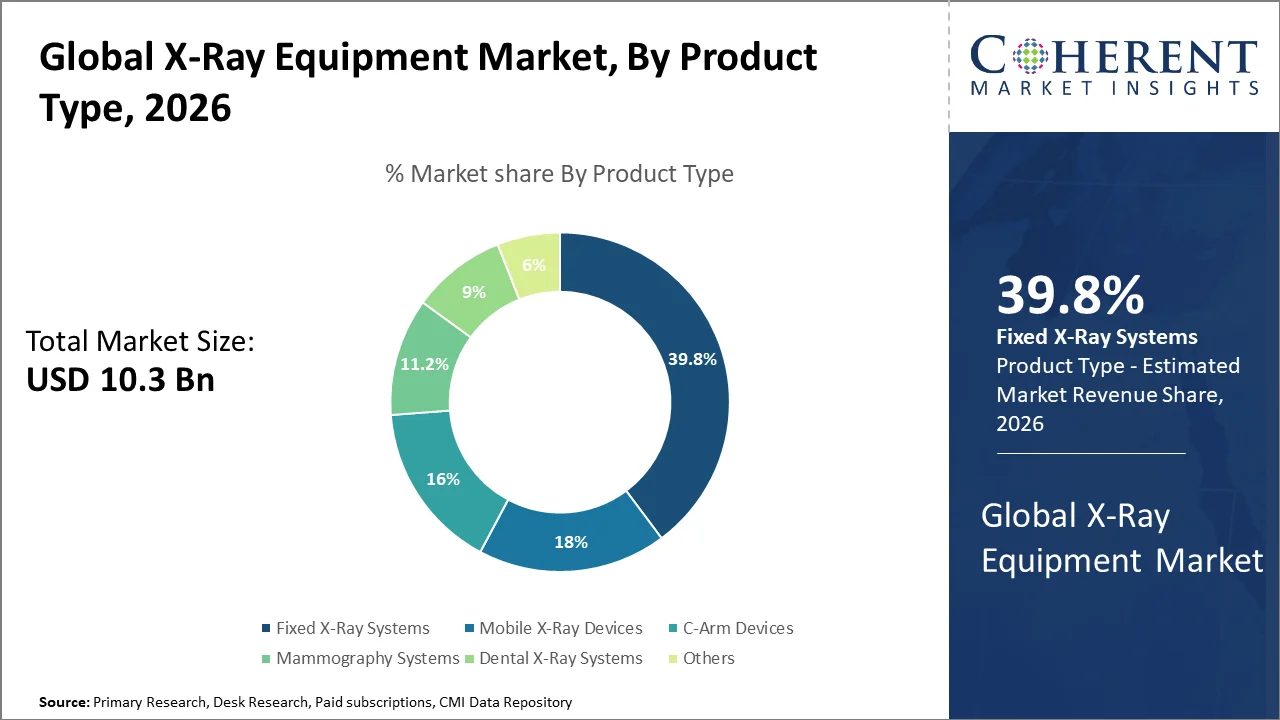
- Fixed X-ray systems are expected to lead the market with a share of 39.8% in 2026 due to widespread installation in hospitals and diagnostic imaging departments for routine radiography, high patient throughput, and continual digital upgrades. For example, a 2024 study reviewed over 2.03 million X-ray images from 44 fixed X-ray systems across 11 hospitals, showing the high use of fixed X-ray systems for routine patient imaging.
- General radiography is slated to account for the largest market share of 33.9% in 2026 because X-ray is the first-line imaging modality for trauma, musculoskeletal disorders, emergency care as well as routine diagnostic examinations. For example, a 2026 study involving 34 experts from 21 hospitals confirmed that general radiography (X-ray) remains the first choice for diagnosing many common conditions.
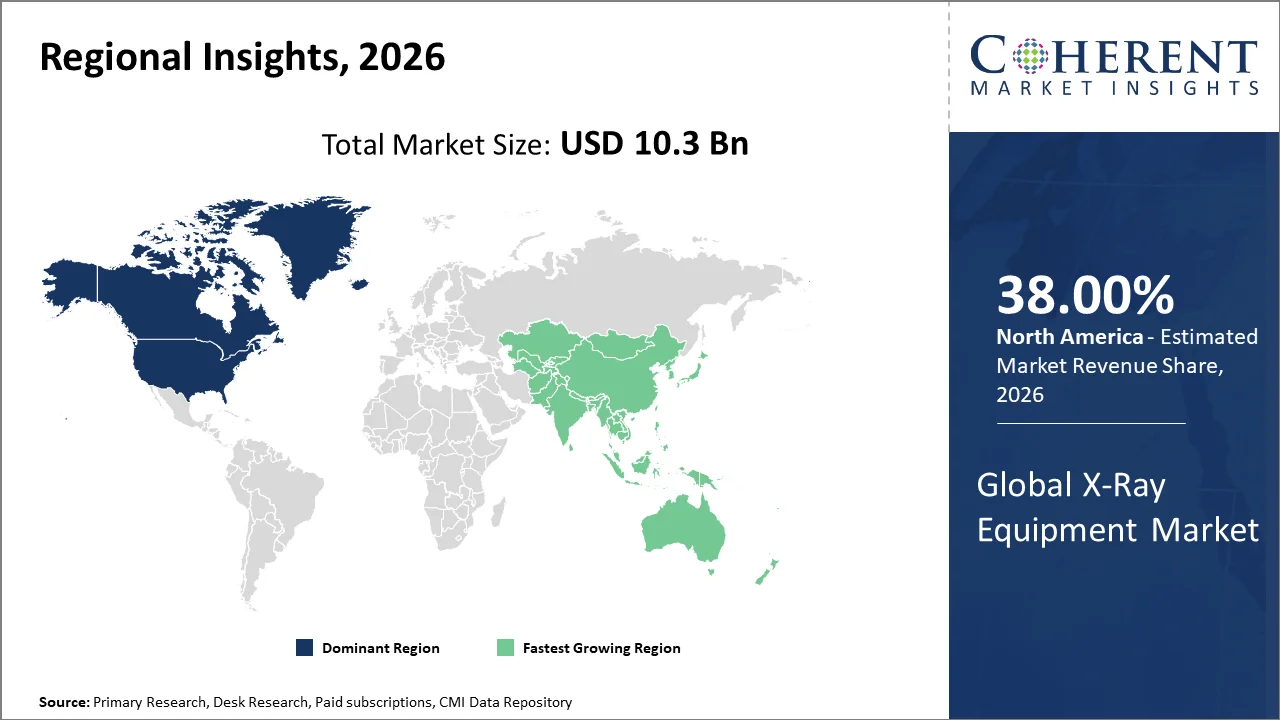
- North America is projected to dominate the global X-ray equipment industry with a share of 38% in 2026 high adoption of digital radiography systems, favorable reimbursement policies as well as strong presence of major X-ray equipment manufacturers. For example, as of July 2026, the U.S. had 9,107 FDA-certified showing the wide use of digital X-ray technology.
- Asia Pacific, registering a CAGR of 6.3%, is anticipated to emerge as the fastest-growing market for X-ray equipment during the forecast period, thanks to expanding healthcare infrastructure, rising chronic disease burden, increasing healthcare expenditure, and growing diagnostic imaging demand.
X-Ray Equipment Market Overview
The global X-ray equipment market is poised to exhibit steady growth during the forecast period. This growth is primarily driven by rising incidence of chronic diseases and orthopedic disorders, increasing demand for early and accurate diagnostic imaging, growing popularity of digital X-ray systems, expanding healthcare infrastructure, and continuous technological advancements in imaging equipment.
X-ray equipment refers to medical imaging devices that use X-ray radiation to generate images of internal anatomical structures for diagnosis and clinical procedures. These systems include digital radiography systems, mobile X-ray devices, fluoroscopy systems, mammography systems, and dental X-ray equipment.
Increasing prevalence of orthopedic disorders, osteoporosis-related fractures, dental problems, and cancer is expected to drive demand for X-ray equipment during the forthcoming period. X-rays are widely used for diagnosing bone fractures, detecting abnormalities in teeth and jaws, evaluating lung conditions such as pneumonia as well as supporting cancer diagnosis and treatment planning through medical imaging applications.
Expansion of healthcare infrastructure, including hospitals, diagnostic centers, and medical facilities, particularly in emerging economies, is increasing the adoption of X-ray systems. Growing demand for minimally invasive and image-guided procedures is also contributing to market growth. Fluoroscopy and C-arm X-ray systems are increasingly used in surgical, orthopedic, and cardiovascular procedures, boosting the adoption of advanced X-ray equipment.
Integration of artificial intelligence (AI) and machine learning into X-ray systems is also supporting market expansion. AI-powered imaging solutions enable automated image analysis, improve diagnostic accuracy as well as reduce reporting time, which is expected to increase adoption of X-ray equipment in the coming years.
For example, Such AI-based solutions help automate image interpretation and improve radiology workflow efficiency.
The X-ray equipment industry is seeing new systems with advanced features as demand for digital radiography grows. In September 2025, United Imaging launched its new digital radiography system, uDR Aurora CX. The system uses computer vision, automation, and AI to improve X-ray imaging quality and workflow. Such innovations are expected to support global X-ray equipment market growth during the forecast period.
Leading X-ray companies are expanding their presence in emerging markets such as India and China to capitalize on growing healthcare demand. For instance, The initiative aims to improve access to digital X-ray imaging as well as strengthen healthcare delivery in the country.
Segmental Insights
Which Product Type Dominates the Global X-Ray Equipment Market?
Fixed X-Ray Systems to Account for Nearly Two-Fifths of the Market in 2026
According to Coherent Market Insights' X-ray equipment market analysis, fixed X-ray systems are expected to lead the market, accounting for a revenue share of 39.8% in 2026. This can be attributed to their increasing adoption in hospitals and diagnostic imaging centers, where they provide high-quality imaging and greater stability.
Fixed radiography systems have the ability to handle a high volume of examinations, thereby increasing their adoption in hospitals and diagnostic centers. Their extensive use in radiography, fluoroscopy, trauma care, and specialized diagnostic procedures, as well as continuous technological advancements such as digital imaging and AI-enabled image processing, is also expected to boost segment growth during the forecast period.
For instance, according to the U.S. FDA, more than 42.6 million mammography procedures were performed in the U.S. in 2024. This highlights the high volume of diagnostic X-ray examinations in healthcare facilities and supports the growing demand for high-throughput fixed X-ray systems.
- Current Industry Events of 2026
- Market Size Estimation
- Regional Breakdown
- Competitive Landscape
- Customer Intelligence
- Segmental Analysis
- Pricing Analysis
- Key Market Drivers, Challenges & Future Trends
- Customized Insights Section
Which Application Generates Highest Revenue in the Global X-Ray Equipment Market?
General Radiography to Account for Over One-Third of the Market in 2026
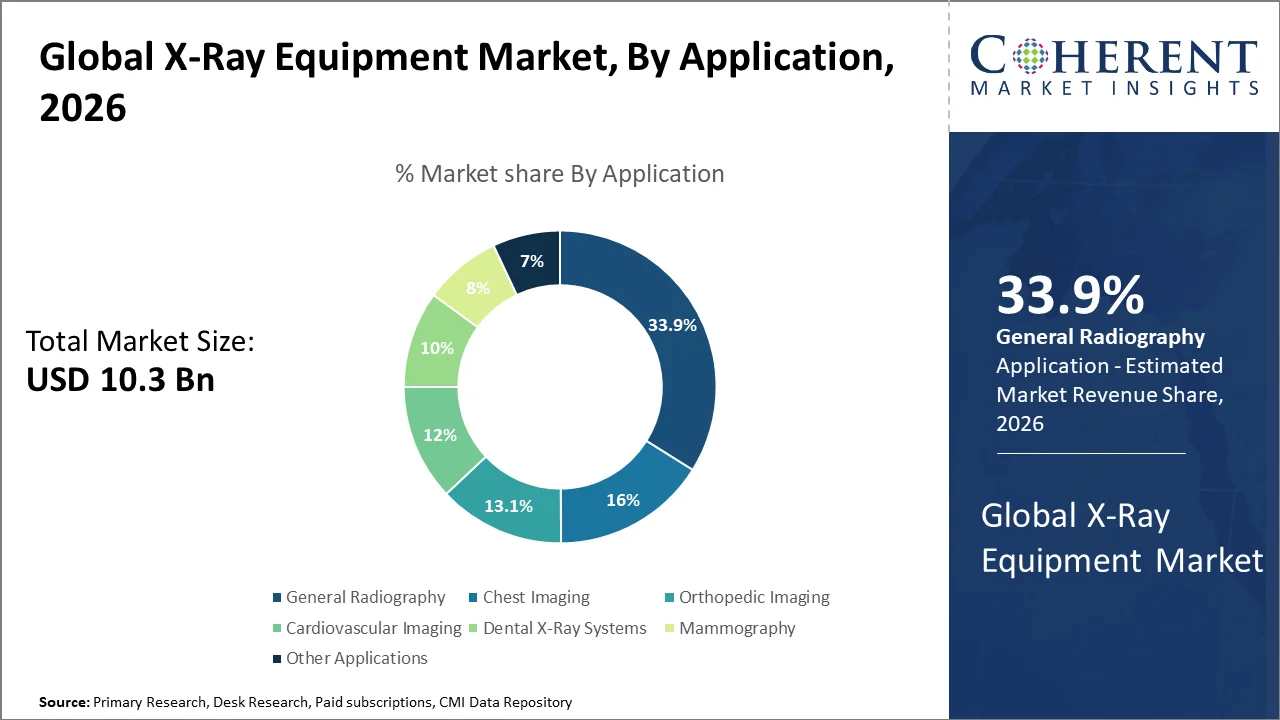
Based on application, general radiography is expected to account for the largest market revenue share of 33.9% in 2026. This is mainly due to the widespread use of X-ray imaging as the first-line diagnostic method for detecting fractures, chest diseases, infections, and other common medical conditions.
General radiography is widely available in hospitals, diagnostic imaging centers, and clinics because it provides fast, accurate, and cost-effective imaging. Increasing number of emergency department visits, rising incidence of chronic and respiratory diseases, growing demand for routine diagnostic imaging, and continued adoption of digital X-ray systems are also supporting segment growth.
X-Ray Equipment Market Growth Drivers
Rising Demand for Early Disease Diagnosis
Increasing emphasis on early disease diagnosis is providing strong impetus for the growth of the X-ray equipment market. The rising prevalence of chronic diseases, injuries, and bone disorders globally is increasing the demand for X-ray imaging, as these conditions require faster and more accurate diagnosis. As the number of diagnostic procedures continues to rise, demand for X-ray systems in hospitals and diagnostic centers is also increasing.
The rising elderly population is also positively impacting X-ray equipment demand, as older adults require more diagnostic monitoring. According to the World Health Organization, the global population aged 60 years and above is estimated to reach 2.1 billion by 2050. This expanding geriatric population is expected to increase the demand for healthcare imaging services.
X-Ray Equipment Market Opportunities
Rise of Digital X-Ray and Advanced Imaging Technologies
Healthcare providers are replacing traditional film-based systems with digital X-ray equipment due to faster image processing, improved image quality, and lower operating costs. For example, in July 2025, Fujifilm Healthcare launched the FDR Go iQ portable digital radiography system, a new digital X-ray solution designed to improve imaging workflow and support efficient bedside imaging in healthcare facilities.
Integration of artificial intelligence (AI) is also enhancing image analysis and workflow efficiency. The FDA continues to authorize AI-enabled medical devices, including radiology-related technologies, supporting the adoption of advanced imaging solutions. These advancements are expected to create significant growth opportunities for the X-ray equipment market during the forecast period.
X-Ray Equipment Market Trends
Shift Towards Portable and Mobile X-Ray Systems
Increasing adoption of portable and mobile X-ray systems is a key market trend. Mobile X-ray equipment is gaining popularity due to its ability to provide imaging in emergency rooms, intensive care units, and remote healthcare facilities without moving patients. Growing demand for point-of-care diagnostics and flexible imaging solutions is driving the adoption of mobile X-ray systems.
Current Events and Their Impact on the X-Ray Equipment Market
Current Event | Description and its Impact |
WHO Resolution on Strengthening Medical Imaging (May 2025) |
|
WHO Approves Six AI Chest X-ray Software Products for TB Screening (June 2025) |
|
Regional Insights
North America to Retain its Dominance Over X-Ray Equipment Market
North America is expected to dominate the global X-ray equipment market, accounting for a share of 38% in 2026. This dominance is attributable to advanced healthcare infrastructure, rising adoption of digital imaging systems, increasing disease burden, and strong demand for early diagnosis and monitoring.
Rising prevalence of chronic diseases is a major factor driving demand for X-ray equipment in North America. According to the U.S. Centers for Disease Control and Prevention (CDC), three in four U.S. adults have at least one chronic condition, while more than half have two or more chronic conditions. The growing need for disease diagnosis and continuous monitoring is encouraging hospitals and diagnostic centers to adopt advanced imaging technologies, including digital X-ray systems.
Moreover, investments in advanced imaging technologies are contributing to the growth of the market in North America. For instance, in October 2025, the partnership between UC San Diego Health and GE HealthCare for integration of advanced imaging systems such as X-ray, CT, MRI, and AI-based solutions was announced. This effort is intended to increase image quality and workflow efficiency as well as accelerate diagnostics, thereby driving the growth of advanced X-ray systems in the region.
Asia Pacific Emerges as the Fastest-Growing X-Ray Equipment Market
Asia Pacific X-ray equipment market is expected to witness a CAGR of 6.3% during the forecast period. This is mostly due to improving healthcare infrastructure, rising healthcare investments, increasing patient population, and growing adoption of advanced diagnostic imaging technologies across countries such as China and India.
Increasing burden of noncommunicable diseases is a key factor boosting sales of X-ray equipment in Asia Pacific. As per the . The rising need for the early diagnosis of these diseases has resulted in a greater demand for diagnostic imaging solutions like X-ray machines.
X-Ray Equipment Market Outlook – Country-wise
U.S. X-Ray Equipment Market Trends
The United States is projected to remain a prominent market for X-ray equipment during the assessment period. This is mainly due to growing adoption of advanced diagnostic imaging technologies, rising demand for early disease detection, and increasing healthcare spending. The presence of well-established hospitals, outpatient imaging centers, and continuous upgrades toward digital and AI-enabled X-ray systems also support market growth in the nation.
China X-Ray Equipment Market Forecast
China’s X-ray equipment market is anticipated to grow steadily during the assessment period. This is attributable to expanding healthcare infrastructure, increasing access to medical imaging services in urban and rural areas as well as government initiatives to improve diagnostic capabilities. In addition, the rising burden of chronic diseases and growing demand for cost-effective imaging solutions are encouraging the adoption of modern X-ray equipment across healthcare facilities.
Who are the Major Companies in the X-Ray Equipment Market?
Some of the major players in X-ray equipment market are Siemens AG, Philips Healthcare, Canon USA Inc., Toshiba Medical Systems, Hitachi Medical Corporation, Fuji Medical Systems, Shimadzu Corporation, and Carestream Healthcare.
Key Strategies Adopted by Industry Players
Leading manufacturers of X-ray equipment are adopting various organic and inorganic strategies to boost their revenue as well as gain a competitive edge in the industry. These include new product launches and approvals, increasing investments in R&D, acquisitions, partnerships, collaborations, mergers, and distribution agreements.
- In January 2025, AirRay-Mini was showcased at CES 2025 as a portable X-ray system. The device is designed to provide fast and accurate X-ray imaging in emergency settings and locations where moving patients is difficult.
- In July 2025, GE Healthcare launched Definium Pace Select ET, an advanced floor-mounted digital X-ray system. The system is designed to deliver high-quality imaging, improve workflow efficiency in high-demand environments as well as enhance access to affordable medical imaging technology.
Market Report Scope
X-Ray Equipment Market Report Coverage
| Report Coverage | Details | ||
|---|---|---|---|
| Base Year: | 2025 | Market Size in 2026: | USD 10.3 Bn |
| Historical Data for: | 2020 To 2024 | Forecast Period: | 2026 To 2033 |
| Forecast Period 2026 to 2033 CAGR: | 4.6% | 2033 Value Projection: | USD 14.1 Bn |
| Geographies covered: |
| ||
| Segments covered: |
| ||
| Companies covered: | Siemens AG, Philips Healthcare, Canon USA Inc., Toshiba Medical Systems, Hitachi Medical Corporation, Fuji Medical Systems, Shimadzu Corporation, and Carestream Healthcare. | ||
| Growth Drivers: |
| ||
| Restraints & Challenges: |
| ||
Analyst Opinion (Expert Opinion)
- Growing demand for diagnostic imaging is supporting market growth. According to the World Health Organization (WHO), around 4.7 billion people worldwide lack access to safe and affordable diagnostic services, creating a strong need for more X-ray equipment, especially in underserved regions. This is expected to support long-term market growth.
- The conventional film-based systems are being replaced by digital X-ray systems. The adoption of digital X-ray systems in hospitals and diagnostic centers is due to their ability to deliver fast images, reduce costs, and facilitate image exchange, hence generating demand for equipment replacements.
- Portability and mobility of X-ray imaging systems are on the rise. Such systems help increase availability of imaging in emergency wards and intensive care units, where moving critically ill patients becomes necessary.
- Artificial intelligence technology is increasing efficiency of X-ray imaging processes. The AI-assisted image analysis allows faster detection of abnormalities and reporting by radiologists.
Speak to the analyst
Want personalized insights?
Take the findings above to one of our principal consultants, or have the report rebuilt around the segments, geographies and competitors you actually track.
Market Segmentation
- By Product Type (Revenue, USD Bn, 2021-2033)
- Fixed X-Ray Systems
- Mobile X-Ray Devices
- C-Arm Devices
- Mammography Systems
- Dental X-Ray Systems
- Others
- By Application (Revenue, USD Bn, 2021-2033)
- General Radiography
- Chest Imaging
- Orthopedic Imaging
- Cardiovascular Imaging
- Dental Imaging
- Mammography
- Other Applications
- By End User (Revenue, USD Bn, 2021-2033)
- Hospitals
- Diagnostic Centers
- Research Centers
- Ambulatory Surgical Centers
- Others
- By Region Insights ( Revenue, USD Bn, 2021 - 2033)
- North America
- U.S.
- Canada
- Latin America
- Brazil
- Argentina
- Mexico
- Rest of Latin America
- Europe
- Germany
- U.K.
- Spain
- France
- Italy
- Russia
- Rest of Europe
- Asia Pacific
- China
- India
- Japan
- Australia
- South Korea
- ASEAN
- Rest of Asia Pacific
- Middle East
- GCC Countries
- Israel
- Rest of Middle East
- Africa
- South Africa
- North Africa
- Central Africa
Sources
Primary Research Interviews
- X-ray equipment manufacturers
- Medical imaging device distributors
- Hospital procurement managers
- Radiologists and diagnostic imaging specialists
- Biomedical engineers
- Healthcare administrators
- Regulatory and industry experts
Databases
- World Health Organization (WHO)
- U.S. Food and Drug Administration (FDA)
- U.S. Centers for Disease Control and Prevention (CDC)
- OECD Health Statistics
- Eurostat
- World Bank Data
- United Nations (UN) Data
Magazines
- Diagnostic Imaging
- Imaging Technology News (ITN)
- AuntMinnie
- Medical Design & Outsourcing
- Healthcare Purchasing News
Journals
- Radiology
- American Journal of Roentgenology (AJR)
- European Radiology
- Journal of Medical Imaging
- Journal of Digital Imaging
Newspapers
- The Wall Street Journal
- Financial Times
- The New York Times
- The Economic Times
- The Hindu BusinessLine
Associations
- Radiological Society of North America (RSNA)
- American College of Radiology (ACR)
- European Society of Radiology (ESR)
- International Society of Radiographers and Radiological Technologists (ISRRT)
- European Coordination Committee of the Radiological, Electromedical and Healthcare IT Industry (COCIR)
Public Domain Sources
- World Health Organization (WHO)
- U.S. Food and Drug Administration (FDA)
- U.S. Centers for Disease Control and Prevention (CDC)
- National Institutes of Health (NIH)
- National Cancer Institute (NCI)
- International Atomic Energy Agency (IAEA)
- OECD
- Eurostat
- World Bank
- United Nations (UN)
Proprietary Elements
- CMI Data Analytics Tool
- Proprietary CMI Existing Repository of Information for Last 10 Years
Get access to 250+ pages report
Every segment, forecast, competitor profile and data table behind the analysis above — available for instant download.
- ESOMAR Member
- ISO 9001:2015 Certified
- D-U-N-S Registered
- GDPR & CCPA Compliant
Missing comfort of reading report in your local language? Find your preferred language:
Transform your Strategy with Exclusive Trending Reports
Frequently Asked Questions
The X-ray equipment market includes medical imaging systems used to diagnose fractures, infections, dental conditions, cardiovascular diseases, and other health problems. It covers digital X-ray systems, portable X-ray machines, mobile X-ray units, and analog X-ray equipment.
The global market is estimated to be valued at USD 10.3 Bn in 2026.
The global X-Ray Equipment Market value is expected to reach USD 14.1 Bn by 2033.
The global market is poised to exhibit a CAGR of 4.6% from 2026 to 2033.
Major growth factors include rising prevalence of chronic diseases and injuries, increasing demand for early and accurate diagnosis, growing aging population, expansion of healthcare infrastructure in emerging economies, and continuous technological advancements such as digital X-ray systems, portable devices, and AI-assisted imaging solutions.
Fixed X-ray systems are expected to lead the market with a share of 39.8% in 2026.
Some major companies in the X-Ray Equipment Market include Siemens AG, Philips Healthcare, Canon USA Inc., Toshiba Medical Systems, Hitachi Medical Corporation, Fuji Medical Systems, Shimadzu Corporation, and Carestream Healthcare.