

Synthetic Antioxidants Market Size and Forecast — 2026-2033
The Global Synthetic Antioxidants Market size is estimated to be valued at USD 4.18 billion in 2026 and is expected to reach USD 6.3 billion by 2033, exhibiting a compound annual growth rate (CAGR) of 7.3% from 2026 to 2033.
Overview
Synthetic antioxidants are chemically manufactured compounds that prevent oxidative degradation in food, polymers, lubricants, and cosmetics. Common types include butylated hydroxyanisole (BHA), butylated hydroxytoluene (BHT), tert-butylhydroquinone (TBHQ), and propyl gallate. These products stabilize materials by scavenging free radicals and interrupting oxidation chains, thus extending shelf life and maintaining quality. In the food industry, synthetic antioxidants are widely used in oils, snacks, and processed meats, while in industrial applications, they enhance the thermal and oxidative stability of plastics and rubber.
Key Takeaways
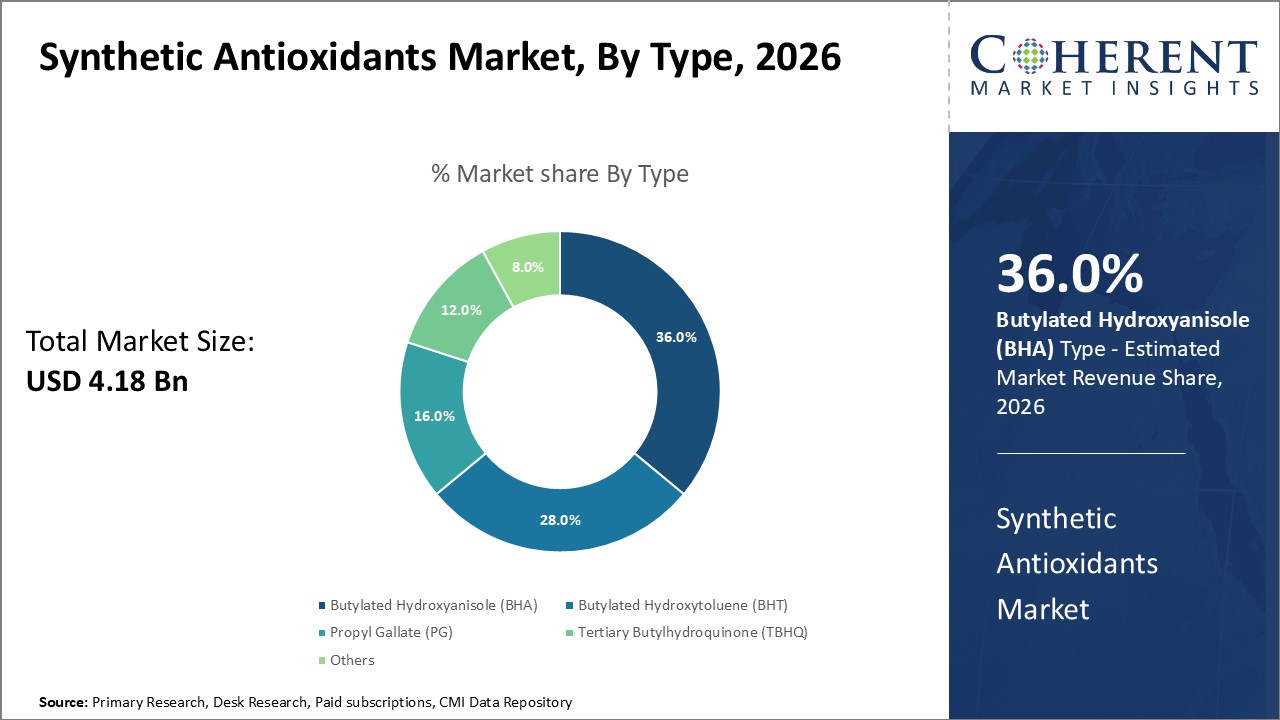
The Butylated Hydroxyanisole (BHA) segment dominates the market, reflecting robust application across food preservation with a 36% share, buoyed by its effective antioxidative properties in fats and oils.
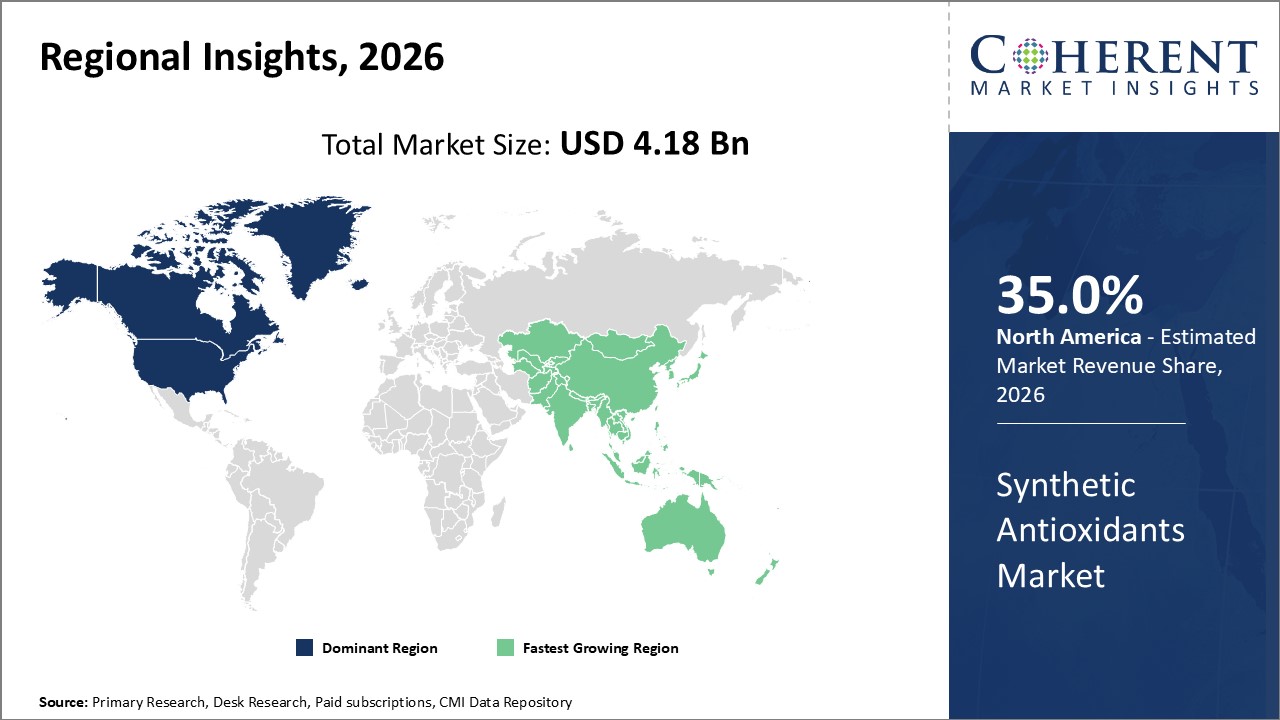
Regionally, North America holds the largest market share, driven by the U.S.'s advanced manufacturing capabilities and stringent regulations promoting antioxidant use.
Meanwhile, Asia Pacific emerges as the fastest-growing market owing to rising processing industries and increasing consumer health awareness, with the region witnessing significant investment into synthetic antioxidant integration.
Synthetic Antioxidants Market Segmentation Analysis
Synthetic Antioxidants Market Insights, By Type
Butylated Hydroxyanisole (BHA) dominates the market share with 36%, primarily due to its extensive use in food preservation, where it provides effective protection against oxidation in fats and oils. The superior antioxidative stability of BHA ensures enhanced shelf life for processed foods, driving consistent demand across the industry. The fastest-growing subsegment within this category is Propyl Gallate (PG), gaining traction due to its increasing applications in cosmetics and pharmaceuticals, where its antioxidant properties are highly valued for improving product stability. PG’s compatibility with various formulations and rising consumer preferences for enhanced efficacy have boosted its market share recently.
Synthetic Antioxidants Market Insights, By Application
The Food & Beverages segment dominates, driven by growing consumption of processed and packaged food worldwide that necessitates effective synthetic antioxidants to prevent spoilage and extend freshness. Pharmaceuticals are the fastest-growing application segment, underpinned by increasing global health challenges involving oxidative stress and the need for stable drug formulations. The rise in chronic diseases has prompted pharmaceutical companies to integrate synthetic antioxidants into their products to improve drug efficacy and longevity.
Synthetic Antioxidants Market Insights, By Form
Powder form dominates, attributed to its ease of handling, stability, and widespread use in food and pharmaceutical industries for precise dosing and longer shelf life. This form accounts for the majority of market revenue due to its broad applicability. Liquid antioxidants are the fastest-growing form, gaining popularity especially in cosmetics and polymer processing, where ease of mixing and uniform dispersion are critical. Their versatility in blending with various formulations supports their increasing uptake. These forms are gaining incremental growth, driven by innovation and specialized industrial needs.
Synthetic Antioxidants Market Trends
Market trends highlight the increasing emphasis on sustainability through bio-based synthetic antioxidants, which address growing consumer and regulatory demands for environmentally friendly products.
Companies introduced eco-friendly formulations in 2025 that maintained or enhanced antioxidative efficiency, particularly in cosmetics and food segments.
Additionally, digital integration in supply chains is enabling better inventory management of antioxidant raw materials, reducing costs and supply interruptions.
Synthetic Antioxidants Market Insights, By Geography
North America Synthetic Antioxidants Market Analysis and Trends
North America holds a dominant position in the Synthetic Antioxidants market, accounting for over 35% of the total market share due to established industries and strict regulatory frameworks requiring effective antioxidant solutions. The U.S. market benefits notably from innovation hubs and advanced pharmaceutical and food processing sectors.
Asia Pacific Synthetic Antioxidants Market Analysis and Trends
Asia Pacific is the fastest-growing region, exhibiting a CAGR exceeding 9% fueled by rapid urbanization, expanding food processing industries, and increasing health consciousness among consumers. Countries like China and India lead in volume growth, driven by rising middle-class income and government initiatives supporting chemical manufacturing.
Synthetic Antioxidants Market Outlook for Key Countries
USA Synthetic Antioxidants Market Analysis and Trends
The U.S. Synthetic Antioxidants market remains a cornerstone of global industry growth, supported by stringent FDA regulations that mandate antioxidant use for food safety and pharmaceutical stability. Market companies like BASF SE and Eastman Chemical maintain significant production facilities and innovation centers here, contributing to a 5% market revenue growth reported in 2025. The USA's robust R&D ecosystems foster product lifecycle advancements and market penetration strategies that cater to diverse end-user needs ranging from processed foods to advanced pharmaceuticals.
China Synthetic Antioxidants Market Analysis and Trends
China's Synthetic Antioxidants market has rapidly expanded, driven by burgeoning food processing and cosmetics industries aligned with urban population growth. Local market players have integrated synthetic antioxidants into polymer manufacturing, supporting infrastructure development. Government policies focusing on food safety and environmental sustainability have increased synthetic antioxidant usage by 18% in 2025. Key industry contributors include large national chemical manufacturers and emerging specialty additives producers, making China a focal point of the Asia Pacific’s fastest-growing market.
Analyst Opinion
The surge in demand from the food preservation sector is a primary quantitative indicator driving the market growth. For instance, increasing exports of processed foods in 2025 from countries like the U.S. and China has led to a 13% rise in the consumption of synthetic antioxidants to extend shelf life and maintain quality.
Pharmaceutical applications are rapidly expanding, particularly with antioxidants used in formulations for oxidative stress-related disorders. In 2025, pharmaceutical companies reported a 16% increase in the incorporation of synthetic antioxidants in drug formulations to improve stability.
Price competitiveness of synthetic antioxidants amid fluctuating raw material costs has significantly influenced market dynamics. The pricing trends in 2026 show a moderate increase of 4% annually due to supply chain optimizations and increases in strategic raw material sourcing, boosting their adoption rate by manufacturers.
Regional imports highlight increasing demand in emerging economies. For example, Southeast Asia witnessed a 21% jump in synthetic antioxidant imports in 2025. This is tied to accelerated use in the cosmetics and polymers industries, driven by growing middle-class populations and urbanization.
- Current Industry Events of 2026
- Market Size Estimation
- Regional Breakdown
- Competitive Landscape
- Customer Intelligence
- Segmental Analysis
- Pricing Analysis
- Key Market Drivers, Challenges & Future Trends
- Customized Insights Section
Market Scope
| Report Coverage | Details | ||
|---|---|---|---|
| Base Year: | 2025 | Market Size in 2026: | USD 4.18 billion |
| Historical Data for: | 2020 To 2024 | Forecast Period: | 2026 To 2033 |
| Forecast Period 2026 to 2033 CAGR: | 7.3% | 2033 Value Projection: | USD 6.3 billion |
| Geographies covered: |
| ||
| Segments covered: |
| ||
| Companies covered: | BASF SE; Eastman Chemical Company; Nouryon; Lanxess AG; Songwon Industrial Co., Ltd.; Zschimmer & Schwarz GmbH & Co KG; SI Group, Inc.; TPC Group Inc.; Ashland Global Holdings Inc.; Akzo Nobel N.V.; Jiangsu Yoke Technology Co., Ltd. | ||
| Growth Drivers: |
| ||
Synthetic Antioxidants Market Growth Factors
The growing shift towards processed and convenience foods globally is driving demand for synthetic antioxidants to extend shelf life and ensure safety. In 2025, processed food consumption rose by nearly 15% in the Asia Pacific, creating corresponding demand in the antioxidant segment. Heightened regulatory focus on food product preservation has compelled manufacturers to adopt synthetic antioxidants as an efficient solution to meet compliance. Advances in polymer and plastic industries, particularly for packaging, have fueled demand for antioxidants that prevent material degradation. Moreover, the rising prevalence of lifestyle diseases has increased pharmaceutical applications for synthetic antioxidants to stabilize medicines, with a reported 16% increase in pharmaceutical antioxidant utilization in 2026.
Synthetic Antioxidants Market Development
In January 2025, BASF introduced a new line of natural antioxidant solutions designed to help food, beverage, and nutrition manufacturers reduce reliance on synthetic preservatives. The portfolio offers plant-derived antioxidant functionality with improved stability and cleaner-label positioning, aligning with growing consumer demand for natural, health-forward ingredient formulations.
In September 2025, Kemin Industries launched an advanced antioxidant blend for animal feed, formulated to protect fats, oils, and feed ingredients from oxidation during storage and distribution. The solution enhances feed quality, supports animal performance, and helps producers maintain nutritional integrity across diverse feed production environments.
Key Players
Leading Companies of the Market
BASF SE
Eastman Chemical Company
Nouryon
Lanxess AG
Songwon Industrial Co., Ltd.
Zschimmer & Schwarz GmbH & Co KG
SI Group, Inc.
TPC Group Inc.
Ashland Global Holdings Inc.
Akzo Nobel N.V.
Jiangsu Yoke Technology Co., Ltd.
Several leading companies emphasize R&D investment to develop novel antioxidant compounds with enhanced efficacy and regulatory compliance. For instance, BASF SE recently launched an eco-friendly synthetic antioxidant that caters to the cosmetic segment, boosting its regional market share by 9% in 2025. Similarly, Eastman Chemical Company leveraged strategic partnerships with pharmaceutical firms to expand its market footprint through customized product developments, leading to a 11% revenue increment in 2023.
Synthetic Antioxidants Market Future Outlook
The Synthetic Antioxidants Industry will continue evolving as industries balance performance and sustainability. Innovation will focus on developing safer, more efficient compounds with lower environmental impact. Emerging opportunities lie in stabilizing bio-based polymers, extending lubricant lifespan, and supporting clean-label transitions in food processing. As regulatory scrutiny increases, hybrid antioxidant systems combining synthetic and natural agents will gain traction. Continuous research in molecular engineering and encapsulation will ensure synthetic antioxidants remain vital in sectors where natural alternatives fall short of technical requirements.
Synthetic Antioxidants Market Historical Analysis
The synthetic antioxidants market developed alongside the rise of processed foods and industrial materials in the mid-20th century. Substances such as BHA, BHT, and TBHQ became essential for preventing oxidation in fats, oils, and plastics. Initially adopted for food preservation, these compounds later found wide use in lubricants, fuels, and polymers due to their cost-effectiveness and stability under high-temperature conditions. While natural antioxidants gained attention for health and labeling reasons, synthetic variants maintained their dominance in high-performance applications requiring thermal resilience. Over time, manufacturing improvements enhanced product purity, reducing toxicity and extending applicability across multiple industrial domains.
Sources
Primary Research Interviews:
Food Technologists
Industrial Chemists
Product Formulators
Quality Control Specialists
Databases:
USDA Food Data Central
EFSA Chemical Safety Database
PubChem Compounds
FDA Food Additive Database
Magazines:
Food Navigator
Chemical Weekly
Food Business News
Modern Food Processing
Journals:
Food Chemistry
Journal of Agricultural and Food Chemistry
Antioxidants (MDPI)
Food Science & Technology International
Newspapers:
The Economic Times (Agri & Food)
The Guardian (Sustainability)
Financial Express (Industry)
Business Line (Agri-Tech)
Associations:
Institute of Food Technologists (IFT)
Food and Agriculture Organization (FAO)
American Oil Chemists’ Society (AOCS)
leCodex Alimentarius Commission
Get access to 250+ pages report
Every segment, forecast, competitor profile and data table behind the analysis above — available for instant download.
- ESOMAR Member
- ISO 9001:2015 Certified
- D-U-N-S Registered
- GDPR & CCPA Compliant
Missing comfort of reading report in your local language? Find your preferred language:
Transform your Strategy with Exclusive Trending Reports
Frequently Asked Questions
The market is predominantly led by BASF SE, Eastman Chemical Company, and Nouryon, which collectively hold substantial market shares through strategic research and development (R&D) and innovation.
The market is projected to grow from USD 4.18 billion in 2026 to approximately USD 6.3 billion by 2033, reflecting a CAGR of 7.3% over the forecast period.
The food & beverages segment remains the largest, supported by expanding processed food markets and stringent preservation requirements globally.
Trends will increasingly focus on sustainable antioxidants, novel applications in pharmaceuticals and animal feed, and integration with innovative packaging technologies.
The competitive landscape is highly consolidated with emphasis on product innovation and regulatory compliance; challenges include raw material price volatility and evolving environmental legislations.
Strategies include product diversification, strategic alliances with end-user industries, increased R&D, and regional expansion targeting emerging economies.