

Global Bulletproof Helmet Market Size and Forecast – 2026-2033
According to Coherent Market Insights, the global bulletproof helmet market is estimated to be valued at USD 1.86 Bn in 2026 and is expected to reach USD 2.71 Bn by 2033, expanding at a compound annual growth rate (CAGR) of 5.5% from 2026 to 2033.
Key Takeaways of the Bulletproof Helmet Market
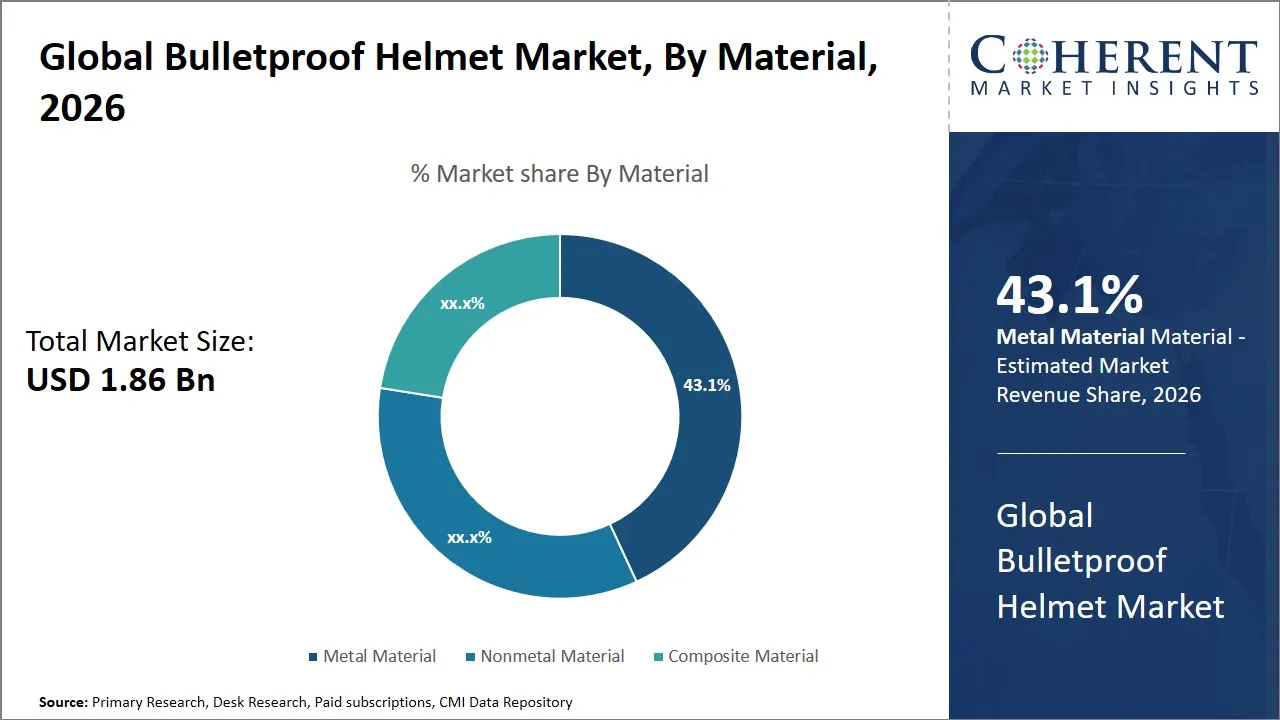
- The metal material segment is projected to capture 43. 1% of the global bulletproof helmet market share in 2026.
- The military segment is expected to account for 39. 5% of the global bulletproof helmet market share in 2026.
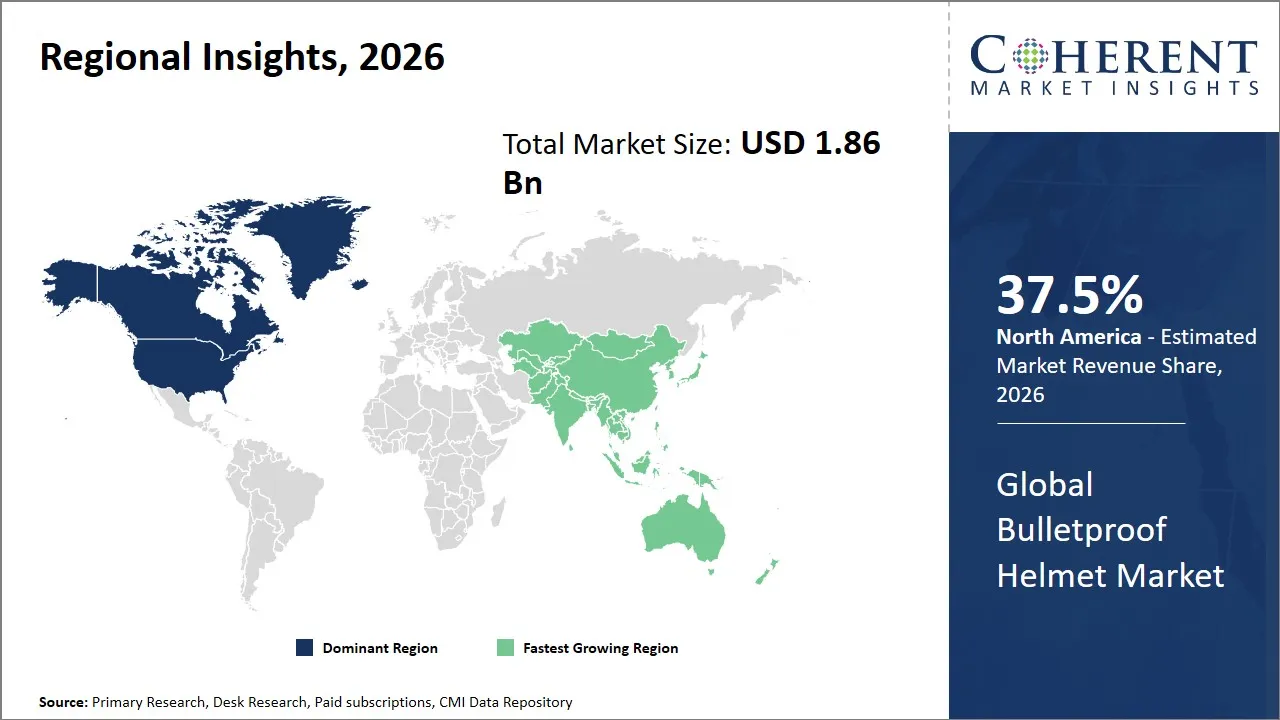
- North America is expected to dominate the bulletproof helmet market with a 37.5 % share in 2026.
- The Asia Pacific region is anticipated to grow the fastest, holding an 18.3 % share in 2026.
Market Overview
- A key market trend in the bulletproof helmet industry is the integration of cutting-edge materials, such as ultra-high-molecular-weight polyethylene (UHMWPE) and advanced composites, which enhance protection while reducing weight for improved comfort and mobility.
- Additionally, smart helmets equipped with communication systems, augmented reality (AR), sports protective equipment, and sensor technologies are gaining traction, enabling real-time data sharing and situational awareness.
- Growing focus on user ergonomics and multifunctionality is prompting manufacturers to innovate, catering to evolving defense and security needs globally.
Current Events and Its Impact
Current Events | Description and its Impact |
Defense Budget Increases & Modernization Programs |
|
Technological Advancement – AI & Smart Helmet Integration |
|
Segmental Insights
- Current Industry Events of 2026
- Market Size Estimation
- Regional Breakdown
- Competitive Landscape
- Customer Intelligence
- Segmental Analysis
- Pricing Analysis
- Key Market Drivers, Challenges & Future Trends
- Customized Insights Section
Why Does the Metal Material Dominates the Global Bulletproof Helmet Market in 2026?
The metal material segment is expected to hold 43.1% of the global bulletproof helmet market share in 2026, due to their unmatched strength and resilience which is very essential feature of a protective head gear. Titanium alloys, stainless steel, and aluminum composites are described as metal materials that can absorb and dissipate high-impact forces, which makes them the most useful in countering the threats of ballistic and blunt trauma. This inherent longevity is of much interest to markets that do not compromise on protection especially in military and law enforcement.
For instance, Titanium alloys are widely used in military helmets, such as the U.S. Army’s Advanced Combat Helmet (ACH), which incorporates titanium to provide lightweight yet robust protection against ballistic threats. The material's high strength-to-weight ratio makes it ideal for helmets that need to withstand high-velocity projectiles while maintaining comfort and maneuverability.
Military Dominates the Global Bulletproof Helmet Market
The military segment is projected to hold 39.5% of the global bulletproof helmet market share in 2026, due to the unequivocal priority placed on safeguarding armed forces personnel against evolving battlefield threats. Modern military operations involve diverse combat environments from urban warfare to counter-terrorism missions where the risk of ballistic and blast injuries prevails. The contemporary warfare in the military presents various combat zones like the urban warfare to counter-terrorism missions in which the risk of ballistic and blast injuries is dominant. When it comes to head protection, especially in case of a gunshot, bulletproof helmets are vital equipment, without which survival and performance efficiency is impossible.
One of the core factors that stimulate development in the military use is the tireless modernization and modernization of military equipment in different countries. As geopolitical tensions in the world increase as well as the asymmetric warfare, armies are spending on high levels of personal protective equipment (PPE). Helmets made of superior quality ballistic materials with added on technologies like communication systems and night vision mounts increase protection and combat readiness, which is responsive to the strategic need of the armed forces in the world.
Regional Insights
North America Bulletproof Helmet Market Analysis and Trends
The North America region is projected to lead the market with a 37.5% share in 2026, it is majorly due to the fact that the region has a strong defense infrastructure, high government expenditure on military modernization, and high safety measures that require high protection equipment to law enforcement and the armed forces. The availability of the top defense contractors like 3M, Gentex Corporation, and Avon Protection is strengthening innovation and implementation of the newest bulletproof helmets with improved ballistic protection and comfort.
The market ecosystem enjoys the firm partnership between the government agencies and the private companies such that the products are developed rapidly in response to the changing threats. Moreover, the supply chain is supported by well-established procurement channels, good trade relations with allied nations, which guarantees the supply of advanced ballistic protection technologies. The current efforts of the U.S. Department of Defenses to furnish its personnel with next generation helmets reinforce the market leadership of North America.
Asia Pacific Bulletproof Helmet Market Analysis and Trends
The Asia Pacific region is expected to exhibit the fastest growth in the market contributing 18.3% share in 2026, because of the growing geopolitical tensions, the growing defense spending of nations such as India, China and South Korea as well as the growing investment in their domestic defense production capacities. The governments in the area are giving more focus to the indigenization and modernization of military equipment, and this has resulted in increased demand of advanced ballistic helmets.
The growing menace due to border wrangles and counter-terrorism activities contribute to the procuring of goods and services both at the governmental and paramilitary levels. In addition, the growing competition like Shenzhen Hengfeng Protection Equipment (China), and the Indian defense industries like Bharat Dynamics Limited are creating a push in the regional market in the area of innovation. Import substitution policies, trade agreements on technology transfers, and strategic alliances with Western defense vendors in Asia Pacific determine the dynamics of trade, which accelerates the adoption of technology in combat head gears.
Bulletproof Helmet Market Outlook for Key Countries
Why is the U.S. Bulletproof Helmet Market Benefiting from Global Defense Leadership?
Its position as a world leader in defense is a great advantage to the U.S. bullet proof helmet market. Major organizations like the Gentex Corporation and Ops-Core (3M brand) take the lead in the sphere with their high-level modular helmet systems which are aimed at various operational requirements. Continuous upgrades in government procurement programs focus on the protection of the soldiers and interoperability. The new lightweight materials and improved cushioning are also pushed in the defense contracts with the research clauses. Also, the cooperation with academic and research institutions leads to innovation in such spheres as helmet sensors and communication integration.
India Bulletproof Helmet Market Trends
The market of bulletproof helmets is characterized by significant growth in India with the help of the governmental programs aimed at modernization of armed forces within the frames of Make in India or Defense Acquisition Procedures that give emphasis to local production. Local companies such as Bharat Dynamics Limited and Kalyani Group are busy working on the development of bulletproof helmets that are of high government specification and at the same time cost effective. India is also using the technological relations with the world defense industries to enhance the quality of helmets and ballistic level. This combination of local production and selective imports contributes to the stable growth of the market in accordance with the increase in military spending and reinforcement of security at the border level.
Why is China Leading the Asia Pacific Bulletproof Helmet Market with Strategic Investments?
China is leading the Asia Pacific region with the massive investments in military modernization and the production of domestic defense equipment. Such companies as Shenzhen Hengfeng Protection Equipment and Norinco provide the Peoples Liberation Army and paramilitary forces with advanced bulletproof heads. The Chinas market plan involves massive emphasis on the incorporation of helmet systems with electronic warfare systems and situational awareness. The pro-self-reliance policies in government defense production generate a favorable atmosphere in which innovation and high-volume production are encouraged which promote swift absorption in most of the service branches.
Germany Bulletproof Helmet Market Trends
The market of Germany bulletproof helmet is booming because of robust defense manufacturing industry with a highly developed and precise engineering and companies such as Rheinmetall and Draeger provide sophisticated bulletproof helmets that allow integration with NATO. The modernization of law enforcement and security of the borders of the German governments stimulates the demand of the helmets that are more resistant to the ballistics and more ergonomic. Active participation of the country in European defense alliances and joint procurement projects will improve the access to the new technologies of the helmets. Furthermore, Germany leads to sustainable manufacturing in defense manufacturing, which affects the development of helmet manufacturing techniques.
Brazil Bulletproof Helmet Market Trends
The market of Brazil’s bulletproof helmet is also developing dynamically with concentration on law enforcement and military modernization based on the domestic issue of insecurity and maintenance of the peace. The government encourages the local players of the industry like Imbel (Industria de Material Belico do Brassil) which provides the helmets adapted to the tropical climate conditions and urban combats. There are trade policies that promote technology transfer agreements with foreign defense companies which enable the company to undertake product improvements efforts. Brazil is able to balance its reliance on imports and its domestic production capacity to satisfy the rising demands of the defense and police forces.
Modernization & Replacement Cycles
Segment | Description | Impact on Market | Trends |
Product Life Cycle | Average lifespan of bulletproof helmets | Helmets are typically replaced every 5-7 years, ensuring steady demand for new products. | Companies are innovating with lighter, stronger materials. |
Technological Advancements | Adoption of new materials and designs | Advances in technology like carbon fiber, composites, and newer ballistic fabrics are pushing for modernization. | New materials are leading to better performance and comfort. |
Government Regulations | Regulatory compliance requirements for military and law enforcement agencies | Strict regulations push the need for replacement to meet new safety standards. | Constant updates to ensure compliance with body armor standards. |
Market Players, Key Development, and Competitive Intelligence
Key Developments
- On January 6, 2026, Ballistic Armor Co. secured a new commitment that will accelerate its multi-year transition from a third-party tactical equipment retailer to a premium innovator and U.S. manufacturer of advanced protective systems.
- In April 2022, Ukrainian steel and mining group Metinvest sent the fourth package of its help to Ukrainian Armed Forces. It included 2,700 bulletproof vests and helmets, company’s statement on Facebook reads. Ukrainian soldiers in Kyiv and Izium, Kharkiv region, has received the tactical items. In total, 4,000 of such sets have been sent to the combat areas in Ukraine.
Top Strategies Followed by Global Bulletproof Helmet Market Players
Player Type | Strategic Focus | Example |
Established Market Leaders | Heavy investment in R&D and innovation | An example being Gentex Corporation, a well-known market player, has remained on top in terms of innovation, with its OPS-CORE FAST SF line of helmets being the top choice, thanks to its lightweight design and greater ballistic protection, which requires it to suit military and law enforcement officers. |
Mid-Level Players | Cost-effective solutions with balanced quality | Ferro Concepts a cost-efficient mid-level player is reputed to manufacture such products as the Tactical Communications Helmet, which is tailored to fit certain customer requirements but does not have the high-quality features seen in larger players. These manufacturers usually use effective production techniques and acquire cheap raw materials and subsequently offer helmets that are of basic safety standards. |
Small-Scale Players | Niche specialization & innovative variants | Hard Head Veterans, as an example, specializes in manufacturing helmets with customizable liners and unique visors to serve customers with certain tactical benefits. Moreover, small-scale companies often use the new technologies such as 3D printing to try prototyping and implement new helmets with new materials faster in response to changes in the market. |
Market Report Scope
Bulletproof Helmet Market Report Coverage
| Report Coverage | Details | ||
|---|---|---|---|
| Base Year: | 2025 | Market Size in 2026: | USD 1.86 Bn |
| Historical Data for: | 2020 To 2024 | Forecast Period: | 2026 To 2033 |
| Forecast Period 2026 to 2033 CAGR: | 5.5% | 2033 Value Projection: | USD 2.71 Bn |
| Geographies covered: |
| ||
| Segments covered: |
| ||
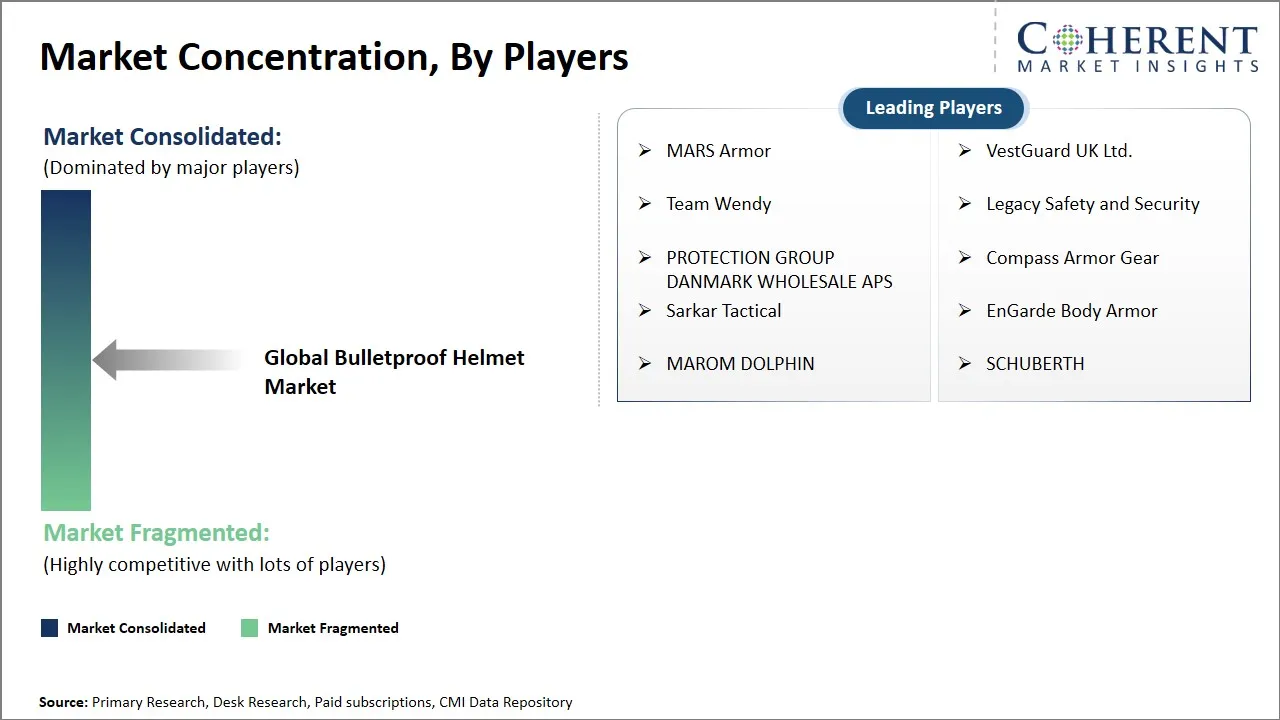
| Companies covered: | MARS Armor, VestGuard UK Ltd., Team Wendy, Legacy Safety and Security, PROTECTION GROUP DANMARK WHOLESALE APS, Compass Armor Gear, Sarkar Tactical, EnGarde Body Armor, MAROM DOLPHIN, and SCHUBERTH | ||
| Growth Drivers: |
| ||
| Restraints & Challenges: |
| ||
Bulletproof Helmet Market Dynamics
Bulletproof Helmet Market Driver - Increasing Global Security Concerns and Rising Defense Budgets
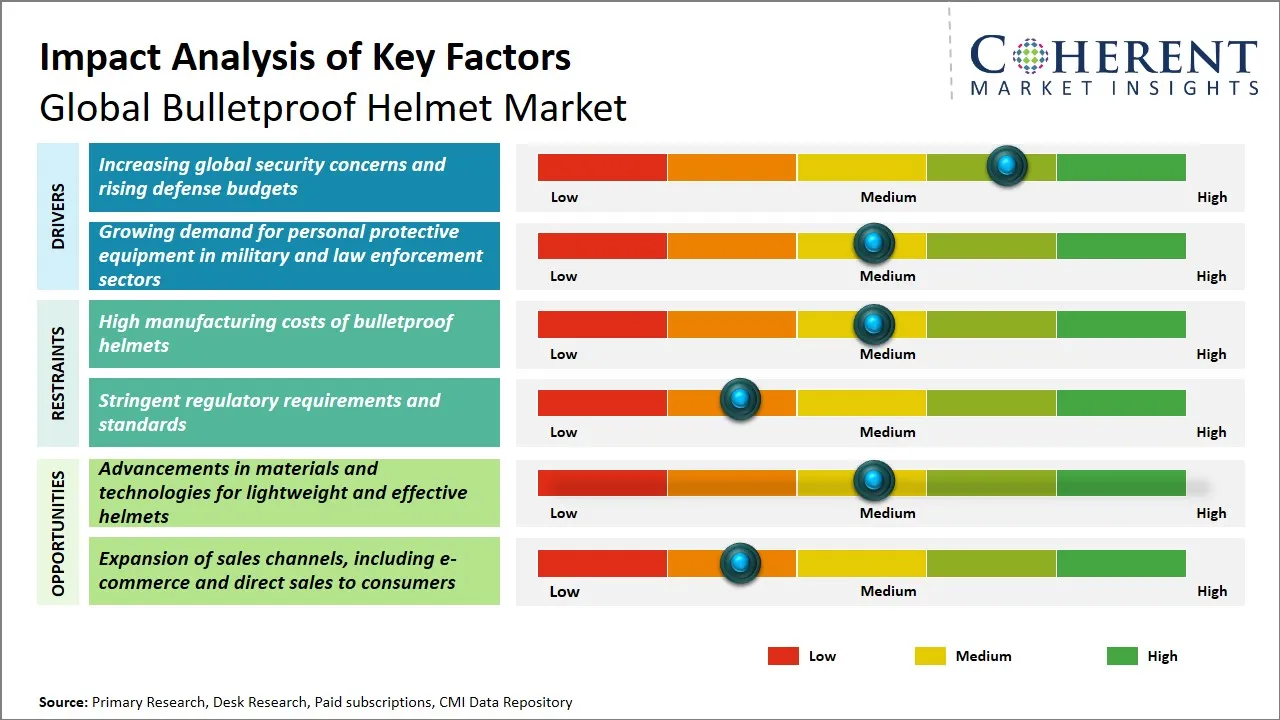
The growing geopolitical threats and the rise of asymmetric warfare in different parts of the world have greatly augmented the global security concerns making countries highly focus on the security of their military and law enforcement personnel. This increased interest in the safety of soldiers is increasing the number of investments in high-tech personal protection products, and bulletproof vests are one of the necessary elements. The world is witnessing governments all around the world devoting even more of their budgets on modernizing their military equipment’s and equipping soldiers on the ground with better chances of survival in the face of rising threats, and keeping their operations geographically ready to be deployed in even more volatile settings.
For instance, The U.S. defense budget for fiscal year 2025 was proposed to be around USD 849.8 billion, with a substantial portion allocated to improving soldier safety, including investments in advanced personal protection like bulletproof helmets and vests.
Bulletproof Helmet Market Opportunity - Advancements in Materials and Technologies for Lightweight and Effective Helmets
The continuous improvement in the sphere of materials science and the technologies of making helmets are the factors that can bring the development of lightweight but quite efficient protective equipment to the market of the global bulletproof helmets. New materials like ultra-high-molecular-weight polyethylene (UHMWPE), graphene composites and new aramid fibers are transforming the way helmets are made as they provide better ballistics protection and lower weight. The coming-of-age materials allow the manufacturers to design helmets which are more mobile and comfortable by the end-users, which is vital when it comes to military officers, police officers, and the security agencies who are required to act in diverse and challenging settings.
In 2023, the U.S. military began deploying new lightweight ballistic helmets made from ultra-high-molecular-weight polyethylene (UHMWPE), which is significantly lighter than traditional Kevlar helmets but offers superior protection. The introduction of graphene-based composites into helmet design has also shown promise, with several defense contractors reporting a 30% reduction in weight without compromising ballistic resistance.
Analyst Opinion (Expert Opinion)
- The market of bulletproof helmet is experiencing the increase of the growth due to the growing fears of the personal safety in the military and civilian settings. The Global Defense Exposition (2023) and the International Security and Defense Conference (2022) provided some insight into the developments in the sphere, with the companies like 3M and Honeywell leading the development of next-generation helmets that would incorporate new materials to provide more excellent ballistic protection.
- The introduction of a lightweight helmet with increased impact resistance by 3Ms recent efforts is an example of how the industry has focused on achieving a balance between the safety and comfort of the helmet, which is important in contemporary battle situations. Debates during these conferences highlighted the increased need to have helmets that are also equipped with smart technologies, including communication devices and built-in visors, which can meet the needs of the various requirements of the military officers and the police.
- But other issues like rising production expenses and the requirement of strict testing criteria were often mentioned as issues against larger adoption. The firms with the greatest emphasis on innovation in the material technology and use feedback on the functional design provided by the end-users are expected to control the market. Finally, the expansion of the bulletproof helmet market will rely on the capacity to constantly adjust to the new challenges and the changing demands of the safety and functionality.
Speak to the analyst
Want personalized insights?
Take the findings above to one of our principal consultants, or have the report rebuilt around the segments, geographies and competitors you actually track.
Market Segmentation
- Material Insights (Revenue, USD Bn, 2021 - 2033)
- Metal Material
- Nonmetal Material
- Composite Material
- Application Insights (Revenue, USD Bn, 2021 - 2033)
- Military
- Law Enforcement
- Civilian Use
- Others (e.g., security, sports)
- Regional Insights (Revenue, USD Bn, 2021 - 2033)
- North America
- U.S.
- Canada
- Latin America
- Brazil
- Argentina
- Mexico
- Rest of Latin America
- Europe
- Germany
- U.K.
- Spain
- France
- Italy
- Russia
- Rest of Europe
- Asia Pacific
- China
- India
- Japan
- Australia
- South Korea
- ASEAN
- Rest of Asia Pacific
- Middle East
- GCC Countries
- Israel
- Rest of Middle East
- Africa
- South Africa
- North Africa
- Central Africa
- North America
- Key Players Insights
- MARS Armor
- VestGuard UK Ltd.
- Team Wendy
- Legacy Safety and Security
- PROTECTION GROUP DANMARK WHOLESALE APS
- Compass Armor Gear
- Sarkar Tactical
- EnGarde Body Armor
- MAROM DOLPHIN
- SCHUBERTH
Sources
Primary Research Interviews
- CEO – Leading Bulletproof Helmet Manufacturer (e.g., Avon Protection or ArmorSource LLC equivalent)
- Supply Chain Director – Major Ballistic Protection Distributor
- Production Lead – Advanced Composite Helmet Fabricator
- Sustainability Officer – PPE Certification Authority
Stakeholders
- Manufacturers
- End-use Sectors
- Military and Defense (Army, Special Forces)
- Law Enforcement Agencies
- Special Security Units (SWAT, Tactical Teams)
- Regulatory & Certification Bodies (e.g., NIJ for ballistic standards, OSHA for PPE)
- E-commerce Platforms and Retailers (Alibaba, IndiaMart, Security Pro USA)
- Technology Integration Players: Smart helmet and integrated comms producers (e.g., Team Wendy)
Databases
- UN Comtrade Database (HS codes for protective headgear)
- India Import Export (EXIM) Database
- USGS Mineral Commodity Summaries (related materials if applicable)
- SIPRI Arms Trade Database
- Global Trade Atlas for PPE
Magazines
- Soldier Modernisation – Trends in ballistic helmet tech
- Police Fleet Magazine – Law enforcement PPE innovations
- Defense News – Military helmet advancements
Journals
- Composites Part B: Engineering – Ballistic helmet materials
- Journal of Materials Science – Protective helmet durability
- International Journal of Impact Engineering – Ballistic performance studies
Newspapers
- Defense News – Global helmet procurement deals
- The Wall Street Journal – Defense budget impacts on PPE
- Business Standard (India) – Local helmet manufacturing growth
- Jane's Defence Weekly – Supply chain disruptions in body armor
Associations
- International Safety Equipment Association (ISEA)
- National Institute of Justice (NIJ)
- National Defense Industrial Association (NDIA)
- Police Executive Research Forum (PERF)
European Security & Defence Association
- Public Domain Sources
- NIJ – Ballistic Resistance Standards for helmets
- OSHA – PPE Guidelines for head protection
- Department of Defense – MIL-STD helmet specs
- SIPRI – Arms and military equipment trade reports
Proprietary Elements
- CMI Data Analytics Tool, Proprietary CMI Existing Repository of information for last 8 years.
Get access to 250+ pages report
Every segment, forecast, competitor profile and data table behind the analysis above — available for instant download.
- ESOMAR Member
- ISO 9001:2015 Certified
- D-U-N-S Registered
- GDPR & CCPA Compliant
Missing comfort of reading report in your local language? Find your preferred language:
Transform your Strategy with Exclusive Trending Reports
Frequently Asked Questions
The global bulletproof helmet market is estimated to be valued at USD 1.86 Bn in 2026 and is expected to reach USD 2.71 Bn by 2033.
It is a helmet designed to protect the wearer’s head from ballistic threats like bullets and shrapnel.
Geopolitical tensions and conflicts boost procurement in defense and security sectors.
The CAGR of global bulletproof helmet market is projected to be 5.5% from 2026 to 2033.
Increasing global security concerns and rising defense budgets and growing demand for personal protective equipment in military and law enforcement sectors are the major factors driving the growth of the global bulletproof helmet market.
High manufacturing costs of bulletproof helmets and stringent regulatory requirements and standards are the major factors hampering the growth of the global bulletproof helmet market.
In terms of material, metal material is estimated to dominate the market revenue share in 2026.