

Global Pizza Market Size and Forecast – 2026 to 2033
The Global Pizza Market is estimated to be valued at USD 236.21 Bn in 2026 and is expected to reach USD 325.79 Bn by 2033, exhibiting a compound annual growth rate (CAGR) of 4.7% from 2026 to 2033.
Key Takeaways of the Pizza Market
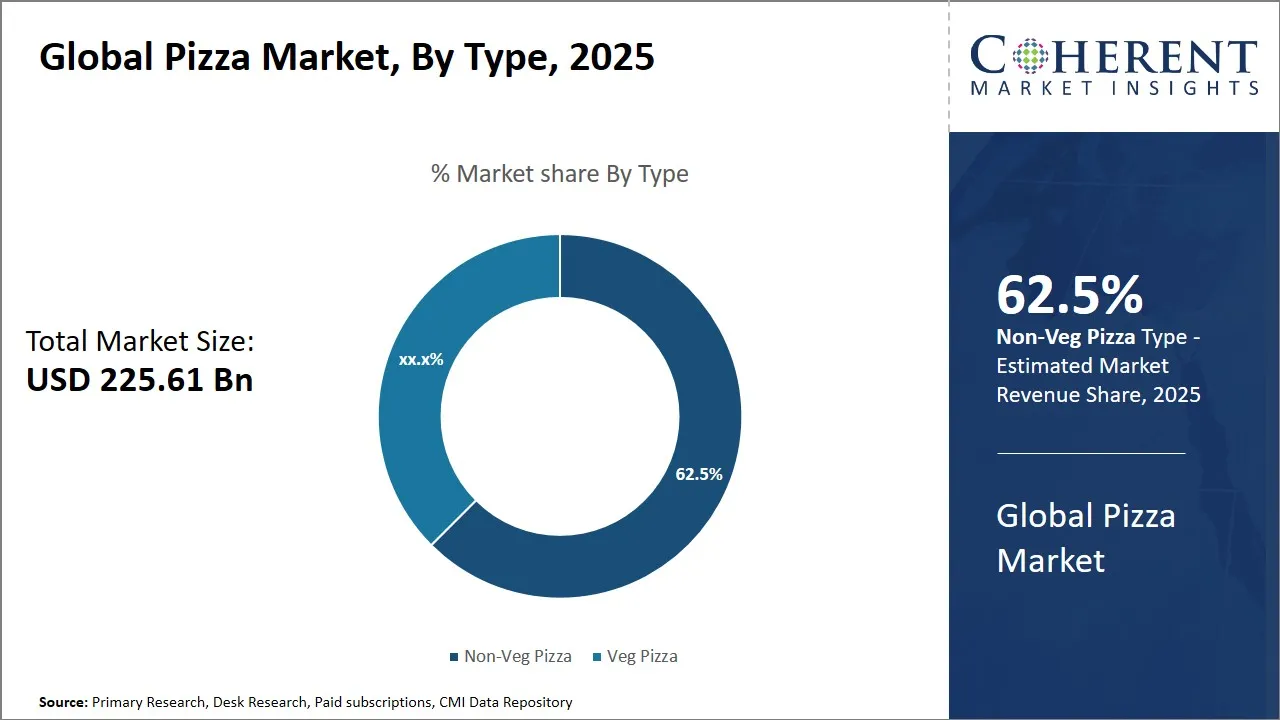
- Non-veg pizza is expected to hold 63.5% share of the market in 2026.
- The thick crust segment is projected to account for 35.6% of the global pizza market in 2026.
- Full-service restaurants hold an estimated 44.6% share of the market in 2026.
- North America leads the pizza market with an estimated 40.2% share in 2026. Asia Pacific is expected to hold 23.5% in 2026 and is the fastest-growing regional market.
Market Overview
The prevailing market trend points towards a rising demand for healthier and gourmet types of pizza with consumers moving towards organic ingredients, gluten free crusts, and new toppings. The rise in sustainability initiatives—such as shifting to eco-friendly packaging—reflects growing consumer concern about environmental impact and is pushing companies to adopt greener practices.
Currents Events and Its Impacts
Current Events | Description and its impact |
Shift toward healthier, premium and “better-for-you” pizzas |
|
Rapid expansion of plant-based and alternative-protein pizza offerings |
|
Segmental Insights
- Current Industry Events of 2026
- Market Size Estimation
- Regional Breakdown
- Competitive Landscape
- Customer Intelligence
- Segmental Analysis
- Pricing Analysis
- Key Market Drivers, Challenges & Future Trends
- Customized Insights Section
Pizza Market Insights, By Type - Non-Veg Pizza Segment Dominates the Market due to its Increasing Consumer Preference for Protein-Rich and Flavorful Options
Non-veg pizza is expected to hold 63.5% share of the global pizza market in 2026. The lasagna menu of non-veg pizzas usually includes diverse meat toppings, including chicken, pepperoni, sausage and ham, which are enjoyed by consumers who are willing to indulge and enjoy the rich taste of pizzas. These toppings are also healthier in terms of their protein content and satisfy the needs of healthy clients who want their meals to be satiating and balanced in the number of macronutrients. The favor towards non-veg pizzas is also supported by cultural factors and changing food habits and culture, particularly in areas where meat eating is a norm.
The opportunity to mix various types of meat with a bunch of different sauces, cheeses and complementary items suit a wide demographic group, which makes it more acceptable among age groups, as well as various areas worldwide. The emergence of gourmet and artisanal non-veg pizzas, the usage of exotic meats, and fusion flavors also appeal to adventurous eaters and food lovers and increases the segments attractiveness in a casual and fine dining setting.
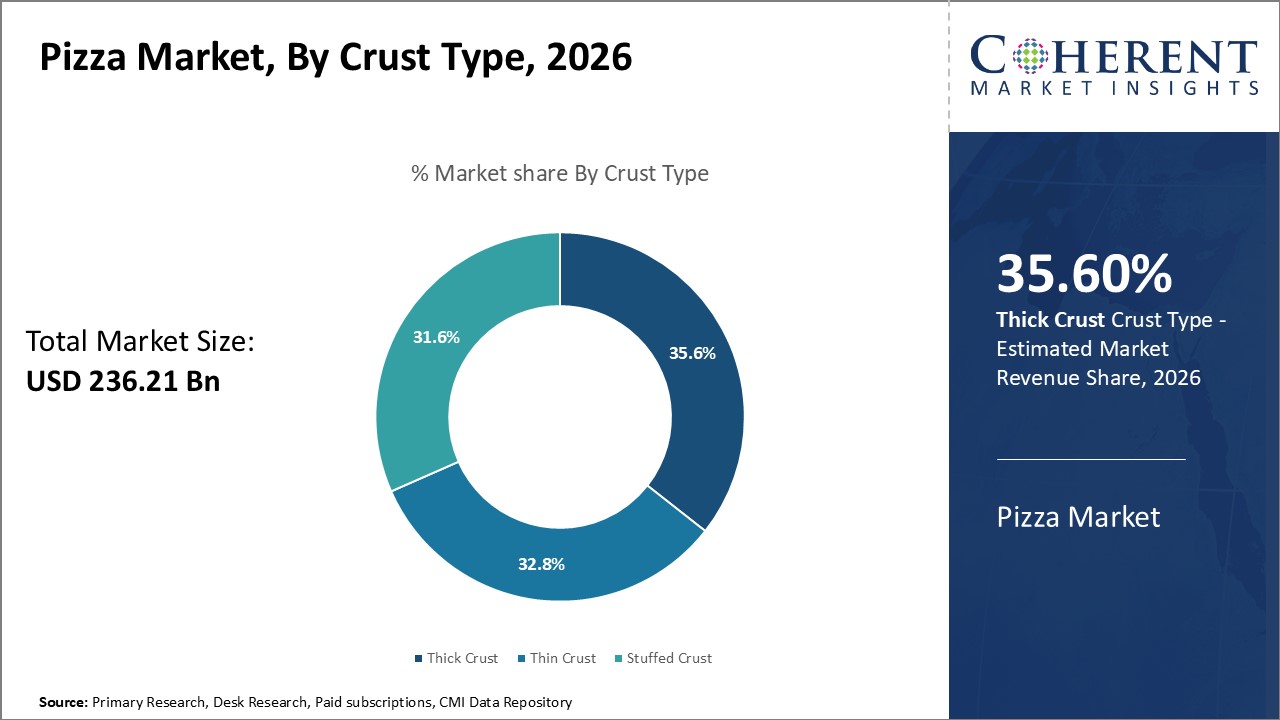
Pizza Market Insights, By Crust Type - Thick Crust Segment Dominates the Market Driven by Preference for Texture, Satiety, and Customization Options
Thick crust segment is projected to hold 35.6% share of the global pizza market in 2026, primarily due to consumer preferences for texture and the enhanced satiety it provides. Thick crust is more likely to offer a more substantial base, dense and with a pleasurable chew, and it seems larger in portion.
The base structure is more robust and has a greater volume, thus being able to support heavier toppings and greater amounts of cheese and sauces without any structural damage. This provides consumers with the freedom to order pizzas with more valuable and richer ingredient content making it a high-value eating experience. Moreover, thick crust pizzas are usually considered to be related to home-style recipes or traditional recipes, which leaves some kind of nostalgia and authenticity in their customers and makes them come back repeatedly.
Pizza Market Insights, By Distribution Channel - Full-Service Restaurants Segment Dominates the Market as Consumers Seek Experiential Dining Combined with Quality and Service
Full-service restaurants segment is anticipated to hold 44.6% share of the market in 2026. Pizza is not merely a fast food in these restaurants, but there is the setting, a caring waitress, and a menu to be tailored to the needs of the client, contributing further to satisfaction and client retention. The dining experience gives the consumption of pizza a social status, resulting into a high frequency of visits and improved spending per customer.
In addition, full-service restaurants are more inclined towards quality ingredients, cooking styles, and presentation, which attract consumers who are ready to spend more on gourmet-type pizzas. The variety of the menu items of both traditional and local tastes, along with chef-inspired researches, represents a wide market range, encompassing food lovers and sophisticated customers.
Regional Insights
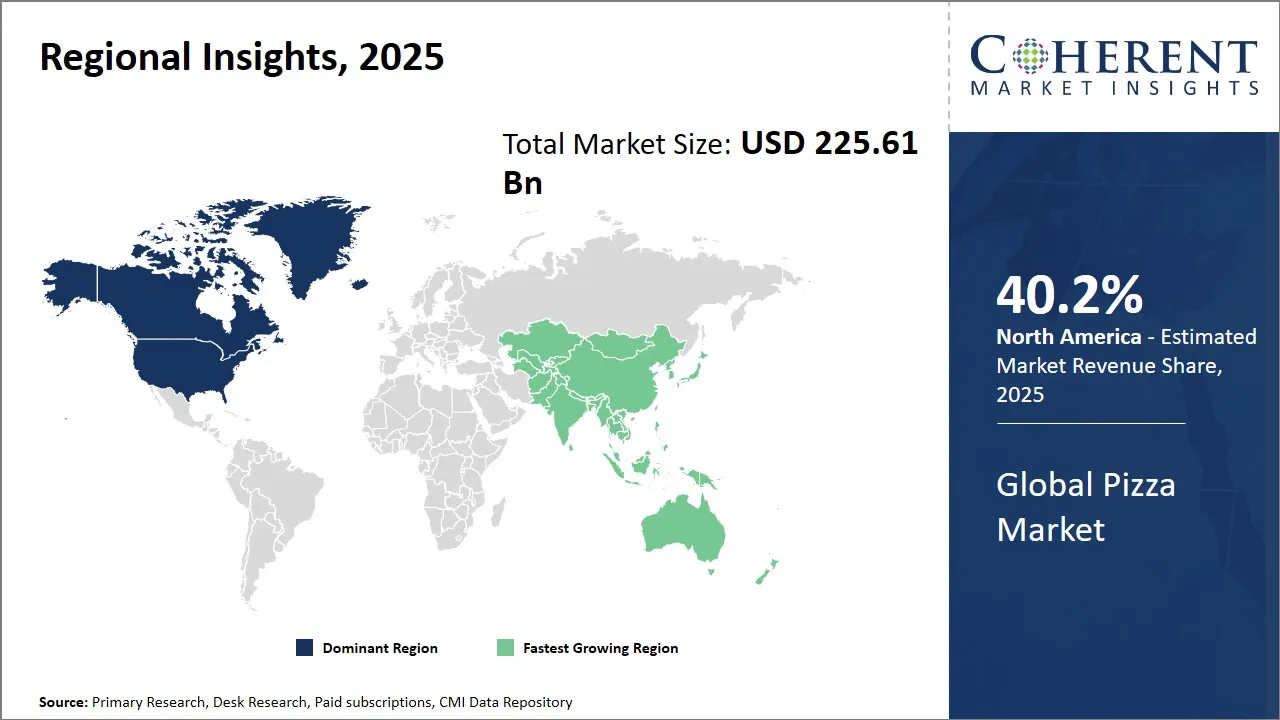
North America Pizza Market Analysis and Trends
The North America region is projected to lead the market with a 40.2% share in 2026, driven by robust consumer demand, high disposable incomes, and a mature food service infrastructure. There is a high density of international and local pizza chains in the U.S. and Canada that is backed by a robust supply chain network and food technology innovations. The North American government policies encourage food safety and innovations, which allow diversification of products into healthier and high-quality pizza products.
Moreover, North America also enjoys the advantage of large trade networks that allow the import of diverse ingredients that make the products diverse and attract consumers. The sizeable market participants like Dominos Pizza, Pizza Hut (Yum! Brands), and Papa Johns have invested a lot in digital ordering, delivery innovation options, and menu customization to local areas, which has cemented their market position and triggered consistent consumption trends.
Asia Pacific Pizza Market Analysis and Trends
The Asia Pacific region is expected to exhibit the fastest growth in the market contributing 23.5% share in 2026 due to the high rate of urbanization, growing middle class population, and changing consumer eating patterns since majority are now consuming westernized fast foods. The expansion is supported with rising disposable income, shifting lifestyles, and exposure to international food cultures brought about by globalization.
The Asian Pacific governments tend to promote the growth of the food industry by providing friendly laws and infrastructure enhancement including better cold chain logistics and e-commerce systems that increase the delivery component.
The ecosystem of the market in this case is dynamic with the joining of not only multinational chains but also innovative local brands producing products based on local preferences. Established chains such as Domino’s Pizza, Pizza Hut, as well as local chains such as Yellow Cab (Philippines) and Sbarro (India), are also taking proactive steps to change their menus to reflect the local flavors and low-cost pricing policies. The trade relations between local and international suppliers of ingredients also add to enriching products.
Pizza Market Outlook for Key Countries
U.S. Pizza Market Trends
The U.S. pizza market continues to lead globally, anchored by a highly competitive environment and strong brand loyalty. The consumer is engaged by the existence of the first-mover such as Domino’s Pizza, Pizza Hut, and Papa Johns, accompanied by the recent developments of delivery services such as online and smartphone ordering.
The U.S. pizza market has a high rate of product innovation, including artisanal and health-conscious pizzas, to meet the changing preferences. Moreover, the variety of the offerings is also provided by the regional pizza varieties, such as New York, deep-dish Chicago, and California, which keeps the market ecosystem vibrant and mature.
India Pizza Market Trends
The market for pizzas in India is growing at an alarming rate because of population expansion in urban areas and shifting food consumption trends. This need among the younger generations is geared towards the growing popularity of pizza amid the growing demand for convenient and novel food items. The market is dominated by global chains like Domino’s, Pizza Hut, and Papa John’s. Regional chains are expanding with cost-effective models and localized flavors. These include paneer, tandoori, and other region-specific topping variants.
China Pizza Market Trends
China is a dynamic and developing market in the field of pizzas that is determined by the combination of foreign franchises and local businesses. Dominos and Pizza Hut are proactive on the store expansion and localization strategies, and their pizzas are tailored to the Chinese taste without sacrificing the authenticity of the brands. There is the accelerated use of online food delivery models such as Meituan and Ele.me that enhances the accessibility of pizza in urban centers.
Government policies that facilitate modern retail and food safety levels facilitate positive market growth and the local manufacturers are increasingly involved in the supply chain, increasing the availability of ingredients.
Italy Pizza Market Trends
The home country of pizza, Italy, has domestic market which is a combination of both vintage pizzeria and modern casual dining stores. It is based on the traditionalism and authenticity of localized pizza varieties such as Neapolitan and Roman ones that are still appealing to both national and global consumers that the market flourishes.
The prominent firms are classic family-owned pizzas, as well as new chains such as Rossopomodoro and Gino Sorbillo, which assist in balancing between artisanship and scalability of the business. The authentic pizza market positioning is further enhanced by government regulations that maintain the standards of the products and their geographical indications.
Brazil Pizza Market Trends
Brazil’s pizza market is strong due to its urban food culture and expanding middle class. Local brands like Mister Pizza and global players like Domino’s intensify competition. Urbanization and shifting eating habits support continuous market expansion. Government efforts to streamline food supply chains and improve food safety also help growth. Brazilian ingredients blended with classic pizza styles create unique offerings that attract diverse consumers.
Delivery vs. Dine-In Profitability
Delivery typically yields 15-25% higher profit margins than dine-in due to lower overheads like reduced seating space and no on-site consumption waste, though it incurs higher packaging and logistics costs averaging 10-15% of revenue. Dine-in profitability benefits from higher average check sizes (up to 30% more) and impulse upsell but faces elevated labor (35-45% of costs) and rent expenses. Benchmarks show delivery profit per order at USD 8-12 versus USD 5-9 for dine-in in mid-sized pizzerias.
Dough Automation Impact
Dough automation via presses and dividers reduces manual labor by 40-60%, freeing staff for other tasks and cutting prep time by 20 minutes per batch. Machines ensure uniform thickness and weight, minimizing errors and waste while handling up to 1,200 kg/hour for high-volume pizzerias. This boosts consistency in crust quality, supports scalability for gluten-free or artisanal doughs, and lowers physical strain on workers.
Robotic Pizza Oven Impact
Robotic ovens streamline dough stretching, topping, and baking, slashing preparation time and enabling 2-3x throughput during peaks. They cut labor costs significantly—e.g., from 16 to 9 employees—allowing price reductions like USD 28 to USD 22 pizzas while maintaining output. Automation enhances efficiency with precise control, reducing energy use and human error for consistent results.
Market Players, Key Development, and Competitive Intelligence

Key Developments
- In April 2025, Domino’s Pizza Inc., an U.S. multinational pizza restaurant chain, partnered with DoorDash, Inc., an online food delivery company. The partnership would allow Domino's to reach new consumers through DoorDash Marketplace.
- In March 2025, Flynn Group, one of the largest franchise operators in the U.S., acquired franchise rights of 45 Pizza Hut restaurants in Alabama, Georgia, and Tennessee. The acquisition would allow Flynn Group to expand its quick service and fast casual brands.
- In March 2025, Domino’s Pizza launched Big 6-in-1 Pizza, a 24-slice pizza offering for group dining. The new offering features six distinct flavors, catering to different preferences of consumers in a single order.
- In January 2025, Tuckers Farm Corporation, a value-oriented investment holding vehicle, acquired Pizza Factory Inc., one of the leading quick-service restaurant franchisors. The acquisition would help Tucker Farm drive value for its franchisees.
- In November 2024, Craveworthy Brand, a multi-restaurant platform company, acquired Fresh Brothers Pizza, a 20-unit, U.S.-based pizza chain. The acquisition would further diversify the company’s portfolio of pizzas.
Top Strategies Followed by Global Pizza Market Players
- The competitiveness of the established players is controlled by the extensive investment in research and development (R&D) in order to produce high-performance products in accordance with the changing consumer preferences. These investments can help them to regularly add new flavors, healthier products and better product formulations, which will improve the taste, texture and shelf life of the pizza. Furthermore, these market leaders strategically enter into partnerships with key players in the industry and the original equipment manufacturers (OEMs) and use the collaborative pros that help them entrench the production capacities and distribution effectiveness.
- For example, Domino’s spends big on AI-driven order automation, GPS-driven delivery technology, and its new product lines, including gluten-free crusts and plant-based toppings, to keep up with changing consumer tastes. Pizza Hut also partners with suppliers of ingredients and equipment to create superior technology in dough and a broader faster baking system that enhances the consistency and throughput of its global branches.
- Mid-tier pizza brands carve out a niche by offering moderately priced options that balance quality and cost. These companies focus on low-cost products by targeting price-sensitive segments of the crowd and ensuring the production process is efficient and supply chain is streamlined to avoid high costs and yet provide a product that is of an acceptable quality.
- For example, companies such as Papa Murphys are made lean by using centralized prep kitchens and low-overhead take-and-bake models that enable the company to offer competitive pricing. Little Caesars and other regional brands have very streamlined production systems (e.g. Hot-N-Ready model) that cut costs on labor and operation, and are therefore appealing to price-sensitive consumers.
- The global pizza market is full of small players, who are likely to concentrate on specialization and innovation to cut across the fray. They cut niche markets by providing distinctive properties like crafted recipes, organic or gluten-free foods and also local flavors which attract local preferences. To keep up with the competition, these firms tend to use the latest technologies, including automated baking machines, internet-based ordering systems, and hi-tech packaging systems that improve the freshness and convenience of the products.
- For example, independent artisanal pizzerias such as Joes Pizza (New York) or 400 Neapolitan brands specialize in high-quality fermentation of dough, local products, and regional cuisine.
Market Report Scope
Pizza Market Report Coverage
| Report Coverage | Details | ||
|---|---|---|---|
| Base Year: | 2025 | Market Size in 2026: | USD 236.21 Bn |
| Historical Data for: | 2020 To 2024 | Forecast Period: | 2026 To 2033 |
| Forecast Period 2026 to 2033 CAGR: | 4.7% | 2033 Value Projection: | USD 325.79 Bn |
| Geographies covered: |
| ||
| Segments covered: |
| ||
| Companies covered: | Domino's Pizza, Inc., Papa John's International, Inc., Pizza Hut, LLC, Sbarro, LLC, PizzaExpress Limited, Yellow Cab Pizza Co., Smokin' Joe's, Uno Pizzeria & Grill, Little Caesar Enterprises Inc., and Vapiano SE | ||
| Growth Drivers: |
| ||
| Restraints & Challenges: |
| ||
Pizza Market Dynamics
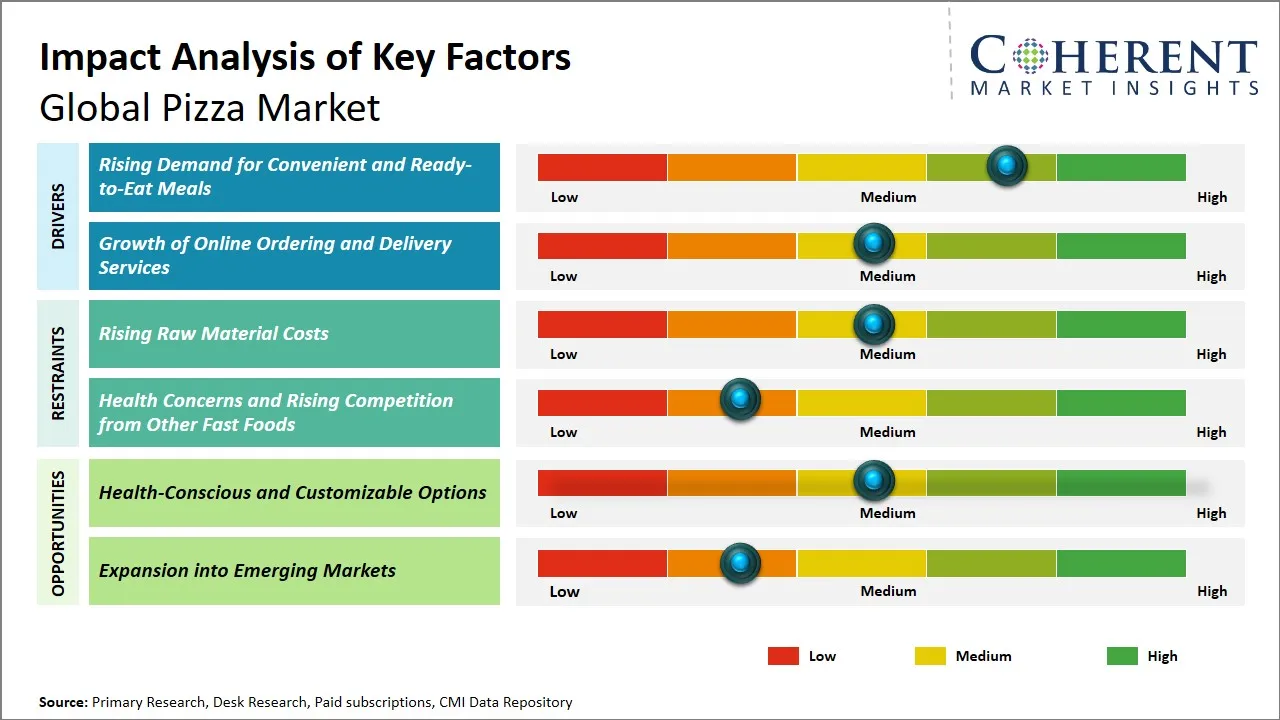
Pizza Market Driver - Rising Demand for Convenient and Ready-To-Eat Meals
The accelerated rate of contemporary lifestyles has contributed largely to the need to have convenient and ready to eat foods and this has made pizza one of the most preferred foods among the consumers across the globe. Working professionals, students, and young families are all turning to fast food solutions that involve minimum preparation and no compromise in eating habits. Pizza, with the possibility of easy customization and its availability in different styles ranging between fresh and frozen food, and take and bake fits best in these emerging consumer trends.
For example, Domino’s AnyWare ordering platform (smartwatch, social media, voice) is a direct response to this convenience-based need, allowing to order on a number of devices and spur a number of deliveries, which grows in the dozens.
Pizza Market Opportunity - Health-Conscious and Customizable Options in the Global Pizza Market
The increased consumer desire to have healthier diets is a great opportunity to the pizza market to develop and diversify its products. Growing knowledge about nutrition and wellness have contributed to customers becoming more interested in the availability of pizza options that meet certain dietary needs such as low calories, gluten-free, vegan, and high-protein pizzas. This trend of health-conscious consumption is forcing pizza producers and restaurant chains to come up with customizable menus where the consumer can choose which ingredients to include to help achieve their personal health objectives, e.g., whole-grain crusts, organic foods vegetables, and lean protein toppings.
As an example, Papa John’s launch of Papa Bowls and gluten-free crust capitalized on rising health trends. These products offer low-carb, gluten-free, and higher-protein choices that attract health-focused customers who previously avoided traditional pizza.
Analyst Opinion (Expert Opinion)
- The pizza industry is undergoing an active transformation due to the fluctuation in customer tastes concerning convenience and development of gourmet pizza. The experiences of the National Pizza Expo (2023) and the Pizza and Pasta Expo (2022) revealed the main trends, and restaurants such as Domino’s and Papa Johns were at the forefront of the innovation in delivery and menu diversification.
- The current case of Domino’s trying to simplify its online order taking and improve its delivery process demonstrates how responsive the markets are to the need to bring convenience to the lives of busy people. Debates at these conferences underlined the increasing trend of the popularity of plant-based toppings and artisanal pizzas, which are more representative of healthier and more eclectic culinary experiences.
- However, challenges such as rising ingredient costs and market saturation were frequently cited as hurdles to sustained growth. Companies that invest in robust marketing strategies, local sourcing, and customization options are likely to stand out in this competitive landscape. Ultimately, the growth of the pizza market will hinge on its ability to innovate while addressing the evolving tastes and expectations of consumers who seek quality, convenience, and sustainability in their dining choices.
Speak to the analyst
Want personalized insights?
Take the findings above to one of our principal consultants, or have the report rebuilt around the segments, geographies and competitors you actually track.
Market Segmentation
- Type Insights (Revenue, USD Bn, 2021 - 2033)
- Non-Veg Pizza
- Veg Pizza
- Crust Type Insights (Revenue, USD Bn, 2021 - 2033)
- Thick Crust
- Thin Crust
- Stuffed Crust
- Distribution Channel Insights (Revenue, USD Bn, 2021 - 2033)
- Full-Service Restaurants
- Quick Service Restaurants
- Others
- Regional Insights (Revenue, USD Bn, 2021 - 2033)
- North America
- U.S.
- Canada
- Latin America
- Brazil
- Argentina
- Mexico
- Rest of Latin America
- Europe
- Germany
- U.K.
- Spain
- France
- Italy
- Russia
- Rest of Europe
- Asia Pacific
- China
- India
- Japan
- Australia
- South Korea
- ASEAN
- Rest of Asia Pacific
- Middle East
- GCC Countries
- Israel
- Rest of Middle East
- Africa
- South Africa
- North Africa
- Central Africa
- North America
- Key Players Insights
- Domino's Pizza, Inc.
- Papa John's International, Inc.
- Pizza Hut, LLC
- Sbarro, LLC
- PizzaExpress Limited
- Yellow Cab Pizza Co.
- Smokin' Joe's
- Uno Pizzeria & Grill
- Little Caesar Enterprises Inc.
- Vapiano SE
Sources
Primary Research Interviews
- CEO – Leading Pizza Chain (e.g., Domino's or Pizza Hut)
- Supply Chain Director – Major Frozen Pizza Manufacturer
- Marketing Head – Independent Pizzeria Network
- Innovation Manager – Plant-Based Pizza Developer
Stakeholders
- Manufacturers
- End-use Sectors:
- Quick Service Restaurants (QSRs) and Pizza Chains
- Frozen and Ready-to-Eat Pizza Brands
- Regulatory & Certification Bodies
- E-commerce Platforms and Delivery Services (e.g., DoorDash, Uber Eats)
- Technology Integration Players: AI-driven order personalization and kitchen automation providers
Databases
- UN Comtrade Database
- USITC Trade Data for Pizza Imports/Exports
- Euromonitor International Pizza Market Database
- Global Trade Atlas (GTA)
Magazines
- Pizza Today – Trends in pizzeria operations and menu innovations
- PMQ Pizza Magazine – Dough recipes, equipment reviews, and industry news
- Canadian Pizza Magazine – North American market updates and operator insights
- Pizza & Pasta Italiana – Global Italian pizza trends and professional guides
- Pizza Marketplace – Business strategies and market analysis for pizza operators
Journals
- Journal of Foodservice Business Research – Consumer preferences in pizza consumption
- International Journal of Gastronomy and Food Science – Pizza formulation and sensory studies
- Food Quality and Preference – Topping innovations and flavor trends in pizza
- Journal of Culinary Science & Technology – Pizza crust development and baking techniques
- Appetite – Behavioral studies on pizza eating habits
Newspapers
- The Wall Street Journal – Global fast-food market shifts including pizza growth
- Financial Times – QSR industry trends and pizza chain expansions
- Bloomberg – Delivery platform impacts on pizza sales
- The Guardian – Health trends in frozen and gourmet pizzas
- Nikkei Asia – Pizza market growth in Asia-Pacific regions
Associations
- Pizza World Association – Global standards for pizza professionals
- Associazione Verace Pizza Napoletana (AVPN) – Neapolitan pizza protection and certification
- Pizza Cook-Off Association (PCA) – Competitive events and industry networking
- Domino's Franchisee Association (DFA) – Franchisee advocacy and operations
- Neapolitan Pizza Makers Association – Artisan pizza training and promotion
Public Domain Sources
- FDA – Food safety guidelines for pizza ingredients and preparation
- USDA – Nutritional data and standards for frozen pizzas
- European Food Safety Authority (EFSA) – Pizza-related food regulations
- World Health Organization – Dietary impacts of processed pizza consumption
Proprietary Elements
- CMI Data Analytics Tool
- Proprietary CMI Existing Repository of information for last 8 years.
Get access to 250+ pages report
Every segment, forecast, competitor profile and data table behind the analysis above — available for instant download.
- ESOMAR Member
- ISO 9001:2015 Certified
- D-U-N-S Registered
- GDPR & CCPA Compliant
Missing comfort of reading report in your local language? Find your preferred language:
Transform your Strategy with Exclusive Trending Reports
Frequently Asked Questions
The global pizza market is estimated to be valued at USD 236.21 Bn in 2026 and is expected to reach USD 325.79 Bn by 2033.
The CAGR of the global pizza market is projected to be 4.7% from 2026 to 2033.
Rising demand for convenient and ready-to-eat meals and growth of online ordering and delivery services are the major factors driving the growth of the global pizza market.
Rising raw material costs and health concerns and rising competition from other fast foods are the major factors hampering the growth of the global pizza market.
In terms of type, non-veg pizza is estimated to dominate the market revenue share in 2026.
Domino's Pizza, Inc., Papa John's International, Inc., Pizza Hut, LLC, Sbarro, LLC, PizzaExpress Limited, Yellow Cab Pizza Co., Smokin' Joe's, Uno Pizzeria & Grill, Little Caesar Enterprises Inc., and Vapiano SE are the major players operating in the market.
North America is expected to lead the global pizza market in 2026.