

Global Private Label Packaged Food Market Size and Forecast – 2026-2033
The global private label packaged food market is estimated to be valued at USD 447.71 Bn in 2026 and is expected to reach USD 672.31 Bn by 2033, exhibiting a compound annual growth rate (CAGR) of 6.0% from 2026 to 2033.
Key Takeaways of the Private Label Packaged Food Market
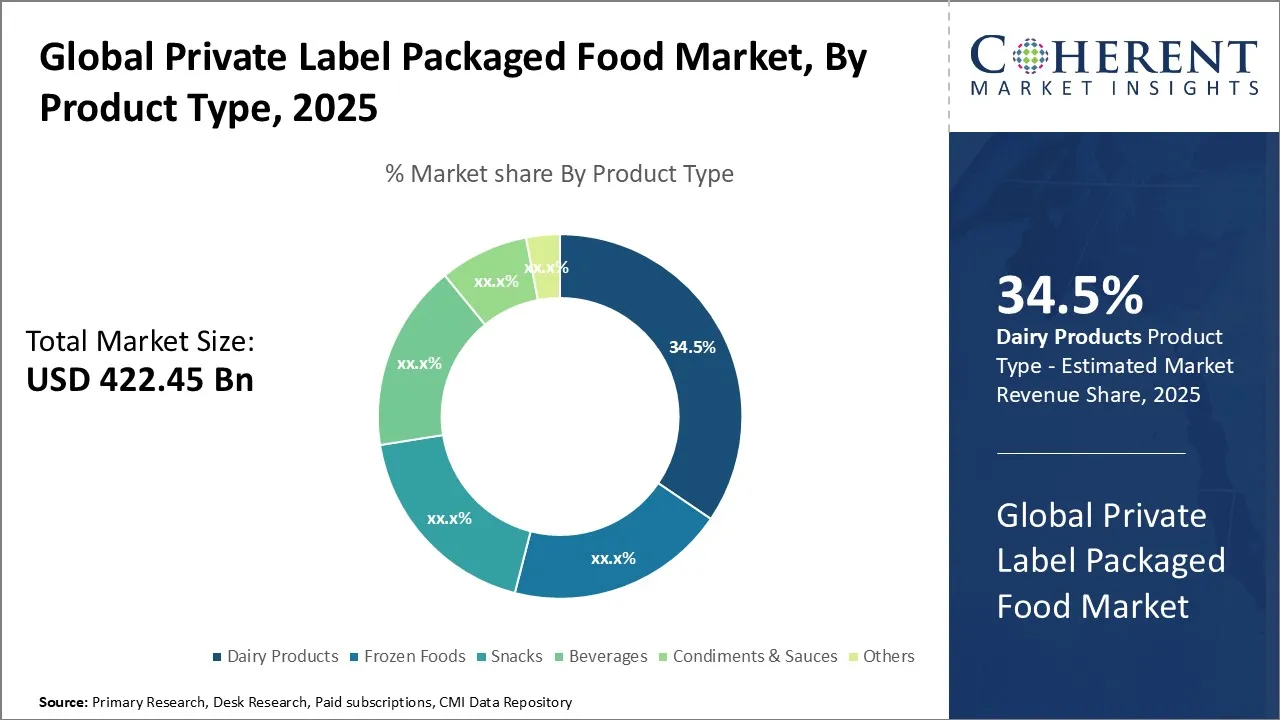
- The dairy products segment is expected to account for 35.5 % share in 2026.
- The hypermarkets and supermarkets segment is expected to hold 28.5 % share in 2026.
- North America is set to lead the global private label packaged food market in 2026 with a 31.3 % share. Asia Pacific, with an estimated share of 24.5% in 2026, and it is projected to be the fastest-growing region.
Market Overview
A key market trend in the private label packaged food sector is the rising demand for healthier and organic options as consumers become more health-conscious and environmentally aware. Additionally, advancements in supply chain efficiencies and digital marketing strategies are enabling retailers to better target specific consumer segments. Private label brands are also leveraging innovation in packaging and product formulations to enhance convenience and sustainability. This includes innovations in fresh food packaging that improve the preservation of perishable products and the growing popularity of ready to eat food products, further driving the market expansion and acceptance among a broader audience.
Current Events and Its Impact
Current Events | Description and its impact |
Sam’s Club Eliminates Artificial Ingredients from Private Label Products |
|
Walmart Launches 'Bettergoods' to Appeal to Younger Shoppers |
|
Segmental Insights
- Current Industry Events of 2026
- Market Size Estimation
- Regional Breakdown
- Competitive Landscape
- Customer Intelligence
- Segmental Analysis
- Pricing Analysis
- Key Market Drivers, Challenges & Future Trends
- Customized Insights Section
Private Label Packaged Food Market Insights, by Product Type - Dairy Products Segment Dominates Due to Rising Consumer Demand for Nutritious and Convenient Food Options
The dairy products segment is expected to hold 35.5% share in 2026. Primarily, increasing consumer awareness about health and nutrition has significantly boosted the demand for dairy products, which are rich sources of essential nutrients such as calcium, protein, and vitamins. As consumers become more health-conscious, they actively seek out products that support bone health, muscle development, and overall wellness, making dairy an attractive category within private labels.
Moreover, the versatility and daily consumption patterns of dairy products contribute to their strong market presence. Items like milk, cheese, yogurt, and butter are staples in many households worldwide, ensuring consistent demand. Private label dairy offerings are often perceived as cost-effective alternatives to national brands without compromising on quality, which appeals to budget-conscious consumers looking for both value and nutrition. Retailers capitalize on this by promoting private label dairy products as affordable yet reliable options, enhancing customer loyalty and repeat purchases.
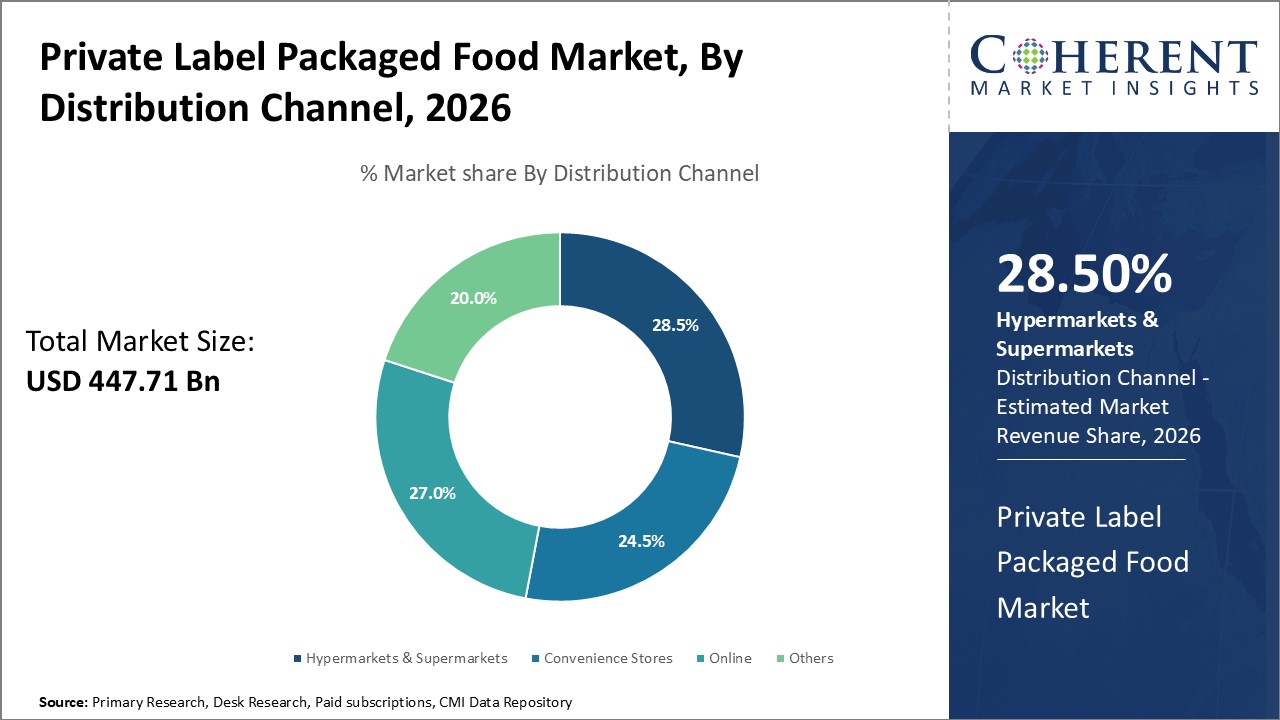
Private Label Packaged Food Market Insights, by Distribution Channel - Hypermarkets & Supermarkets Segment Dominates with Strong Consumer Trust and Expansive Product Assortments
The hypermarkets and supermarkets segment is projected to account for 28.5% share in 2026, owing to their unmatched ability to cater to diverse consumer needs through wide product varieties and competitive pricing. As large-scale retail formats, they provide consumers with a one-stop shopping experience, where private label products are prominently featured alongside national brands, enhancing visibility and accessibility.
One of the primary factors fueling the dominance of hypermarkets and supermarkets is consumer trust tied to store brands. Shoppers tend to associate private label products offered by these brick-and-mortar giants with reliable quality, given the rigorous quality control and brand reputation maintained by these retailers. This trust plays a critical role in converting trials of private label packaged foods into sustained buying habits, thereby consolidating the segment’s growth.
Regional Insights
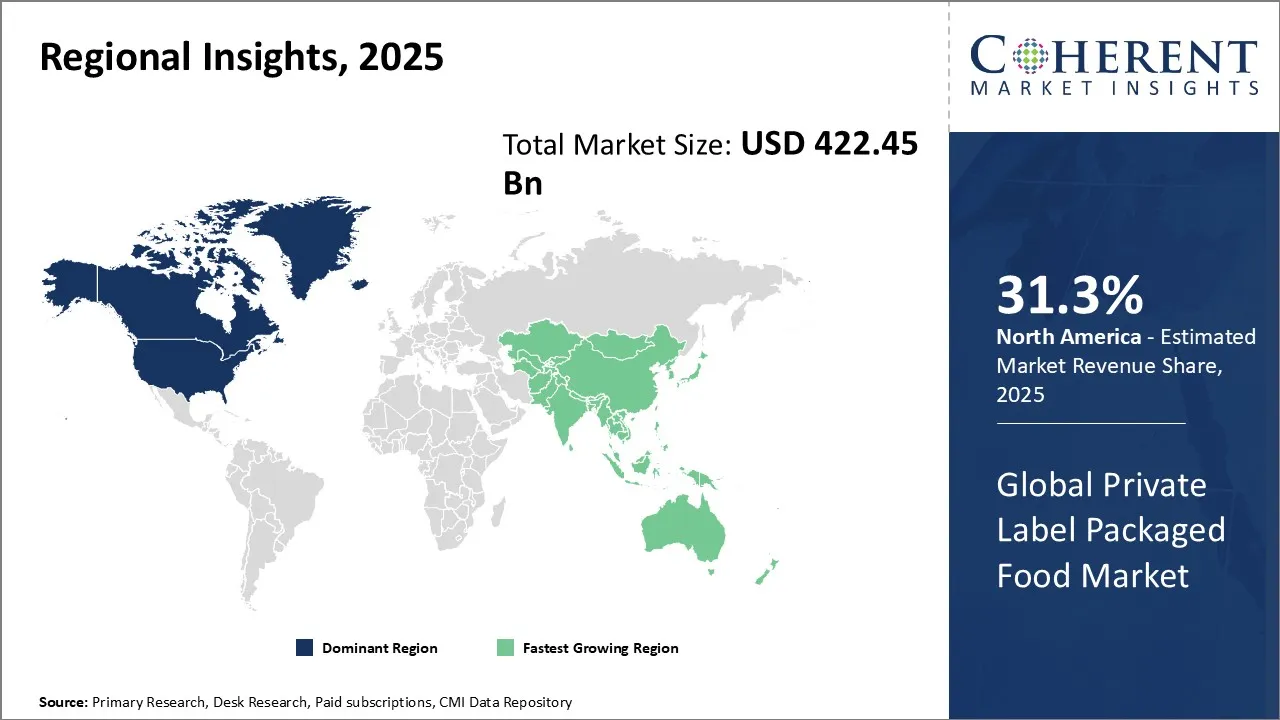
North America Private Label Packaged Food Market Analysis and Trends
The North America region is projected to lead the market with a 31.3% share in 2026, driven by a combination of changing consumer preferences, increased retail competition, and growing interest in value-oriented products. Consumers are increasingly prioritizing affordability, convenience, and healthier options, which private labels cater to effectively. U.S. and Canadian consumers appreciate high-quality ingredients at a lower price point compared to national brands, driving private label penetration across major retail chains such as Walmart, Costco, and Target. These retailers have leveraged their scale and bargaining power to offer competitive private label products in a wide range of categories, including snacks, dairy, frozen foods, and beverages.
The U.S. regulatory framework, including the FDA's oversight of food safety and labeling requirements, ensures product transparency and builds consumer trust in private label brands. Additionally, the increasing shift towards e-commerce and online grocery shopping has opened new growth opportunities for private label products, offering better accessibility and personalized shopping experiences for consumers. North America also benefits from an efficient distribution network, well-developed logistics, and an established food manufacturing industry, supporting the rapid growth and quality improvements within the private label packaged food segment.
Asia Pacific Private Label Packaged Food Market Analysis and Trends
The Asia Pacific region is expected to exhibit the fastest growth in the market contributing 24.5% share in 2026, spurred by rapidly evolving consumer behaviors, a growing middle class, and expanding modern retail formats such as supermarkets and e-commerce. Increasing health awareness, convenience-driven consumption, and competitive pricing fuel the adoption of private label products. Governments in countries like China, India, and Southeast Asia are increasingly supporting the development of domestic food manufacturing through policies encouraging innovation, safety standards, and local sourcing, fostering growth in private label offerings.
The region’s diverse and populous markets create strong demand for varied product innovation tailored to local tastes at accessible prices. Key market players like Walmart (through its private label brands), Aeon, and Reliance Retail play pivotal roles in proliferating private label presence. Trade liberalization and improving logistics networks also boost supply chain efficiency, enabling private label growth beyond urban centers.
Global Private Label Packaged Food Market Outlook for Key Countries
U.S. Private Label Packaged Food Market Analysis and Trends
The U.S. private label packaged food market is highly competitive, backed by a strong retail presence including Walmart, Kroger, and Costco, which have extensive private label portfolios emphasizing quality and innovation. U.S. consumers are increasingly receptive to store brands due to enhanced product quality and value perception. The regulatory framework encourages food transparency and safety, which private label producers leverage to build consumer trust. Growing online grocery penetration has further accelerated private label adoption, with major retailers expanding their e-commerce private label offerings.
Germany Private Label Packaged Food Market Analysis and Trends
Germany continues to lead Europe private label packaged food market with retail giants Aldi and Lidl as primary drivers. These retailers focus on cost efficiency without compromising product quality, appealing to value-conscious German consumers. Government regulations ensure high food safety and traceability, which reinforces consumer confidence. The country’s well-developed food processing industry supports a diverse and high-quality private label product range. German private labels are renowned for premium offerings in organic, gluten-free, and health-oriented segments.
China Private Label Packaged Food Market Analysis and Trends
China private label packaged food market is rapidly evolving due to changing consumer preferences amid rising incomes and urbanization. Key retailers such as Alibaba (through Freshippo) and Sun Art Retail have boosted private label penetration via integrated online-offline platforms. The government’s emphasis on food safety standards and local manufacturing innovation creates a favorable environment for private label development. Chinese consumers favor flavor innovations and convenience, prompting private label producers to expand into ready-to-eat and health-focused products.
U.K. Private Label Packaged Food Market Analysis and Trends
The U.K. private label packaged food market features strong competition among retailers such as Tesco, Sainsbury’s, and Marks & Spencer, whose private label brands have expanded into premium and specialty categories. British consumers value sustainability and ethical sourcing, driving private labels to innovate with organic and environmentally responsible packaging. Regulatory oversight ensures product quality and food provenance transparency, enhancing private label credibility. The U.K.’s mature e-commerce sector offers additional channels for the private label distribution and consumer engagement.
India Private Label Packaged Food Market Analysis and Trends
India private label packaged food market is gaining momentum, supported by a flourishing retail ecosystem including Reliance Retail, Big Bazaar, and e-commerce platforms like Flipkart exploiting private label growth. Government initiatives to boost the food processing sector and support ‘Make in India’ strategies foster the development of domestic private label food products. Consumer demand is shifting towards affordable, hygienic, and diverse packaged food options, with private labels capitalizing on regional tastes and convenience trends to expand their footprint.
Macro and Micro Economic Factors Impacting on Private Label Packaged Food Market Growth
Macro-Economic Factors
- Inflation and Consumer Price Sensitivity: Rising food prices and general cost-of-living pressures are accelerating consumer shifts toward private label brands, which are perceived as more affordable alternatives to national brands.
- Regulatory Environment: New labeling, food safety, and sustainability requirements raise compliance costs, especially for smaller producers, but also reinforce consumer trust in regulated private label products.
- Digitalization and E-commerce Growth: Accelerated growth of online grocery shopping and digital-first retail models offer private label brands broader reach and drive adoption among digitally engaged consumers.
Micro Economic Factors
- Retailer and Manufacturer Strategy: Investments in product innovation, quality improvement, and portfolio expansion empower retailers to build customer loyalty and capture higher margins on private label offerings.
- Consumer Demand Shift: Growing consumer preference for healthier, organic, clean-label, vegan, and sustainable products is encouraging retailers to launch specialty and premium private label lines.
- Product Differentiation and Branding: Enhanced packaging formats, improved shelf placement, and targeted marketing—often leveraging social media and influencer channels—build trust and encourage trial, especially among Gen Z consumers.
Market Players, Key Development, and Competitive Intelligence
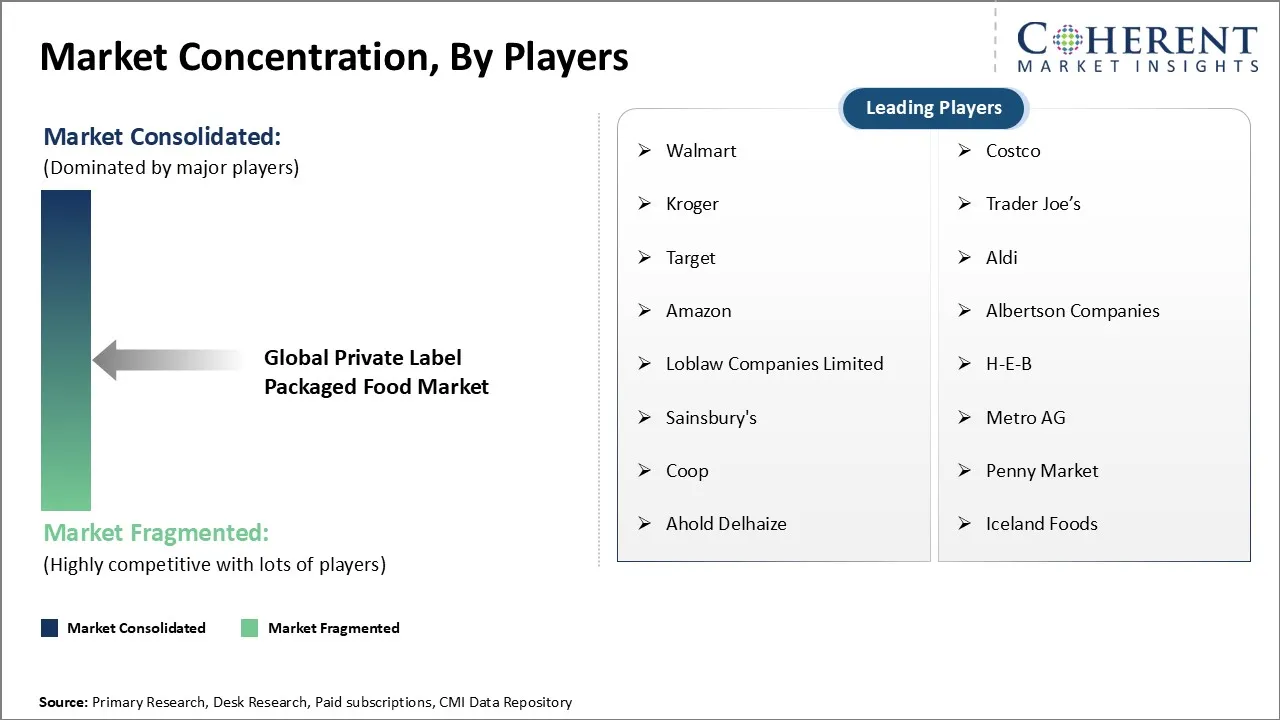
Key Developments
- In May 2024, Walmart launched its private-label food brand, Bettergoods, offering a range of products including frozen foods, dairy, snacks, beverages, pastas, soups, coffee, and chocolate.
- In May 2024, discount supermarket chain Aldi introduced a recyclable packaging for two of its private-label butter products, making it the first U.K. supermarket to do so.
Top Strategies Followed by Global Private Label Packaged Food Market Players
- Established market leaders invest heavily in research and development to continuously innovate high-performance products that meet evolving consumer demands. By integrating advanced food technologies and enhancing nutritional profiles, these companies are able to deliver differentiated offerings that stand out on retail shelves.
- For instance, Walmart's Great Value brand, expanded its R&D efforts to produce healthier versions of popular products, such as low-sodium canned foods and plant-based alternatives, meeting the increasing the demand for health-conscious foods.
- Mid-level players, while lacking the extensive resources of their larger counterparts, adopt pragmatic strategies centered on cost-effective product solutions that strike a balance between quality and affordability. Their primary target audience consists of price-sensitive consumers who seek value without compromising basic standards. To compete effectively, these players engage in collaborations with technology providers, co-packers, and regional distributors to enhance production efficiency and reduce operational costs.
- For example, Target's Archer Farms is a good example of a mid-scale player that has developed high-quality, affordable packaged foods like organic snacks and gluten-free products, catering to health-conscious yet budget-driven consumers. To remain competitive, mid-tier players engage in partnerships with technology providers, co-packers, and regional distributors.
- Small-scale players, including niche producers and startups, distinguish themselves by concentrating on specialized product features and innovation tailored to unique consumer preferences. Emphasizing attributes such as organic ingredients, clean labeling, or regional flavors, these companies leverage cutting-edge food technologies to develop novel products that cater to specific market segments often overlooked by larger competitors.
- For example, Thrive Market leverages organic, gluten-free, and sustainable ingredients to provide products with clean labeling to consumers interested in ethical food choices. Their strategic approach involves focusing on the direct-to-consumer model, which allows them to reduce overhead costs and build a loyal customer base through a subscription service.
Market Report Scope
Private Label Packaged Food Market Report Coverage
| Report Coverage | Details | ||
|---|---|---|---|
| Base Year: | 2025 | Market Size in 2026: | USD 447.71 Bn |
| Historical Data for: | 2020 To 2024 | Forecast Period: | 2026 To 2033 |
| Forecast Period 2026 to 2033 CAGR: | 6.0% | 2033 Value Projection: | USD 672.31 Bn |
| Geographies covered: |
| ||
| Segments covered: |
| ||
| Companies covered: | Walmart, Costco, Kroger, Trader Joe’s, Target, Aldi, Amazon, Albertson Companies, Loblaw Companies Limited, H-E-B, Sainsbury's, Metro AG, Coop, Penny Market, Ahold Delhaize, and Iceland Foods | ||
| Growth Drivers: |
| ||
| Restraints & Challenges: |
| ||
Private Label Packaged Food Market Dynamics
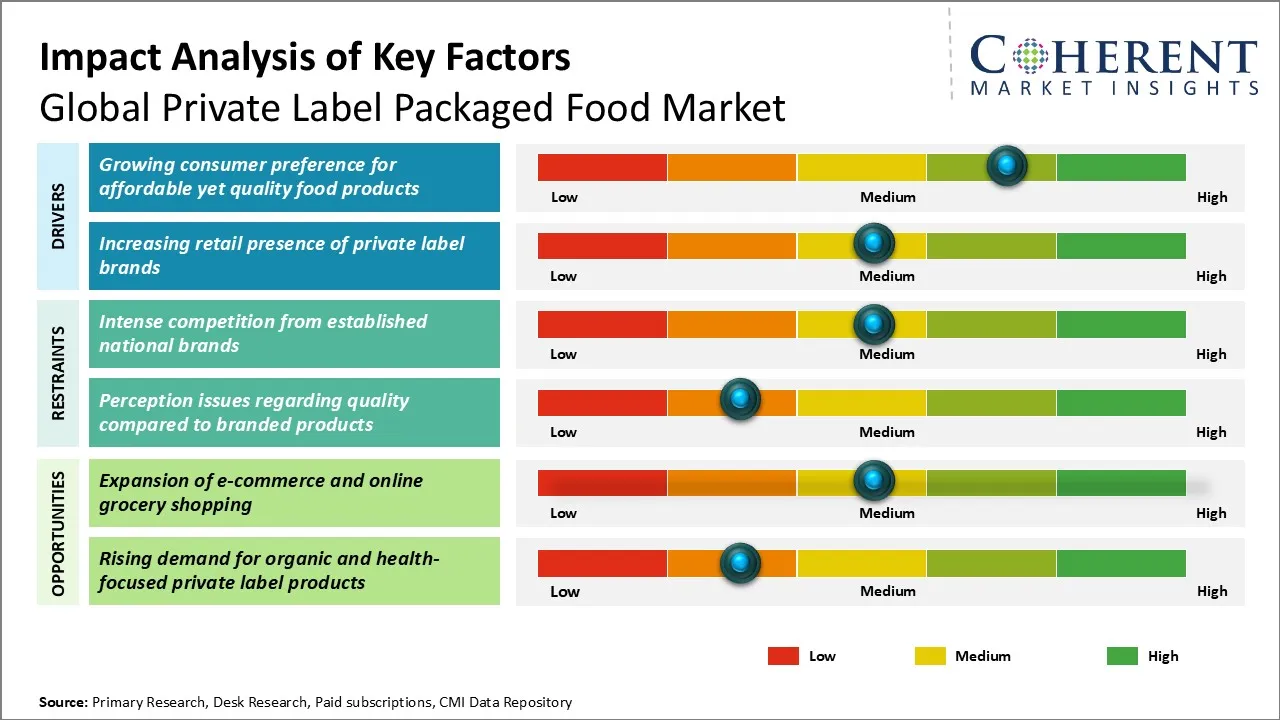
Private Label Packaged Food Market Driver - Growing Consumer Preference for Affordable Yet Quality Food Products
One of the primary factors driving the expansion of the global private label packaged food market is the increasing consumer demand for products that strike a balance between affordability and quality. As consumers become more budget-conscious without compromising on nutritional value and taste, private label brands have emerged as attractive alternatives to established national brands. Retailers are leveraging this trend by investing in the development of private label products that not only meet safety and quality standards but also offer competitive pricing, making them accessible to a wider demographic.
For example, Walmart, significantly invested in its private label range, Great Value, which includes food products that offer similar taste and quality to national brands but at a lower price point. This has been a key factor in the increasing popularity of private labels, particularly during economic downturns when consumers are more inclined to choose budget-friendly alternatives.
Private Label Packaged Food Market Opportunity - Expansion of E-commerce and Online Grocery Shopping
The rapid expansion of e-commerce and online grocery shopping presents a significant growth opportunity for the global private label packaged food market. Increasing internet penetration, smartphone adoption, and advancements in digital payment systems have transformed consumer purchasing behavior, making online platforms a preferred channel for grocery shopping. Private label brands benefit from this trend as e-commerce offers extensive shelf space and the ability to target niche consumer segments more effectively than traditional retail outlets. Additionally, the convenience of home delivery and subscription models encourages repeat purchases, fostering brand loyalty and higher sales volumes for private label packaged foods.
Instacart, allows private label brands to thrive in the online grocery space. The platform's partnership with retailers like Costco and Kroger has created a space for private label brands such as Kirkland Signature and Simple Truth to be prominently featured on its digital marketplace.
Analyst Opinion (Expert Opinion)
- The global private label packaged food market is witnessing remarkable growth, driven by shifting consumer preferences toward value and quality. Insights from the Private Label Manufacturers Association Conference (2023) and the Global Food Innovation Summit (2022) highlighted key trends, with retailers like Walmart and Aldi leading the charge in expanding their private label offerings.
- Walmart’s recent introduction of organic private label products demonstrates a strategic move to cater to health-conscious consumers, capitalizing on the rising the demand for clean-label foods. Discussions at these events emphasized the importance of quality and transparency in private label products, as consumers increasingly seek alternatives to national brands. However, challenges such as supply chain disruptions and increasing competition from established brands were noted as potential hurdles.
- Companies that prioritize innovation in product development and invest in branding will likely gain a competitive edge. Additionally, leveraging data analytics to understand consumer preferences can enhance product alignment with market demands. Ultimately, the private label packaged food market's trajectory will depend on its ability to innovate while effectively addressing consumer expectations for quality, sustainability, and value.
Speak to the analyst
Want personalized insights?
Take the findings above to one of our principal consultants, or have the report rebuilt around the segments, geographies and competitors you actually track.
Market Segmentation
- Product Type Insights (Revenue, USD Bn, 2021 - 2033)
- Dairy Products
- Frozen Foods
- Snacks
- Beverages
- Condiments & Sauces
- Others
- Distribution Channel Insights (Revenue, USD Bn, 2021 - 2033)
- Hypermarkets & Supermarkets
- Convenience Stores
- Online
- Others
- Regional Insights (Revenue, USD Bn, 2021 - 2033)
- North America
- U.S.
- Canada
- Latin America
- Brazil
- Argentina
- Mexico
- Rest of Latin America
- Europe
- Germany
- U.K.
- Spain
- France
- Italy
- Russia
- Rest of Europe
- Asia Pacific
- China
- India
- Japan
- Australia
- South Korea
- ASEAN
- Rest of Asia Pacific
- Middle East
- GCC Countries
- Israel
- Rest of Middle East
- Africa
- South Africa
- North Africa
- Central Africa
- North America
- Key Players Insights
- Walmart
- Costco
- Kroger
- Trader Joe’s
- Target
- Aldi
- Amazon
- Albertson Companies
- Loblaw Companies Limited
- H-E-B
- Sainsbury's
- Metro AG
- Coop
- Penny Market
- Ahold Delhaize
- Iceland Foods
Sources
Primary Research Interviews
- Retail Strategy Director – Leading Private Label Food Retailer
- Procurement Manager – Major Supermarket Chain
- Product Development Head – Leading Private Label Food Manufacturer
- Marketing Head – Top Private Label Brand in Packaged Food
- Supply Chain Manager – Large-Scale Private Label Distributor
Stakeholders
- Manufacturers
- Private Label Food Brands
- Private Label Retailers
- Private Label Food Product Suppliers
- E-commerce Platforms
- Distributors and Wholesalers
- Regulatory & Certification Bodies:
- Food and Drug Administration (FDA)
- European Food Safety Authority (EFSA)
- Food Standards Australia New Zealand (FSANZ)
Databases
- UN Comtrade Database
- India Import Export (EXIM) Database
Magazines
- Food & Drink International – Trends in Private Label Packaged Foods
- Private Label Manufacturer – Growth of Private Label Packaged Food Market
- Food Business News – Innovations in Private Label Packaging
- Packaged Food Business Journal – Developments in Private Label Categories
- Global Food Insights – Market Developments and Consumer Trends in Packaged Foods
Journals
- Journal of Food Science – Private Label Packaging and Marketing Trends
- Food Research International – Consumer Preferences in Packaged Foods
- Journal of Retailing – Retail Dynamics in Private Label Growth
- International Journal of Consumer Studies – Packaging Preferences in Private Label Foods
Newspapers
- The Financial Times – Market Growth in Private Label Packaged Foods
- The Guardian – Consumer Trends in Packaged Food Consumption
- Asia Pacific Food News – The Rise of Private Label Food in Asia
- European Nutrition News – Regulations and Policies Affecting Private Label Foods
- The New York Times – Impact of Private Label Trends on Consumer Spending
Associations
- Private Label Manufacturers Association (PLMA)
- National Grocers Association (NGA)
- European Federation of Food Banks (FEBA)
- Global Retailers Federation
- International Association for Food Protection (IAFP)
Public Domain Sources
- FDA – Guidelines for Food Safety and Packaged Food Regulations
- European Commission – Food Law and Packaged Food Standards
- World Health Organization (WHO) – Food Safety and Nutritional Guidelines
- OECD – Consumer Trends in Packaged Foods and Retail Insights
- Global Food Safety Initiative (GFSI) – Packaging Standards for Food Safety
Proprietary Elements
- CMI Data Analytics Tool, Proprietary CMI Existing Repository of information for last 8 years.
Get access to 250+ pages report
Every segment, forecast, competitor profile and data table behind the analysis above — available for instant download.
- ESOMAR Member
- ISO 9001:2015 Certified
- D-U-N-S Registered
- GDPR & CCPA Compliant
Missing comfort of reading report in your local language? Find your preferred language:
Transform your Strategy with Exclusive Trending Reports
Frequently Asked Questions
The global private label packaged food market is estimated to be valued at USD 447.71 Bn in 2026 and is expected to reach USD 672.31 Bn by 2033.
The CAGR of the global private label packaged food market is projected to be 6.0% from 2026 to 2033.
The major product categories in the global private label packaged food market include dairy, snacks, frozen foods, beverages, canned goods, and dry grocery items.
E-commerce is influencing the private label packaged food market by providing broader visibility, facilitating direct-to-consumer sales, and enabling retailers to target specific consumer segments through personalized promotions and subscription models.
Growing consumer preference for affordable yet quality food products and increasing retail presence of private label brands are the major factors driving the growth of the global private label packaged food market.
Intense competition from established national brands and perception issues regarding quality compared to branded products are the major factors hampering the growth of the global private label packaged food market.
In terms of product type, the dairy products segment is estimated to dominate the market revenue share in 2026.