

Patient Positioning Devices Market Size and Share Analysis - 2026 To 2033
The global patient positioning devices market size is estimated to reach USD 1,500.9 Mn in 2026 and is projected to grow at a compound annual growth rate (CAGR) of 4.8% during the forecast period (2026-2033), surpassing USD 2,085.9 Mn by 2033. This growth can be attributed to rising number of surgical procedures worldwide, increasing prevalence of chronic diseases, and continuous technological advancements in healthcare infrastructure.
Key Takeaways from the Patient Positioning Devices Market Report
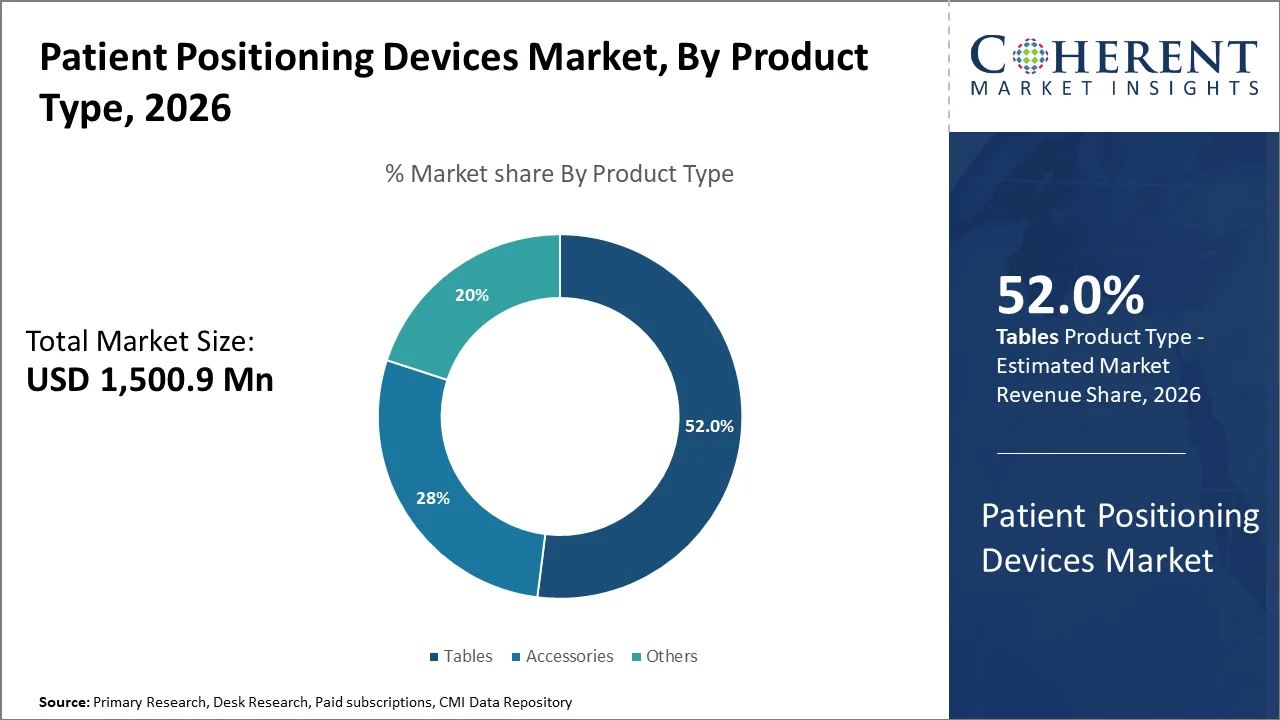
- Tables segment is expected to lead the market with a share of 52% in 2026 due to rising adoption in operating rooms, diagnostic imaging suites, and hybrid surgical environments. For instance, the CDC’s National Hospital Discharge Survey reported approximately 51.4 Mn inpatient procedures performed in the United States, highlighting the growing demand for advanced surgical tables that support patient stability, imaging compatibility, and precision during complex procedures.
- Surgeries segment is slated to account for the largest market share of 56% in 2026 owing to rising orthopedic, cardiovascular, neurological, and minimally invasive procedures worldwide. For example, the World Health Organization estimates that more than 313 Mn surgical procedures are performed globally each year, showing the growing demand for advanced patient positioning systems that improve surgical access as well as enhance patient stability and procedural safety.
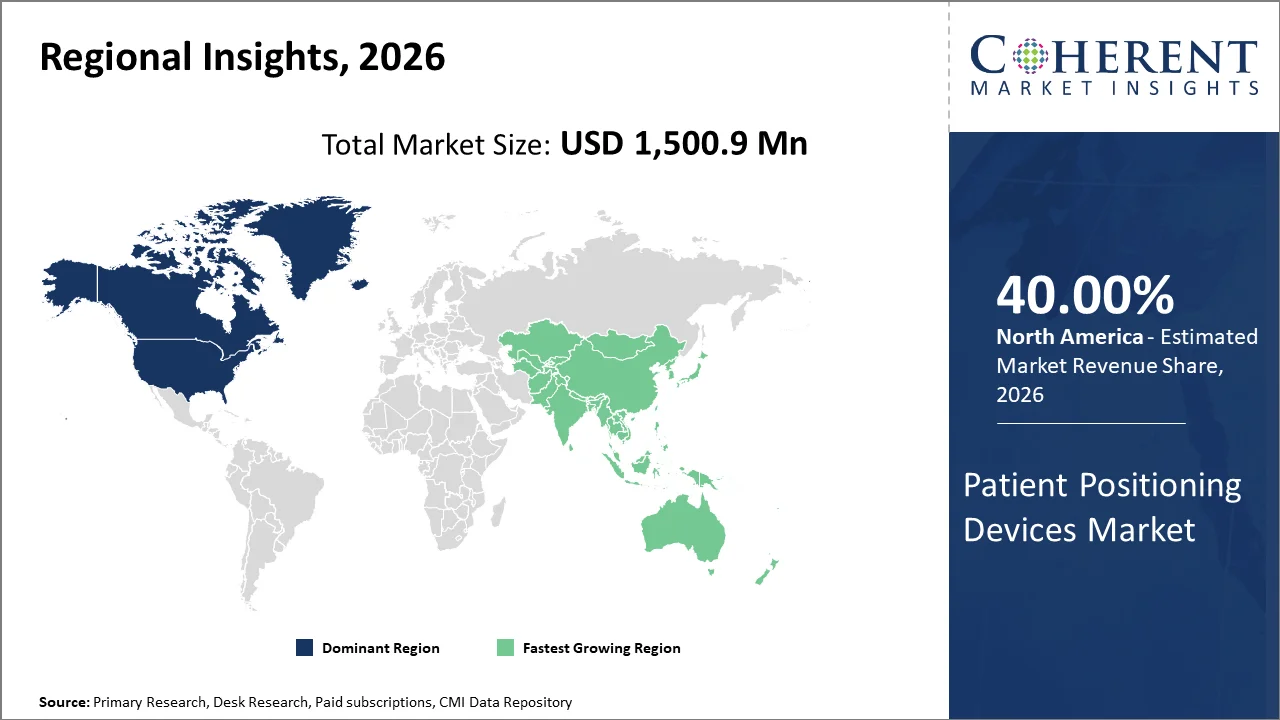
- North America is projected to dominate the global patient positioning devices industry with a share of 40% in 2026, mostly due to rising adoption of technologically advanced positioning systems, higher healthcare expenditure, and large procedural volumes. For instance, the Centers for Medicare & Medicaid Services (CMS) reported that U.S. healthcare expenditure increased to approximately USD 5.3 trillion in 2024, accounting for nearly 18.0% of the country’s GDP, highlighting substantial investments in advanced operating room technologies and hospital equipment.
- Asia Pacific, capturing a share of 25% in 2026, is poised to emerge as the fastest growing market for patient positioning devices during the forecast period, thanks to expanding healthcare infrastructure, rising prevalence of chronic diseases, and increasing investments in advanced surgical and diagnostic technologies.
Patient Positioning Devices Market Overview
The global patient positioning devices market is poised to register steady growth during the forecast period. This is primarily due to rising prevalence of chronic diseases, increasing number of surgical procedures, growing demand for advanced diagnostic imaging, and expansion of healthcare infrastructure.
Patient positioning devices are used in various surgical and diagnostic procedures to ensure patient safety and provide surgeons with easy access to the area of operation. The choice of surgical positioning devices largely depends on the type of surgery being performed. Proper patient positioning in the operating room is important in order to provide the best possible care and prevent complications such as nerve damage and pressure ulcers.
Increasing prevalence of chronic diseases and technological advancements in patient positioning equipment are expected to drive the growth of the global patient positioning devices market. In addition, growing geriatric population and rising focus on patient safety, comfort, and precision during medical procedures are also driving adoption of patient positioning devices across hospitals, ambulatory surgical centers, and diagnostic facilities.
According to the This expanding geriatric population is expected to increase the need for operating tables, supports, and immobilization devices during the forthcoming period.
Growing emphasis on ergonomic design is supporting the growth of the patient positioning device market. Manufacturers are increasingly developing solutions that enhance patient comfort while also reducing physical strain on healthcare providers, thereby improving safety and workflow efficiency in clinical and surgical environments.
Similarly, rising emphasis on patient safety and reduced complications is fueling demand for patient positioning devices. Improper positioning can cause pressure ulcers, nerve injuries, and post-operative complications. As a result, hospitals are increasingly investing in advanced systems to improve outcomes and reduce liability risks.
Expansion of minimally invasive and precision surgeries are also positively impacting sales of patient positioning device sales. Modern healthcare is shifting toward minimally invasive surgery (MIS), robotic-assisted procedures, and image-guided interventions. These require high-precision patient alignment, increasing reliance on advanced positioning devices.
Segmental Insights
Which Product Type Leads the Patient Positioning Devices Market?
Tables Lead the Market with More Than Half of the Market Revenue Share in 2026
According to Coherent Market Insights’ latest patient positioning devices market analysis, tables segment is projected to lead with a share of 52% in 2026. This is attributable to growing number of surgical procedures worldwide and rising demand for advanced operating tables that improve patient safety, comfort, and surgical precision.
Hospitals and ambulatory surgical centers are increasingly adopting electrically powered and imaging-compatible positioning tables to support minimally invasive surgeries and complex diagnostic procedures. In addition, technological advancements such as automated adjustment systems, radiolucent tabletops, and integrated pressure management features are also driving demand for patient positioning tables across healthcare facilities.
Leading manufacturers of patient positioning devices are introducing advanced solutions to capitalize on emerging opportunities as well as meet end user demand for hospital tables. For example, Getinge launched the Maquet Corin operating table for modern surgical environments.
- Current Industry Events of 2026
- Market Size Estimation
- Regional Breakdown
- Competitive Landscape
- Customer Intelligence
- Segmental Analysis
- Pricing Analysis
- Key Market Drivers, Challenges & Future Trends
- Customized Insights Section
Which Application Holds the Largest Share in the Patient Positioning Devices Market?
Surgeries Segment Remains the Leading Application
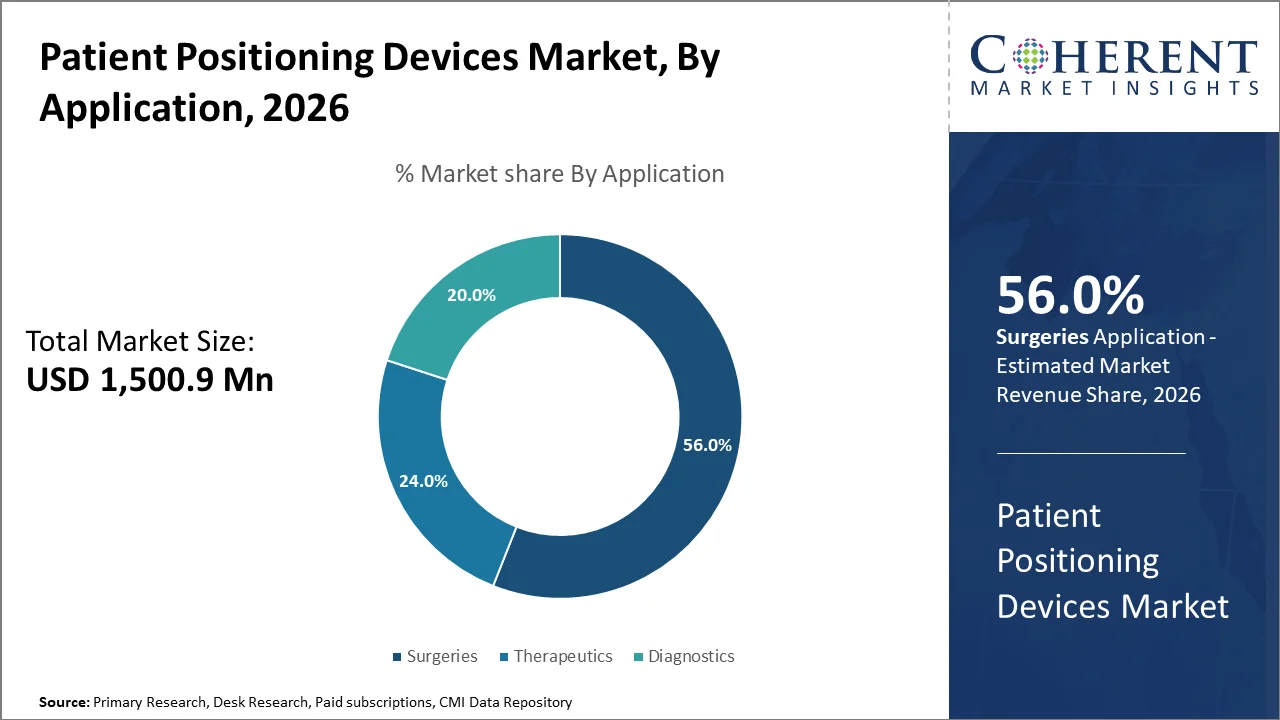
Surgeries segment is anticipated to account for a prominent market revenue share of 56% in 2026. This is mostly due to growing volume of surgical procedures across the world and rising demand for accurate patient alignment and stability during complex operations. Patient positioning devices play a key role in improving surgical access, minimizing intraoperative movement, and reducing the risk of complications. This has significantly increased their adoption across hospitals and ambulatory surgical centers.
In addition, advancements in minimally invasive and image-guided surgeries, especially in orthopedics, neurosurgery, and cardiovascular procedure, are increasing the need for specialized positioning systems. Similarly, growing emphasis on patient safety standards and adoption of advanced operating room technologies are also supporting growth of surgeries segment in the market.
Patient Positioning Devices Market Growth Drivers
Rising Number of Surgical Procedures
Increasing volume of surgical procedures across orthopaedics, cardiology, oncology, neurosurgery, and general surgery is providing a strong impetus for the growth of the patient positioning devices market. According to widely cited WHO-backed estimates based on global surgical studies, more than 313 million surgical procedures are performed globally each year. Every procedure requires precise patient positioning to ensure surgical accuracy, safety, and optimal outcomes, which directly drives the demand for patient positioning devices and systems.
Patient Positioning Devices Market Opportunities
Increasing Burden of Chronic Diseases
Rising prevalence of chronic conditions such as cancer, cardiovascular diseases, and musculoskeletal disorders is creating lucrative growth opportunities for the patient positioning devices market. These conditions often lead to higher diagnostic imaging and surgical volumes, both of which rely on precise positioning systems. Thus, increasing cases of chronic diseases are expected to boost the demand for patient positioning devices during the forecast period.
Patient Positioning Devices Market Trends
Rise of Advanced and Motorized Positioning Systems
Manual positioning systems in the contemporary world are gradually being supplemented by motorized, ergonomic, and multi-functional operating tables that enhance precision, patient safety, and workflow efficiency. This shift toward advanced patient positioning systems is expected to support market revenue growth in the coming years.
For example, in March 2024, Getinge launched the Maquet Corin operating table, designed for modern surgical environments. The system features motorized positioning, programmable surgical presets, and integrated safety and workflow optimization functions, reflecting the broader industry shift toward smart, digitally controlled patient positioning systems in operating rooms.
Patient Positioning Devices Market Innovations
Adoption of Robotics and Digital Technologies
Product innovation is taking center stage in the patient positioning systems market. Leading patient positioning device manufacturers are increasingly integrating robotics, digital controls, and smart operating room (OR) technologies into advanced positioning systems. These solutions may include automated positioning features, AI-assisted alignment, and connectivity with integrated OR systems to enhance surgical precision and workflow efficiency. Rising adoption of these advanced technologies is expected to boost growth of the patient positioning devices market during the forecast period.
Current Events and Their Impact on the Patient Positioning Devices Market
Current Event | Description and its Impact |
Increase in Global Surgical Procedures |
|
Expansion of Robotic-Assisted Surgeries in Hospitals |
|
Regional Insights
North America Remains at the Epicenter of Patient Positioning Devices Market Growth
North America is expected to retain its dominance over the global patient positioning devices market during the forecast period, capturing a share of 40% in 2026. This can be attributed to strong hospital infrastructure, high surgical volumes, and rapid adoption of advanced operating room technologies such as motorized and imaging-compatible positioning systems.
Rising number of surgical procedures linked to chronic diseases and age-related conditions is boosting North American patient positioning devices market. Surgical procedures require precise and ergonomic patient positioning to ensure accuracy and patient safety, thereby increasing demand for advanced positioning solutions.
According to the U.S. Census Bureau, the population aged 65 years and older is projected to reach about 82 million by 2050. This, in turn, is expected to increase the need for surgical care and advanced hospital equipment, thereby supporting market growth.
Asia Pacific to Emerge as Central Hub for Patient Positioning Device Manufacturers
Asia Pacific is anticipated to emerge as a hotbed for manufacturers of patient positioning devices during the forecast period, holding a share of 25% in 2026. This is mostly due to rapid healthcare infrastructure expansion, increasing hospital admissions, and rising surgical procedures in countries like China and India.
Rising burden of chronic diseases such as cardiovascular disorders and diabetes is boosting Asia Pacific patient positioning devices market values. Noncommunicable diseases account for around two-thirds of all deaths in the WHO South-East Asia Region, according to the World Health Organization. This, in turn, creates need for improved surgical and diagnostic care infrastructure that supports demand for patient positioning devices.
Patient Positioning Devices Market Outlook – Country-wise
U.S. Patient Positioning Devices Market Trends
The United States is expected to remain a leading market for patient positioning devices during the forecast period. This is mostly due to advanced healthcare infrastructure, increasing surgical volumes, and rapid adoption of robotic-assisted and image-guided surgical systems. Similarly, rising demand for minimally invasive procedures, continuous upgrades in operating room (OR) infrastructure, and growing integration of AI-enabled surgical navigation systems that require highly precise and adaptable patient positioning solutions are supporting market expansion.
Rising number of chronic disease-related surgeries and diagnostic procedures, which require precise patient positioning for better clinical outcomes, is boosting market growth in the nation. Nearly 3 in 4 U.S. adults are living with at least one chronic condition, according to CDC-backed estimates. This, in turn, is increasing the need for surgical and hospital-based interventions where advanced positioning systems are widely used.
China Patient Positioning Devices Market Forecast
The patient positioning devices market in China is expected to grow steadily during the assessment period. This can be attributed to rapid expansion of healthcare infrastructure, increasing hospital admissions, and rising demand for advanced surgical care. In addition, increasing investments by hospitals in hybrid operating rooms and rising focus on patient safety and surgical efficiency are also increasing adoption of advanced patient positioning devices across healthcare facilities in China.
Who are the Major Companies in the Patient Positioning Devices Market?
Some of the major players in Patient Positioning Devices Market are Alvo, Civco Radiotherapy, C-Rad, Dexta, Eschmann Equipment, Elekta AB, Getinge AB, GE Healthcare, Hill-Rom, Inc., Innovative Medical Products, Inc., Leoni AG, Merivaara Corp., Medifa-Hesse GmbH & Co. Kg, Mizuho OSI, Opt Surgisystems S.R.L, Mediland Enterprise Corporation, Schuremed, Smith & Nephew PLC, Span America Medical Systems, Inc., Steris PLC, Stryker Corporation, Skytron, and Xodus Medical Inc.
Key Strategies Adopted by Industry Players
Top patient positioning devices companies are adopting various organic and inorganic strategies to boost their revenue as well as gain a competitive edge over the industry. These include product innovation, development of ergonomically advanced and radiolucent positioning systems, and integration of imaging-compatible and AI-assisted positioning technologies. They are also adopting strategies like collaborations, mergers and acquisitions, and facility expansions to strengthen their market presence and competitiveness.
- In April 2026, Xodus Medical launched the Hot Pink Pad after receiving FDA 510(k) clearance. It is a dual-function patient temperature management and positioning system designed to support surgical workflows, enhance patient safety, and improve perioperative efficiency.
- In March 2026, Smith+Nephew presented its latest orthopaedic technologies at the AAOS 2026 Annual Meeting. The company showcased handheld robotics along with its reconstruction and trauma solutions.
- In 2026, Xodus Medical promoted the Freeman Arm Positioner for use in surgical procedures. The device is designed to make arm positioning easier and more stable for patients during surgery.
Market Report Scope
Patient Positioning Devices Market Report Coverage
| Report Coverage | Details | ||
|---|---|---|---|
| Base Year: | 2025 | Market Size in 2026: | USD 1,500.9 Mn |
| Historical Data for: | 2020 To 2024 | Forecast Period: | 2026 To 2033 |
| Forecast Period 2026 to 2033 CAGR: | 4.8% | 2033 Value Projection: | USD 2,085.9 Mn |
| Geographies covered: |
| ||
| Segments covered: |
| ||
| Companies covered: | Alvo, Civco Radiotherapy, C-Rad, Dexta, Eschmann Equipment, Elekta AB, Getinge AB, GE Healthcare, Hill-Rom, Inc., Innovative Medical Products, Inc., Leoni AG, Merivaara Corp., Medifa-Hesse GmbH & Co. Kg, Mizuho OSI, Opt Surgisystems S.R.L, Mediland Enterprise Corporation, Schuremed, Smith & Nephew PLC, Span America Medical Systems, Inc., Steris PLC, Stryker Corporation, Skytron, and Xodus Medical Inc. | ||
| Growth Drivers: |
| ||
| Restraints & Challenges: |
| ||
Analyst Opinion (Expert Opinion)
- The global patient positioning devices industry is growing steadily mostly due to continuous rise in surgical and diagnostic procedures worldwide. Patient positioning devices are essential in operating rooms to ensure correct alignment, improve surgical precision, and reduce procedural complications, especially in orthopedics, neurology, and minimally invasive surgeries.
- Aging populations are significantly increasing patient positioning device demand, as elderly patients are more likely to require surgeries and imaging procedures. This is especially relevant in hospitals and ambulatory surgical centers where repeated positioning support is needed for safe and efficient care delivery.
- Over 300 million major surgeries are performed globally each year, highlighting the large procedural base that directly drives demand for patient positioning equipment used in operating rooms.
- Technological improvements such as motorized surgical tables, radiolucent materials, and MRI/CT-compatible positioning systems are enhancing procedural accuracy and reducing patient risk, supporting broader adoption in advanced healthcare systems.
Speak to the analyst
Want personalized insights?
Take the findings above to one of our principal consultants, or have the report rebuilt around the segments, geographies and competitors you actually track.
Market Segmentation
- By Product Type Insights ( Revenue, USD Mn, 2021 - 2033)
- Table
- Accessories
- Others
- By Application Insights ( Revenue, USD Mn, 2021 - 2033)
- Surgeries
- Therapeutics
- Diagnostics
- By End User Insights ( Revenue, USD Mn, 2021 - 2033)
- Hospital
- Diagnostic Laboratories
- Ambulatory Surgical Centers
- Others
- By Region Insights ( Revenue, USD Mn, 2021 - 2033)
- North America
- U.S.
- Canada
- Latin America
- Brazil
- Argentina
- Mexico
- Rest of Latin America
- Europe
- Germany
- U.K.
- Spain
- France
- Italy
- Russia
- Rest of Europe
- Asia Pacific
- China
- India
- Japan
- Australia
- South Korea
- ASEAN
- Rest of Asia Pacific
- Middle East
- GCC Countries
- Israel
- Rest of Middle East
- Africa
- South Africa
- North Africa
- Central Africa
- North America
Sources
Primary Research interviews
- Orthopedic surgeons, neurosurgeons, and general surgeons across tertiary care hospitals
- Operation theatre (OT) nurses and surgical technologists
- Hospital procurement managers and biomedical engineering departments
- Medical device distributors and hospital supply chain specialists
- Anesthesiologists involved in surgical positioning practices
Databases
- PubMed (National Library of Medicine)
- National Institutes of Health (NIH) Database
- World Health Organization (WHO) Global Health Observatory
- World Bank Health Data Repository
- OECD Health Statistics Database
- U.S. Food and Drug Administration (FDA) Device Database
- European Medicines Agency (EMA) Medical Device Information Portal
Magazines
- Medical Device & Diagnostic Industry (MD+DI) Magazine
- MedTech Outlook
- Medical Device Network (Industry News Section)
- Health Management Technology Magazine
- OR Today (Operating Room Today)
Journals
- The Lancet
- The BMJ (British Medical Journal)
- Journal of Medical Devices (ASME)
- Anesthesiology Journal (American Society of Anesthesiologists)
- Journal of Clinical Anesthesia
- International Journal of Surgery
Newspapers
- Reuters Health News
- The New York Times (Health Section)
- The Guardian (Healthcare Coverage)
- The Washington Post (Health & Science Section)
- The Economic Times (India – Healthcare Section)
Associations
- World Health Organization (WHO)
- American College of Surgeons (ACS)
- Association for the Advancement of Medical Instrumentation (AAMI)
- International Federation of Biomedical Engineering (IFMBE)
- International Society for Quality in Health Care (ISQua)
- ISO (International Organization for Standardization – Medical Device Standards Division)
Public Domain sources
- WHO Global Health Reports and Surgical Safety Guidelines
- CDC (Centers for Disease Control and Prevention) Surgical Safety and Infection Control Data
- World Bank Open Data (Healthcare Infrastructure Indicators)
- NIH Open Access Publications
- Government health ministry publications (India, US, EU member states)
- FDA publicly accessible device approval and recall records
Proprietary Elements
- CMI Data Analytics Tool
- Proprietary CMI Existing Repository of information for last 10 years
Get access to 250+ pages report
Every segment, forecast, competitor profile and data table behind the analysis above — available for instant download.
- ESOMAR Member
- ISO 9001:2015 Certified
- D-U-N-S Registered
- GDPR & CCPA Compliant
Missing comfort of reading report in your local language? Find your preferred language:
Transform your Strategy with Exclusive Trending Reports
Frequently Asked Questions
The global Patient Positioning Devices Market is estimated to be valued at USD 1,500.9 Mn in 2026.
The global Patient Positioning Devices Market value is expected to reach USD 2,085.9 Mn by 2033.
The global market is poised to exhibit a CAGR of 4.8% from 2026 to 2033.
Major growth factors include rising prevalence of chronic diseases, increasing number of surgeries, and expanding healthcare infrastructure globally.
Table segment is set to lead the market with a share of 52% in 2026.
Some major companies in the Patient Positioning Devices Market include Alvo, Civco Radiotherapy, C-Rad, Dexta, Eschmann Equipment, Elekta AB, Getinge AB, GE Healthcare, Hill-Rom, Inc., Innovative Medical Products, Inc., Leoni AG, Merivaara Corp., Medifa-Hesse GmbH & Co. Kg, Mizuho OSI, Opt Surgisystems S.R.L, Mediland Enterprise Corporation, Schuremed, Smith & Nephew PLC, Span America Medical Systems, Inc., Steris PLC, Stryker Corporation, Skytron, and Xodus Medical Inc.
North America, with 40% share in 2026, is set to lead the market during the forecast period.