

Pediatric Electrolyte Solution Market Size and Share Analysis: (2026 - 2033)
The global pediatric electrolyte solution market is estimated to be valued at USD 1,482 Mn in 2026 and is projected to reach USD 2,390 Mn by 2033, registering a compound annual growth rate (CAGR) of 6.8% during the forecast period (2026-2033). This growth can be attributed to increasing cases of pediatric dehydration and growing adoption of oral rehydration therapy (ORT). According to an article published by the National Library of Medicine, dehydration is a major global contributor to illness and death in children. Diarrheal diseases and resulting dehydration account for approximately 14% to 30% of deaths among infants and young children worldwide.
Key Takeaways from the Pediatric Electrolyte Solution Market Report
- Sodium segment is expected to lead the market with a share of more than 35% in 2026, supported by its essential role in ORS-based pediatric dehydration therapy.
- By route of administration, oral segment is slated to account for a prominent market share of 80% as oral rehydration therapy is the WHO-recommended first-line treatment for pediatric dehydration and is preferred due to its low cost, safety, and ease of home administration. ORS is preferred because it is simple, safe, and home-administered.
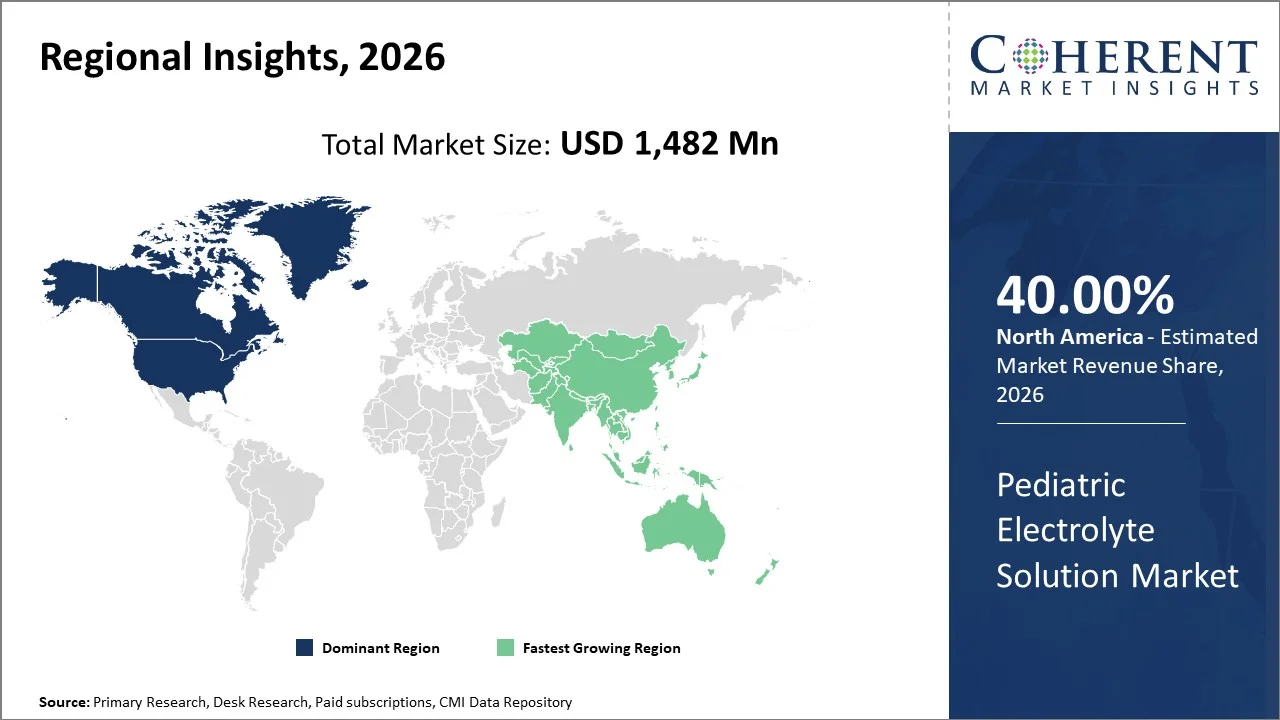
- North America is projected to retain its dominance over the global pediatric electrolyte solution industry with a share of 40% in 2026, driven by a well-established healthcare infrastructure, high awareness of oral rehydration therapy (ORT), strong presence of leading pharmaceutical manufacturers, and widespread availability of pediatric electrolyte products across hospital and retail pharmacy channels.
- Asia Pacific, accounting for a 32% share in 2026, is projected to emerge as the fastest-growing market for pediatric electrolyte solutions during the forecast period, owing to a large pediatric population, rising incidence of diarrhea-induced dehydration, and increasing government-led ORS adoption initiatives across nations like India, China, Pakistan, and Bangladesh. For example, about 61% of children under five with diarrhea in India receive ORS (packets or pre-packaged fluids), according to
Pediatric Electrolyte Solution Market Overview
The global pediatric electrolyte solution market is poised to exhibit steady growth over the forecast period. This is due to rising prevalence of pediatric diarrhea and gastrointestinal disorders, increasing cases of dehydration among infants and children, and growing awareness among parents and healthcare professionals regarding timely rehydration therapy.
Improving access to over-the-counter oral rehydration solutions and expanding pediatric healthcare infrastructure in emerging economies are also boosting pediatric electrolyte solution market growth. Similarly, introduction of better-tasting, low-osmolarity formulations is supporting market expansion.
Pediatric electrolyte solution, also known as oral rehydration solution (ORS), is used to manage dehydration caused by diarrhea and vomiting. The solution contains a balanced mixture of water, salts, and glucose, which helps replace fluids and electrolytes lost from the body. It also enhances water absorption in the intestines, helping prevent and treat dehydration.
Increasing global burden of diarrheal diseases is providing a strong impetus for the growth of pediatric electrolyte solution market. According to recent estimates by the
Moreover, increasing hospital admissions due to seasonal infections, such as rotavirus and viral gastroenteritis, are expected to drive demand for pediatric electrolyte solutions over the forecast period. In addition, government-led child health initiatives and WHO-recommended oral rehydration therapy (ORT) programs are also positively impacting pediatric electrolyte solution sales.
Segmental Insights
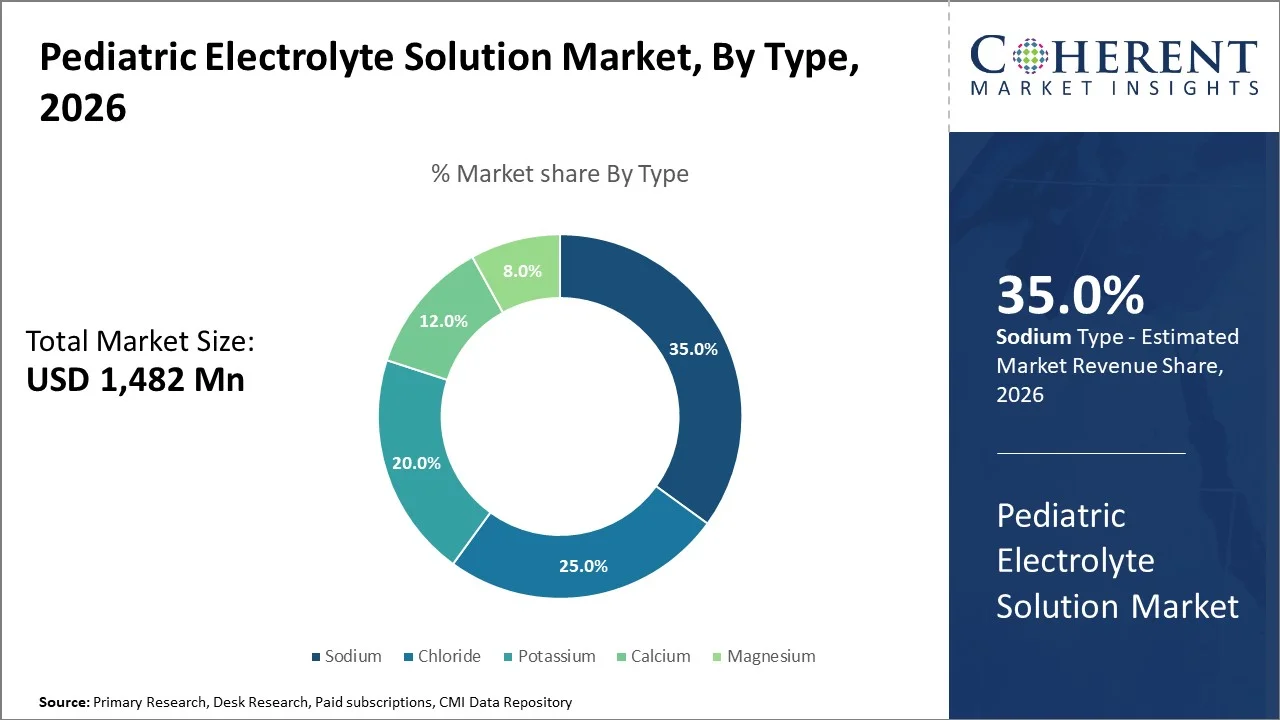
Which Pediatric Electrolyte Solution Type Leads the Global Market?
Sodium-Based Formulations Account for the Largest Share of Demand
According to Coherent Market Insights’ latest pediatric electrolyte solution market analysis, sodium segment is set to hold the largest market share of over 35% in 2026. This dominance is primarily attributed to sodium’s essential role in maintaining fluid balance, preventing dehydration, and restoring electrolyte levels in children suffering from diarrhea, vomiting, or fever-related fluid loss.
Sodium-based pediatric electrolyte solutions are widely recommended by healthcare professionals because sodium is the primary electrolyte lost during dehydration episodes. These formulations help in efficient rehydration by promoting water absorption in the intestines through sodium-glucose co-transport mechanisms. As a result, they are considered a first-line treatment in oral rehydration therapy (ORT).
- Current Industry Events of 2026
- Market Size Estimation
- Regional Breakdown
- Competitive Landscape
- Customer Intelligence
- Segmental Analysis
- Pricing Analysis
- Key Market Drivers, Challenges & Future Trends
- Customized Insights Section
What Drives the Dominance of Oral Pediatric Electrolyte Solutions?
Convenience and Low Cost Make Oral Electrolyte Solutions the Preferred Choice
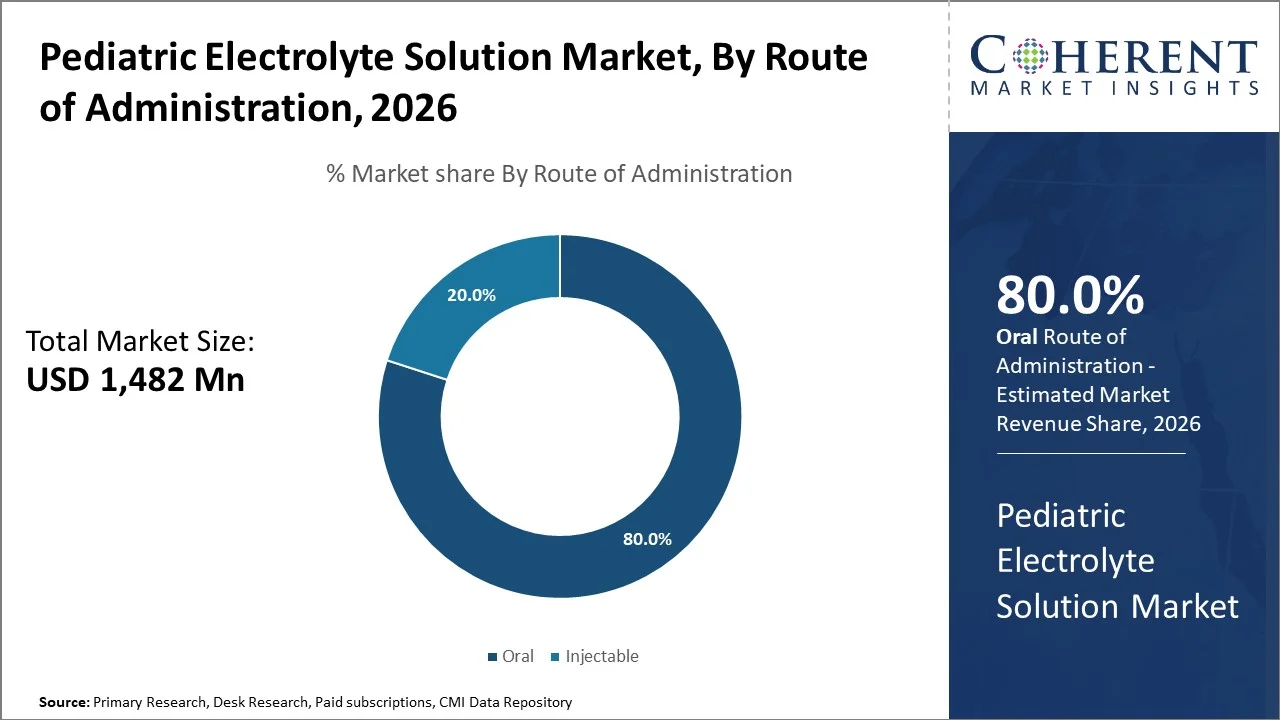
Based on route of administration, oral segment is expected to account for the largest market share of 80% in 2026. This is due to its ease of administration, especially for home-based treatment of mild to moderate dehydration caused by diarrhea, vomiting, and fever in children.
Oral pediatric electrolyte solutions do not require medical supervision, making them highly accessible for parents and caregivers in both urban and rural settings. Their low cost compared to intravenous (IV) therapy also fuels their adoption, especially in low- and middle-income regions where healthcare affordability is a key concern.
In addition, oral rehydration solutions (ORS) are widely recommended by global health organizations such as the WHO and UNICEF as the first-line treatment for pediatric dehydration. ORS is effective in managing over 90% of cases of mild to moderate dehydration, significantly reducing the need for IV intervention as well as reinforcing the dominance of the oral segment.
Pediatric Electrolyte Solution Market Growth Drivers
Rising Incidence of Pediatric Dehydration: Increasing prevalence of diarrhea, vomiting, fever, and gastrointestinal infections in children is expected to fuel growth of pediatric electrolyte solutions during the forthcoming period. This is because these conditions often lead to rapid fluid and electrolyte loss. They are especially common in infants and toddlers.
Diarrheal diseases remain a major global health concern in children. According to the This is expected to drive demand for oral rehydration and electrolyte solutions continue in the coming years.
Pediatric Electrolyte Solution Market Opportunities
Growing Awareness of Oral Rehydration Therapy (ORT): Rising awareness of Oral Rehydration Therapy (ORT) is expected to create lucrative growth opportunities for pediatric electrolyte solution manufacturers during the forecast period. Parents and caregivers are increasingly recognizing that early use of electrolyte solutions can help prevent complications and reduce the need for hospitalization.
This is also driving overall pediatric electrolyte solution market demand. As awareness and accessibility improve, demand for pediatric electrolyte solutions is expected to grow steadily, creating strong opportunities for manufacturers. As awareness and accessibility improve, demand for pediatric electrolyte solutions is expected to grow steadily, creating strong opportunities for manufacturers.
Growth in Home Healthcare and Self-care Treatment: There is a rising shift from hospital-based care to home healthcare due to convenience for parents, lower healthcare costs, and the easy availability of OTC electrolyte solutions. This is expected to boost demand for pediatric electrolyte solutions, especially through retail and online sales channels, during the forthcoming period.
Pediatric Electrolyte Solution Market Trends
Shift Towards Improved Taste and Child-Friendly Formulations: Rising preference for more palatable products is a key growth-shaping trend in the pediatric electrolyte solution market. Leading companies are focusing on developing better flavors to enhance compliance among children, reducing bitterness, and introducing sugar-balanced formulations. These innovations improve treatment adherence and are expected to support overall market growth for pediatric electrolyte solutions.
Pediatric Electrolyte Solution Market Innovations
Rise of Clean-label and Natural Ingredient Formulations
Patients in the contemporary world are showing a strong preference towards natural and organic electrolyte solutions. This shift is triggering innovation in the pediatric electrolyte solutions industry, prompting companies to develop clean-label pediatric oral rehydration solutions free from artificial colors and synthetic preservatives.
Similarly, ready-to-drink (RTD) electrolyte solutions like pre-mixed liquid solutions and ready-to-use bottles are becoming popular across the world. This is due to their convenience, ease of administration, and portability. In addition, companies are increasingly using eco-friendly and biodegradable packaging solutions to improve sustainability as well as woo more eco-conscious customers.
For example, in January 2025, This launch marked a strategic shift from traditional ORS sachets toward ready-to-drink pediatric-friendly electrolyte solutions, improving ease of use, portability, and rapid administration
Current Events and Their Impact on the Pediatric Electrolyte Solution Market
Current Event | Description and its Impact |
WHO/UNICEF reinforcement of ORS as first-line treatment amid rising child dehydration burden (2025–2026) |
|
India regulatory crackdown on mislabelled “ORS-like” electrolyte drinks (2025–2026) |
|
Regional Insights
High Gastroenteritis Burden and Strong Clinical Protocols Support North America’s Leadership
North America is projected to dominate the global pediatric electrolyte solution market with a 40% share in 2026. This can be attributed to strong clinical adoption of oral rehydration solutions (ORS), high awareness among caregivers, and well-established hospital and pharmacy distribution networks.
The region also benefits from structured pediatric care guidelines where ORS is routinely recommended for mild to moderate dehydration cases. In addition, rising cases of acute gastroenteritis and increased use of electrolyte solutions in both hospital and home-care settings are boosting North America pediatric electrolyte solution market growth.
According to the This, in turn, is expected to boost ORS consumption across pediatric and adult populations. Furthermore, North America accounts for a major share of ORS usage in clinical settings due to standardized treatment protocols and high healthcare accessibility.
High Disease Burden and Government Health Programs Boosting Sales in Asia Pacific
Asia Pacific is forecast to emerge as the fastest-growing pediatric electrolyte solution market, accounting for a global market share of 32% in 2026. This is mainly due to increasing incidence of diarrheal diseases, large pediatric population base, and strong government-backed oral rehydration therapy (ORT) initiatives. Expanding rural healthcare access, NGO-led child health programs, and increasing availability of low-cost ORS sachets are also boosting Asia Pacific pediatric electrolyte solution market.
According to global health estimates, diarrheal diseases still cause around 525,000 deaths annually in children under five, making ORS a critical first-line treatment in developing economies across Asia Pacific. WHO continues to recommend ORS as the primary therapy for childhood dehydration, which has led to large-scale adoption programs in countries such as India, China, and Indonesia.
Pediatric Electrolyte Solution Market Outlook – Country-wise
U.S. Pediatric Electrolyte Solution Market Trends
The United States remains a leading market for pediatric electrolyte solutions. This is mostly due to growing incidence of acute gastroenteritis in children, strong clinical reliance on oral rehydration therapy (ORT), and widespread availability of electrolyte products across retail pharmacies and healthcare facilities. The country’s well-developed healthcare system ensures early intervention for pediatric dehydration cases, where ORS-based solutions are commonly recommended as first-line treatment.
China Pediatric Electrolyte Solution Market Forecast
China’s pediatric electrolyte solution market is expected to grow steadily during the assessment period. This can be attributed to a large pediatric population base, high prevalence of infectious diarrhea, and expanding access to primary healthcare services. Government-led public health initiatives and improvements in rural healthcare infrastructure have significantly increased the availability of oral rehydration solutions in community health centers and hospitals.
Who are the Major Companies in the Pediatric Electrolyte Solution Market?
Some of the major players in Pediatric Electrolyte Solution Market are Mead Johnson, Abbott, Johnson and Johnson Services Inc., Otsuka Pharmaceutical Co., Ltd., Pendopharma, McKesson Medical-Surgical Inc., Good Sense (Perrigo Company plc), KINDERLYTE, Suero Oral Inc., and SOS Hydration.
Key Strategies Adopted by Industry Players
Leading manufacturers of pediatric electrolyte solutions are adopting various organic and inorganic strategies to strengthen their position as well as boost their sales. They are increasingly investing in advanced formulation development, including improved taste profiles, reduced sugar content, and enhanced electrolyte balance to improve child compliance and clinical effectiveness. For instance, several players are introducing flavored and ready-to-drink ORS variants to increase acceptance among infants and children.
Latest Developments in Pediatric Electrolyte Solution Market
- In January 2025, Kenvue, the company behind ORSL electrolyte drinks, launched a WHO-recommended Oral Rehydration Solution (ORS) in a ready-to-drink form to treat dehydration caused by diarrhea. The product follows WHO guidelines and is promoted as a science-based hydration solution.
- In September 2024, Otsuka Pharmaceutical Factory announced an additional OS-1 Jelly product (Apple Flavor). The jelly is an oral rehydration solution designed to help manage dehydration.
Market Report Scope
Pediatric Electrolyte Solution Market Report Coverage
| Report Coverage | Details | ||
|---|---|---|---|
| Base Year: | 2025 | Market Size in 2026: | USD 1,482 Mn |
| Historical Data for: | 2020 To 2024 | Forecast Period: | 2026 To 2033 |
| Forecast Period 2026 to 2033 CAGR: | 6.8% | 2033 Value Projection: | USD 2,390 Mn |
| Geographies covered: |
| ||
| Segments covered: |
| ||
| Companies covered: | Mead Johnson, Abbott, Johnson and Johnson Services Inc., Otsuka Pharmaceutical Co., Ltd., Pendopharma, McKesson Medical-Surgical Inc., Good Sense (Perrigo Company plc), KINDERLYTE, Suero Oral Inc., and SOS Hydration | ||
| Growth Drivers: |
| ||
| Restraints & Challenges: |
| ||
Analyst Opinion (Expert Opinion)
- Pediatric electrolyte solution demand is rising as a result of high global pediatric diarrheal burden. Diarrhea remains a leading cause of dehydration in children, and ORS is the WHO-recommended first-line treatment. Globally, diarrheal diseases in children under 5 still contribute to hundreds of thousands of deaths annually, reinforcing persistent baseline demand for oral rehydration solutions.
- Strong clinical endorsement ensures sustained usage across healthcare systems. The World Health Organization (WHO) and UNICEF recommend ORS as the primary treatment for most pediatric dehydration cases due to diarrhea, with low-osmolarity formulations (≈245 mOsm/L) widely adopted in global protocols, ensuring standardized and recurring procurement across public health systems.
- High treatment penetration but uneven access creates growth headroom. Studies show ORS utilization can exceed 60–70% in some countries, while dropping below 20% in others.
- Large-scale pediatric demand and healthcare integration are supporting expansion of electrolyte solution market. Over 60% of pediatric dehydration cases globally are treated using ORS. This is further creating the market opportunities.
Speak to the analyst
Want personalized insights?
Take the findings above to one of our principal consultants, or have the report rebuilt around the segments, geographies and competitors you actually track.
Market Segmentation
- By Type Insights ( Revenue, USD Mn, 2021 - 2033)
- Sodium
- Chloride
- Potassium
- Calcium
- Magnesium
- By Route of Administration Insights ( Revenue, USD Mn, 2021 - 2033)
- Oral
- Injectable
- By Distribution Channel Insights ( Revenue, USD Mn, 2021 - 2033)
- Hospital Pharmacies
- Retail Pharmacies
- Online Pharmacies
- By Region Insights ( Revenue, USD Mn, 2021 - 2033)
- North America
- U.S.
- Canada
- Latin America
- Brazil
- Argentina
- Mexico
- Rest of Latin America
- Europe
- Germany
- U.K.
- Spain
- France
- Italy
- Russia
- Rest of Europe
- Asia Pacific
- China
- India
- Japan
- Australia
- South Korea
- ASEAN
- Rest of Asia Pacific
- Middle East & Africa
- GCC Countries
- Israel
- Rest of Middle East & Africa
- Africa
- South Africa
- North Africa
- Central Africa
- North America
- Key Players
- Mead Johnson
- Abbott
- Johnson and Johnson Services Inc.
- Otsuka Pharmaceutical Co., Ltd.
- Pendopharma
- McKesson Medical-Surgical Inc.
- Good Sense (Perrigo Company plc)
- KINDERLYTE
- Suero Oral Inc.
- SOS Hydration
Sources
Primary Research interviews
- Pediatricians
- Hospital procurement heads
- Pharmacists
- Neonatal care specialists
- Clinical nutrition experts
Databases
- PubMed
- World Bank Data
- WHO Global Health Observatory
- NIH Database
- CDC Data Portal
- OECD Health Statistics
Magazines
- The Lancet Child & Adolescent Health Digest
- Medical News Today
- Healthcare Packaging Magazine
- Pediatrics Today
- Clinical Medicine Insights
Journals
- Journal of Pediatric Gastroenterology and Nutrition
- The Lancet Child & Adolescent Health
- Pediatrics (American Academy of Pediatrics)
- Journal of Clinical Medicine
- Nutrients (MDPI)
Newspapers
- The Hindu
- Times of India
- The Indian Express
- The Economic Times
- Financial Times (Health section)
Associations
- American Academy of Pediatrics (AAP)
- Indian Academy of Pediatrics (IAP)
- World Health Organization (WHO)
- UNICEF
- International Pediatric Association (IPA)
Public Domain sources
- WHO reports on childhood dehydration and ORS usage
- UNICEF child health statistics
- Government health ministry portals (India, US CDC public data)
- UN health and nutrition reports
Proprietary Elements
- CMI Data Analytics Tool
- Proprietary CMI Existing Repository of information for last 8 years
Get access to 250+ pages report
Every segment, forecast, competitor profile and data table behind the analysis above — available for instant download.
- ESOMAR Member
- ISO 9001:2015 Certified
- D-U-N-S Registered
- GDPR & CCPA Compliant
Missing comfort of reading report in your local language? Find your preferred language:
Transform your Strategy with Exclusive Trending Reports
Frequently Asked Questions
The global Pediatric Electrolyte Solution Market is estimated to be valued at USD 1,482 Mn in 2026.
The global Pediatric Electrolyte Solution Market value is expected to reach USD 2,390 Mn by 2033.
The global market is poised to exhibit a CAGR of 6.8% from 2026 to 2033.
Major growth factors include rising incidence of diarrhea and introduction of new pediatric electrolyte solutions.
Some major companies in the Pediatric Electrolyte Solution Market include Mead Johnson, Abbott, Johnson and Johnson Services Inc., Otsuka Pharmaceutical Co., Ltd., Pendopharma, McKesson Medical-Surgical Inc., Good Sense (Perrigo Company plc), KINDERLYTE, Suero Oral Inc., and SOS Hydration.
North America, with 40% share in 2026, is set to lead the market during the forecast period.