

Sciatica Market Size and Share Analysis- Growth Trends and Forecasts (2026-2033)
The Sciatica Market size is anticipated to grow at a CAGR of 10.4% with USD 6.5 Bn in 2026 and is expected to reach USD 13 Bn in 2033. The primary drivers are defined by the rising burden of low back pain, increasing prevalence of lumbar disc herniation and radiculopathy, higher demand for non-surgical pain management, and growing adoption of neuromodulation and digital musculoskeletal care solutions. According to the World Health Organization, low back pain affected 619 million people globally in 2020 and is projected to rise to 843 million by 2050, creating sustained demand for sciatica diagnosis, rehabilitation, pain management, injections, and surgical interventions.
Key Takeaways
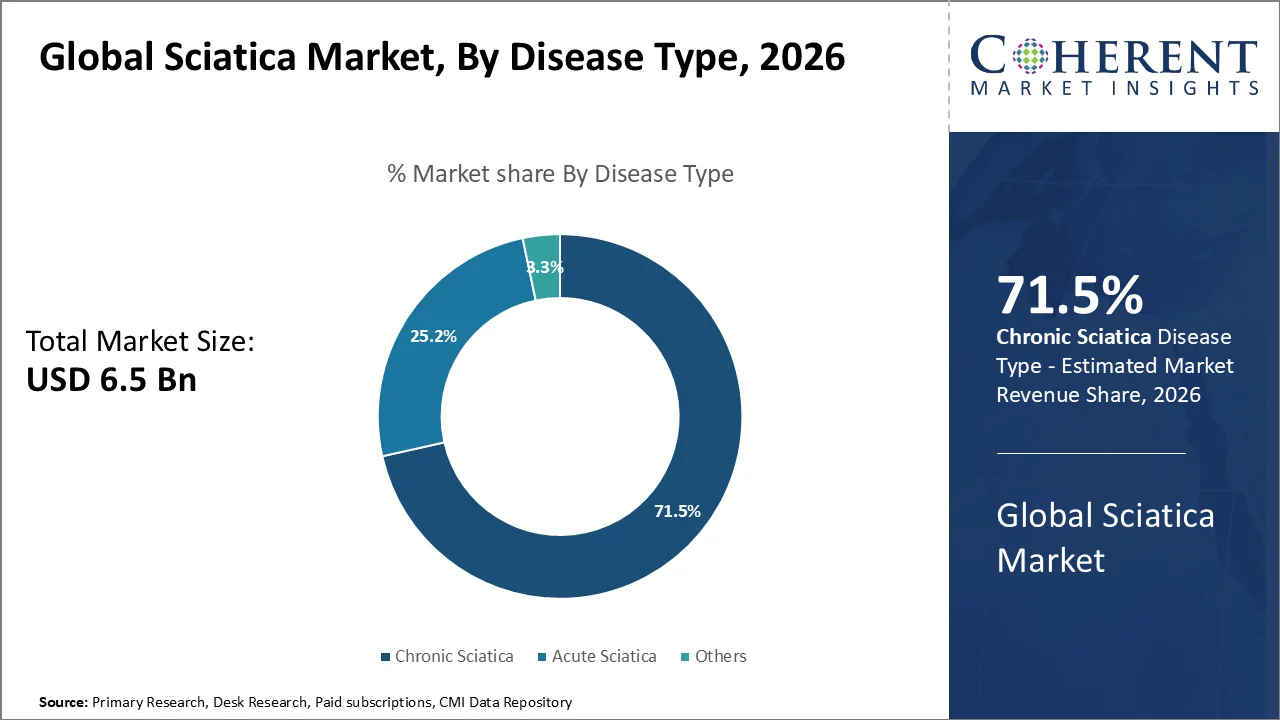
- The chronic sciatica segment is likely to dominate the market with 71.5% in 2026. The segment’s growth is owing to the rising cases of recurring lower back pain, disc herniation, and age-related spinal degeneration.
- The nonsteroidal anti-inflammatory drugs segment is set to lead with 44.2% in 2026. The segment’s growth is owing to the wide use as first-line pain relief therapy.
- The oral segment is set to lead with 57.1% in 2026. The segment’s growth is owing to higher patient convenience, easy dosage administration, and strong availability of tablets and capsules. Studies indicate that approximately 71%–91% of patients favor a daily oral pill over frequent injections, even when oral treatment requires more frequent dosing.
- The retail pharmacies segment is set to lead with 54% in 2026. The segment’s growth is owing to the easy access to prescription and over-the-counter pain medications. Retail pharmacies are widely preferred for repeat purchases of NSAIDs, muscle relaxants, and supportive pain management therapeutics.
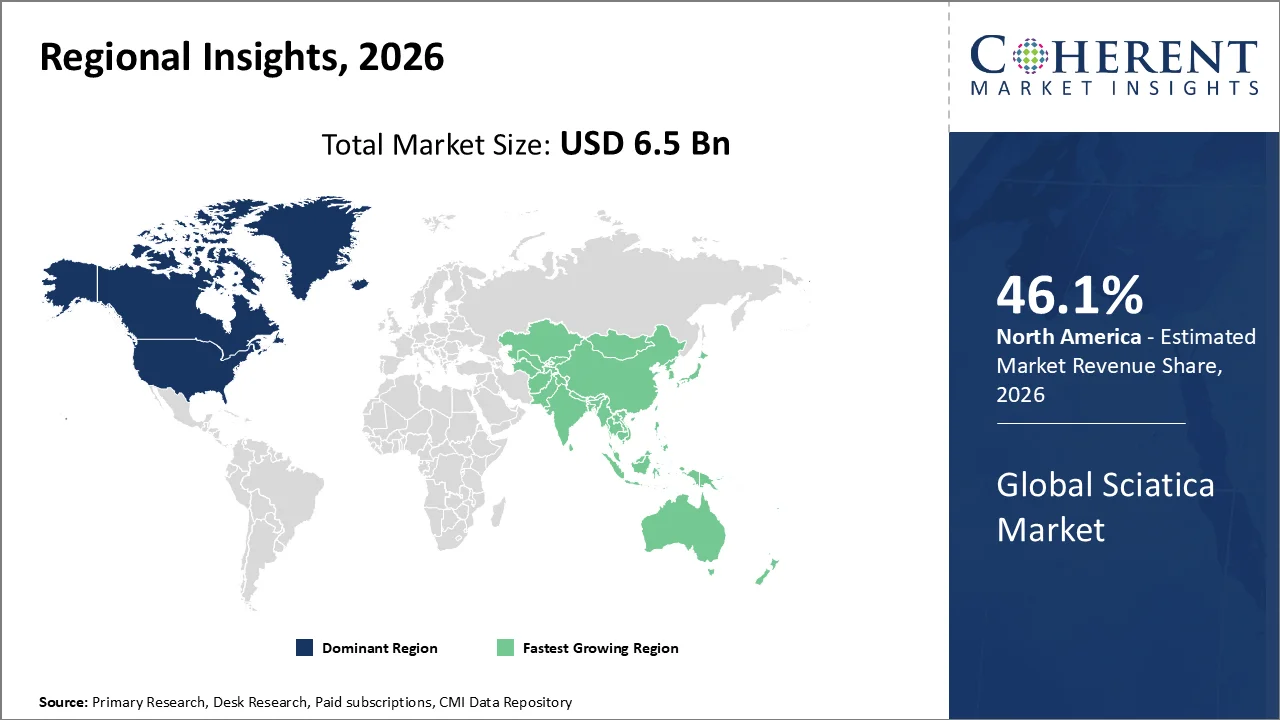
- North America is expected to acquire the prominent share of 46.1% in 2026. The region’s growth is owing to the high prevalence of lower back pain, advanced pain management infrastructure, and strong adoption of minimally invasive spine therapies. In December 2025, Semnur Pharmaceuticals, Inc. advanced its SP-102 program, a non-opioid injectable corticosteroid gel for moderate-to-severe lumbosacral radicular pain.
Segmental Insights
Why is Chronic Sciatica Segment Acquiring the Largest Share?
On the basis of disease type, the chronic sciatica segment is projected to account for the largest Sciatica Market share of 71.5% in 2026. The segment’s growth is owing to the rising burden of recurring lumbar radicular pain, disc herniation, spinal stenosis, degenerative disc disease, and age-related nerve compression.
The segment is further supported by product innovation and specialized spine-care launches. In February 2025, the FDA approved suzetrigine, sold as Journavx, as a new non-opioid pain medication for acute pain management. In a sciatica-related back pain study, the drug reduced pain by about 2 points, similar to placebo, thereby indicating that stronger evidence is still needed for the relief of chronic sciatica.
- Current Industry Events of 2026
- Market Size Estimation
- Regional Breakdown
- Competitive Landscape
- Customer Intelligence
- Segmental Analysis
- Pricing Analysis
- Key Market Drivers, Challenges & Future Trends
- Customized Insights Section
Nonsteroidal Anti-Inflammatory Drugs hold the Largest Market Share
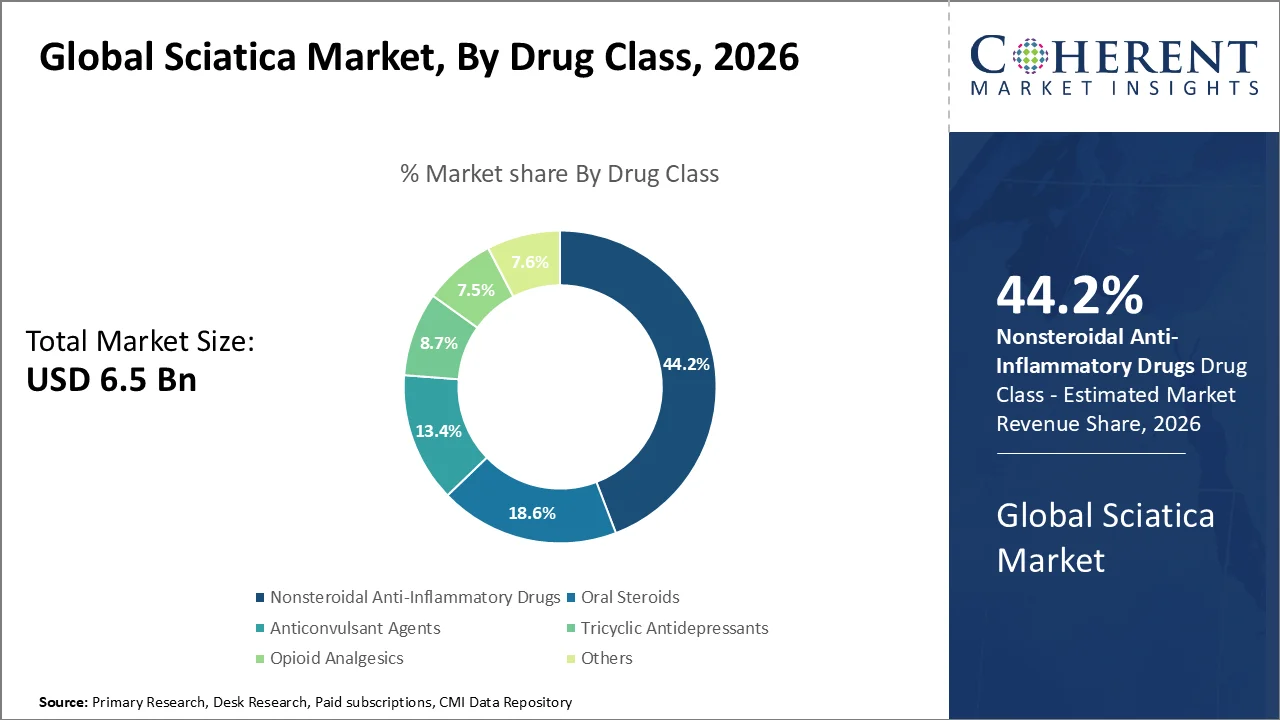
On the basis of drug class, the nonsteroidal anti-inflammatory drugs segment lead with a major 44.2% share in 2026. The growth is owing to the wide use of NSAIDs as first-line therapy for pain, inflammation, and functional limitation associated with sciatica and low back pain. NSAIDs such as ibuprofen, naproxen, diclofenac, and celecoxib are widely prescribed because they are affordable, easily available through retail pharmacies, and suitable for early-stage or flare-up management before advanced interventions are considered.
The clinical guidance continues to support the NSAID use in low back pain management when used carefully. The NICE recommends considering oral NSAIDs for low back pain while accounting for gastrointestinal, liver, cardio-renal risks, age, and the need for the lowest effective dose for the shortest duration.
Market Drivers
Technology Advancements are Transforming the Sciatica Market in the US
Technology advancements are rapidly transforming the U.S. sciatica market. The innovations shift treatment approaches from conventional off-label oral therapies toward targeted, device-based, and non-opioid interventions.
According to the National Institutes of Health (NIH) PMC database, sciatica has a high lifetime incidence. It affects approximately 13% to 40% of the global population and thus underpins a substantial and persistent clinical burden. In the United States, the back and sciatic nerve-related complications remain highly prevalent, with nearly 26% of adults experiencing chronic low back or sciatic pain, thereby underscoring the need for more effective as well as long-term solutions.
To address this growing burden and reduce dependence on opioid-based therapies, advanced medical technologies are being adopted in clinical practice. A notable development in this direction is Globus Medical’s February 2025 acquisition of Nevro for approximately USD 250 million, strengthening its neuromodulation portfolio. This deal highlights the increasing adoption of closed-loop spinal cord stimulation systems. This is improving the long-term radicular pain management outcomes in the U.S. sciatica market.
Regenerative and Biologic Therapies: Major Breakthrough in Sciatica Market
The sciatica market is witnessing a major transformation with the growing adoption of regenerative and biologic therapies. This marks a shift from symptomatic relief to disease-modifying approaches. Only 9.3% of individuals recognize the preventable nature of sciatica, conventional treatments like NSAIDs and muscle relaxants offer only short-term pain relief. This creates a substantial unmet clinical need and thus support the market expansion.
To address neural healing, the official clinical trial registries highlight active parallel controlled human studies evaluating platelet-rich plasma (PRP) injections against traditional steroids to evaluate the long-term functional recovery.
In November 2024, Semnur Pharmaceuticals executed a USD 2.5 billion SPAC merger with Denali Capital Acquisition Corp to speed up the commercialization of Semdexa. The non-opioid injectable, granted FDA Fast-Track designation, reflects a broader industry transition toward localized biologics as well as regenerative pain management solutions in sciatica care.
Current Events and Their Impact on the Sciatica Market
Current Event | Description and its Impact |
2026 Medicare Physician Fee Schedule and OPPS/ASC updates in the U.S. |
|
Strengthening Regulatory Oversight for Pain Therapies and Clinical Evidence Requirements |
|
Sciatica Market Trends
- Rising adoption of non-surgical pain management therapies, including NSAIDs, physiotherapy, epidural steroid injections, and nerve blocks, improves symptom control. Sciatica has an annual incidence of around 1–5%.
- Growing preference for minimally invasive spine procedures, such as microdiscectomy and endoscopic decompression, supports faster recovery and shorter hospital stays. Microdiscectomy recovery commonly involves around six weeks of modified activity.
- Increasing prevalence of lower back pain, lumbar disc herniation, obesity, and sedentary lifestyles drives demand for sciatica treatment Low back pain affects 58–84% of the general population during their lifetime, with sciatica accounting for 5–10% of these cases.
- Expanding insurance coverage, pain management clinics, and rehabilitation services improve patient access to diagnosis, medication, injections, and surgical interventions. Globally, low back pain is the leading cause of disability, creating a strong treatment and rehabilitation need.
Regional Insights
North America Dominates Owing to the Advanced Pain Management Infrastructure
The North America region accounts for 46.1% of the market share in 2026. The region’s growth is owing to high diagnosis rates, advanced pain management clinics, strong spine surgery infrastructure, and active pharmaceutical innovation. The U.S. has a large burden of chronic pain and low back pain, creating sustained demand for analgesics, physical therapy, imaging, epidural steroid injections, and surgical intervention.
In August 2025, Audizen Drops launched as a liquid dietary supplement positioned for sciatic nerve discomfort and neuropathy support across the U.S., U.K., Canada, Australia, and New Zealand. The product uses a sublingual format and natural ingredients aimed at reducing inflammation, supporting nerve function, and easing sciatica-related discomfort.
Asia Pacific Sciatica Market Trends
Asia Pacificis expected to witness strong growth in Sciatica Market over the forecast period. The region’s growth is owing to aging populations, rising spine disorders, improving healthcare infrastructure, and increasing investment in orthopedic and neurology care. Countries such as India, China, Japan, and South Korea are witnessing growing demand for pain clinics, physiotherapy centers, MRI-based diagnosis, and minimally invasive spine procedures.
India is emerging as a high-growth country due to the hospital infrastructure expansion as well as the rising awareness of spine health. In June 2024, Fortis Escorts Hospital Faridabad launched a dedicated spine clinic supported by cutting edge computer-assisted Neuronavigation Medtronic Stealth Station S8 technology. The clinic offers multidisciplinary care for spine conditions including sciatica, cervical pain, spinal injury, non-surgical pain blocks, microdiscectomy, disc replacement, and minimally invasive spine surgeries.
Strong Drug Innovation are Accelerating the Sciatica Market in United States
The United States Sciatica Market is driven by the high chronic pain treatment demand, strong drug innovation, advanced spine care infrastructure, and a major policy focus on reducing opioid exposure. The firms like Scilex, Semnur Pharma, Vertex Pharmaceuticals, and SpineThera are strengthening innovation in sciatica-related and pain management pipelines. In January 2025, Frenelle Pharma launched with a portfolio focused on long-acting injectable technologies across pain management, addiction treatment, as well as animal health. Its SpineThera subsidiary is advancing SX600, a long-acting injectable drug for lumbar radicular pain, or sciatica, which has shown best-in-class potential in a Phase 2 clinical trial.
China Sciatica Market Trends
China Sciatica Market is expected to grow steadily due to the country’s large aging population, rising low back pain burden, and increasing adoption of hospital-based spine care. China’s National Bureau of Statistics reported that people aged 60 years and above reached over 296 million in 2023, increasing the risk of degenerative disc disease, spinal stenosis, and chronic sciatic nerve compression. In March 2023, researchers from six tertiary hospitals in China reported positive results from a multicenter randomized clinical trial showing that acupuncture significantly reduced pain and improved function in patients with chronic sciatica caused by lumbar disc herniation. The findings strengthen clinical adoption of acupuncture as an evidence-based treatment option in China.
Who are the Major Companies in Sciatica Industry
Some of the major key players in Sciatica Market are Sorrento Therapeutics, Inc., Teva Pharmaceutical Industries Ltd., Aurobindo Pharma Ltd., Zydus Cadila, Glenmark Pharmaceuticals Ltd., Amneal Pharmaceuticals LLC, Jubilant Life Sciences Ltd., Hikma Pharmaceuticals PLC., Mylan N.V., Horizon Therapeutics Plc., Sun Pharmaceutical Industries Ltd., Alkem Labs, SCILEX Pharmaceuticals, Inc., Seikagaku Corporation, Kolon Life Science, Inc., Teijin Limited, and SpineThera, Inc.
Key News
- In June 2026, Pinnacle Chiropractic launched a redesigned website to improve patient education on SOT Technique, Craniopathy, and chiropractic care for conditions including sciatica. The platform helps patients understand specialized treatment approaches and make informed care decisions before scheduling consultations.
- In August 2025, Arialief launched a neuropathy supplement across the U.S., U.K., Canada, Australia, and New Zealand, targeting sciatic nerve discomfort. The product supports the sciatica-related pain management through ingredients aimed at reducing inflammation, supporting nerve health, as well as improving mobility.
Market Report Scope
Sciatica Market Report Coverage
| Report Coverage | Details | ||
|---|---|---|---|
| Base Year: | 2025 | Market Size in 2026: | USD 6.5 Bn |
| Historical Data for: | 2020 To 2024 | Forecast Period: | 2026 To 2033 |
| Forecast Period 2026 to 2033 CAGR: | 10.4% | 2033 Value Projection: | USD 13 Bn |
| Geographies covered: |
| ||
| Segments covered: |
| ||
| Companies covered: | Sorrento Therapeutics, Inc., Teva Pharmaceutical Industries Ltd., Aurobindo Pharma Ltd., Zydus Cadila, Glenmark Pharmaceuticals Ltd., Amneal Pharmaceuticals LLC, Jubilant Life Sciences Ltd., Hikma Pharmaceuticals PLC., Mylan N.V., Horizon Therapeutics Plc., Sun Pharmaceutical Industries Ltd., Alkem Labs, SCILEX Pharmaceuticals, Inc., Seikagaku Corporation, Kolon Life Science, Inc., Teijin Limited, and SpineThera, Inc | ||
| Growth Drivers: |
| ||
| Restraints & Challenges: |
| ||
Analyst Opinion
- Sciatica market growth is supported by rising disc-related nerve compression cases. Lumbar disc herniation affects around 1–3% of the population annually, and nearly 90% of sciatica cases are linked to spinal disc herniation, creating strong demand for pain management and rehabilitation therapies.
- Chronic sciatica is a key commercial focus, as symptoms can persist beyond 12 weeks and often reduce mobility, productivity, and quality of life. This supports the higher use of NSAIDs, muscle relaxants, epidural injections, physiotherapy, and surgical referrals.
- NSAIDs is widely used as first-line pharmacological therapy for acute sciatica, thereby supporting the strong drug demand. NICE-linked guidance recommends considering oral NSAIDs for low back pain/sciatica. The clinical studies note their broad use despite safety monitoring needs.
Speak to the analyst
Want personalized insights?
Take the findings above to one of our principal consultants, or have the report rebuilt around the segments, geographies and competitors you actually track.
Market Segmentation
- By Disease Type (Revenue, USD Bn, 2021-2033)
- Acute Sciatica
- Chronic Sciatica
- Others
- By Drug Class (Revenue, USD Bn, 2021-2033)
- Nonsteroidal Anti-Inflammatory Drugs
- Oral Steroids
- Anticonvulsant Agents
- Tricyclic Antidepressants
- Opioid Analgesics
- Others
- By Route of Administration (Revenue, USD Bn, 2021-2033)
- Oral
- Injectable
- By Distribution Channel (Revenue, USD Bn, 2021-2033)
- Hospital Pharmacies
- Retail Pharmacies
- Online Pharmacies
- By Region (Revenue, USD Bn, 2021-2033)
- North America
- U.S.
- Canada
- Latin America
- Brazil
- Mexico
- Argentina
- Rest of Latin America
- Europe
- Germany
- U.K.
- France
- Italy
- Spain
- Russia
- Rest of Europe
- Asia Pacific
- China
- India
- Japan
- Australia
- South Korea
- ASEAN
- Rest of Asia Pacific
- Middle East
- GCC
- Israel
- Rest of Middle East
- Africa
- South Africa
- Central Africa
- North Africa
- North America
Sources
Primary Research Interviews
- Neurologists
- Orthopedic spine surgeons
- Neurosurgeons
- Pain management specialists
- Physiotherapists
- Rehabilitation specialists
- Hospital administrators
- Spine clinic managers
- Pharmaceutical distributors Medical device distributors
- Key opinion leaders (KOLs) in neurology, orthopedics, and pain management
Databases
- World Health Organization (WHO)
- Centers for Disease Control and Prevention (CDC)
- National Institutes of Health (NIH)
- National Library of Medicine
- Organisation for Economic Co-operation and Development (OECD)
- Global Burden of Disease Database
Magazines
- Practical Pain Management
- SpineUniverse
- Pain Medicine News
- Neurology Today
- Orthopedics Today
Journals
- Spine
- The Spine Journal
- European Spine Journal
- Pain
- Journal of Pain Research
- The Lancet Neurology
- Journal of Neurosurgery: Spine
- Physical Therapy
Newspapers
- The New York Times
- The Guardian
- The Wall Street Journal
- Financial Times
Associations
- North American Spine Society
- American Academy of Neurology
- American Association of Neurological Surgeons
- International Association for the Study of Pain
- American Academy of Physical Medicine and Rehabilitation
- Eurospine
- American Chronic Pain Association
Public Domain Sources
- Company Annual Reports And Investor Presentations
- Government Health Ministry Publications
- Clinical Trial Registries Such As ClinicalTrials.gov
- Public Hospital And Healthcare Utilization Reports
- Drug Approval And Regulatory Databases
Proprietary Elements
- CMI Data Analytics Tool
- Proprietary CMI Existing Repository of Information for the Last 10 Years
Get access to 250+ pages report
Every segment, forecast, competitor profile and data table behind the analysis above — available for instant download.
- ESOMAR Member
- ISO 9001:2015 Certified
- D-U-N-S Registered
- GDPR & CCPA Compliant
Missing comfort of reading report in your local language? Find your preferred language:
Transform your Strategy with Exclusive Trending Reports
Frequently Asked Questions
The Sciatica Market is expected to reach USD 13 Bn in 2033.
Major players operating in the global Sciatica Market include Sorrento Therapeutics, Inc., Teva Pharmaceutical Industries Ltd., Aurobindo Pharma Ltd., Zydus Cadila, Glenmark Pharmaceuticals Ltd., Amneal Pharmaceuticals LLC, Jubilant Life Sciences Ltd., Hikma Pharmaceuticals PLC., Mylan N.V., Horizon Therapeutics Plc., Sun Pharmaceutical Industries Ltd., Alkem Labs, SCILEX Pharmaceuticals, Inc., Seikagaku Corporation, Kolon Life Science, Inc., Teijin Limited, and SpineThera, Inc.
The lack of FDA-approved, disease-modifying therapies, the high costs of advanced procedures, and severe side effects are the key factors hampering growth of the market.
The aging global population, rising rates of obesity and sedentary lifestyles, and significant advancements in minimally invasive surgical and diagnostic technologies is boosting the demand for Sciatica.
The Sciatica Market is anticipated to grow at a CAGR of 10.4% between 2026 and 2033.
Among regions, North America is expected to account for a largest market share in the global Sciatica Market over the forecast period.
Sciatica is nerve pain caused by the irritation, compression, or pinching of the sciatic nerve in your lower spine.