Laboratory Gas Generator Market Analysis & Forecast: 2026-2033

Laboratory Gas Generator Market Size and Forecast – 2026 – 2033
The Global Laboratory Gas Generator Market size is estimated to be valued at USD 907.0 million in 2026 and is expected to reach USD 1,428.0 million by 2033, exhibiting a compound annual growth rate (CAGR) of 6.7% from 2026 to 2033.
Global Laboratory Gas Generator Market Overview
Laboratory gas generators are on-site systems that produce high-purity gases such as nitrogen, hydrogen, and zero air for analytical and research laboratories. These products replace traditional gas cylinders by generating gases continuously from ambient air or water, improving safety and operational efficiency. Laboratory gas generators are commonly used with gas chromatography, mass spectrometry, and other analytical instruments. Key features include purity control, pressure stability, compact footprints, and low maintenance requirements, making them a reliable and cost-effective solution for modern laboratories.
Key Takeaways
Nitrogen gas generators hold the dominant market share by gas type, driven by extensive use in chemical analysis and pharmaceutical labs requiring high purity and reliability.
Hydrogen gas generators are the fastest-growing subsegment, bolstered by expansion into electronics and clean energy sectors.
PSA technology leads in terms of technology segment share due to cost-effectiveness and purity levels, with membrane technology expanding rapidly, given its compact form factor, aiding adoption in space-constrained labs.
Pharmaceutical & Biotechnology industries remain the largest end-users by market revenue, supported by increasing R&D and stringent purity requirements. The food and Beverage segment exhibits rapid growth due to rising demand for quality control and shelf-life enhancement applications.
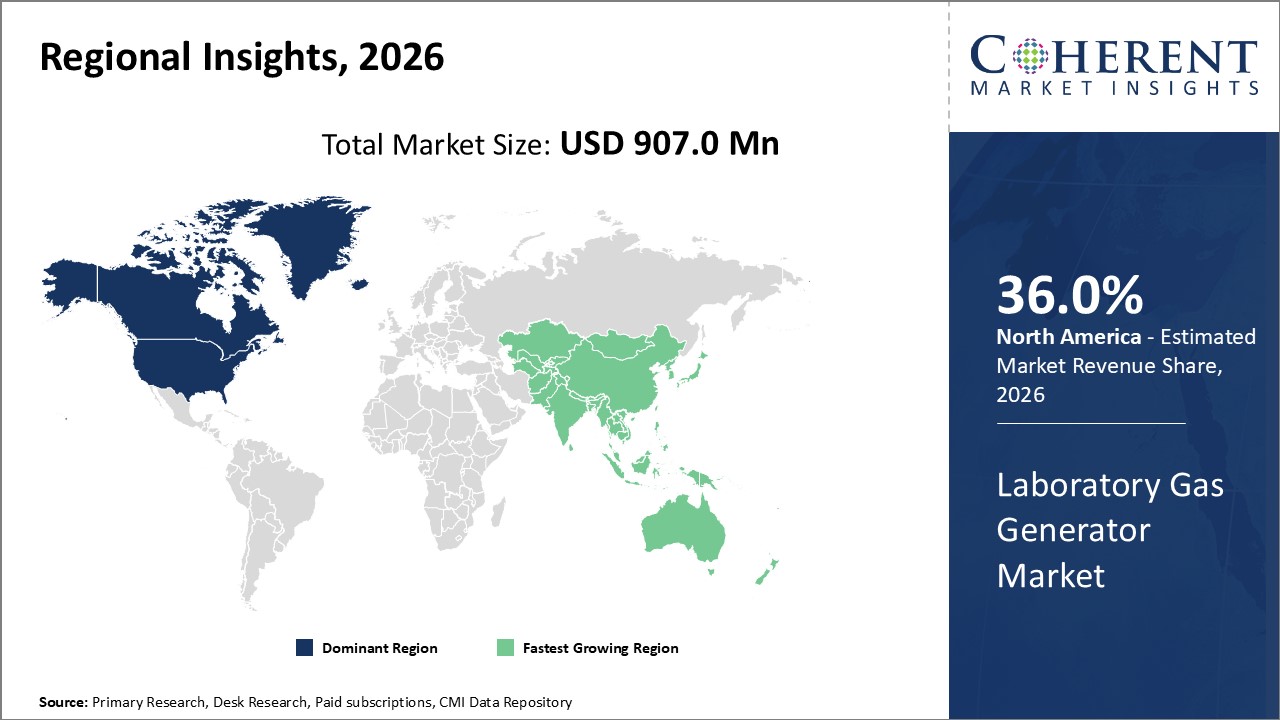
North America dominates the market owing to well-established laboratory infrastructure and strict regulatory frameworks.
Asia Pacific is emerging as the fastest-growing region, fueled by expanding healthcare and electronics manufacturing sectors, government incentives, and increasing industrial automation adoption.
Laboratory Gas Generator Market Segmentation Analysis
To learn more about this report, Request Free Sample
Laboratory Gas Generator Market Insights, By Gas Type
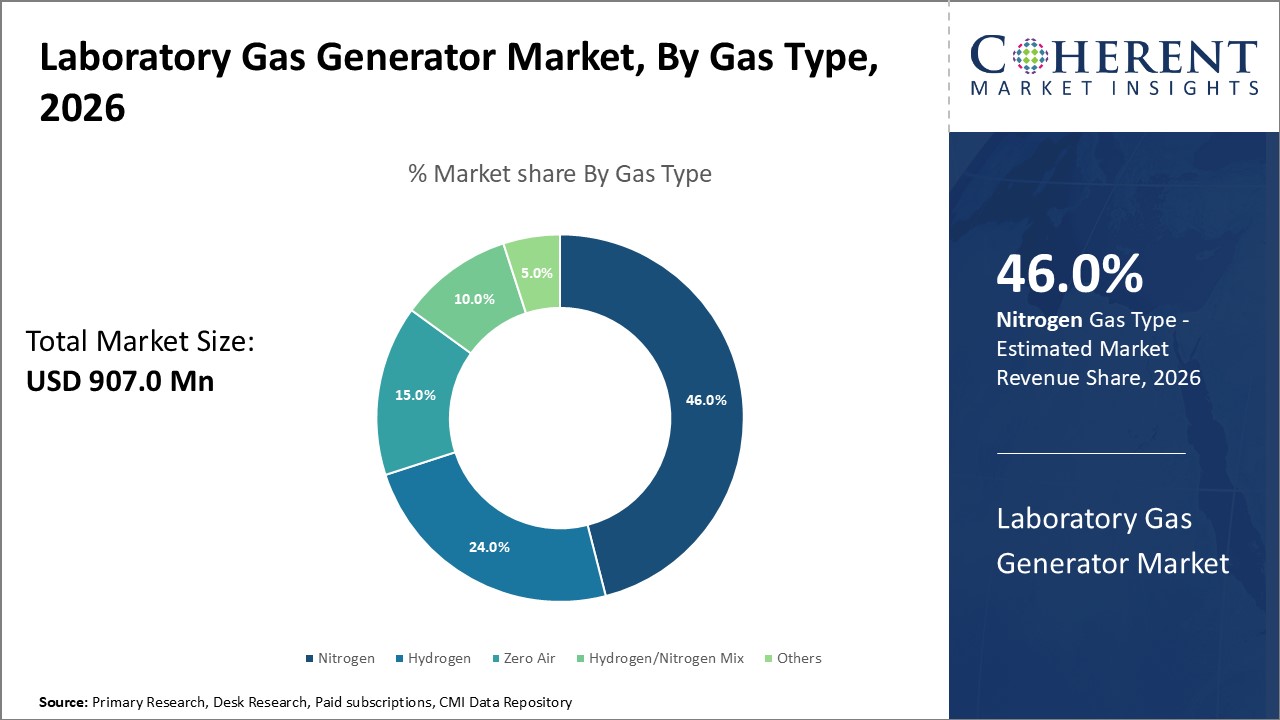
Nitrogen dominates the market share with approximately 46%. Nitrogen generators lead because of their extensive application in pharmaceutical labs for chromatography and sample preparation, emphasizing gas purity demands. This subsegment benefits from technological enhancements like improved PSA systems that maintain purity levels above 99.999%, essential for sensitive analytical processes. Hydrogen generators are the fastest-growing subsegment, primarily driven by the electronics industry’s need for ultra-pure hydrogen in semiconductor manufacturing and increasing clean energy applications. Zero Air and Hydrogen/Nitrogen mix subsegments continue to develop steadily, providing tailored gases for combustion analysis and environmental testing, respectively.
Laboratory Gas Generator Market Insights, By Technology
PSA holds the dominant segment share due to its ability to deliver high-purity gases economically at scale, making it a preferred choice for large and mid-sized laboratory facilities. This technology is favored in pharmaceutical and chemical analysis labs due to consistent output and low maintenance costs. Membrane technology is the fastest-growing subsegment because of its compact design and suitability for smaller labs, providing reliable gas generation with lower capital expenditure. Electrolysis technology mainly supports hydrogen generation in fuel cell testing and clean energy research laboratories.
Laboratory Gas Generator Market Insights, By End-User Industry
Pharmaceutical & Biotechnology dominates market share, accounting for the greatest demand fueled by stringent regulatory standards and intensifying R&D efforts requiring continuous, high-purity gas supplies for quality control and research activities. This sector drives innovation in market growth strategies with customized gas generation solutions. Electronics Manufacturing is the fastest-growing subsegment given its expanding role in semiconductor and display technologies, where high-purity hydrogen generators are crucial. Chemical Analysis applications demonstrate steady growth due to ongoing industrial quality assurance needs. The Food and Beverage segment uses laboratory gases for packaging and preservation quality checks.
Laboratory Gas Generator Market Trends
The Laboratory Gas Generator market is influenced by technological advancements emphasizing energy efficiency and safety.
A significant trend in 2026 is the integration of IoT sensors enabling predictive maintenance, reducing operational downtime, and lowering total cost of ownership.
Additionally, miniaturization of gas generators has led to broader adoption in smaller laboratories and academic research institutes where space constraints exist.
The focus on eco-friendly operations has also driven demand for generators with reduced carbon footprint, aligning with global sustainability goals.
For example, Asia Pacific’s emerging markets have benefitted from government subsidies encouraging modern laboratory builds equipped with advanced gas generation units.
Laboratory Gas Generator Market Insights, By Geography
To learn more about this report, Request Free Sample
North America Laboratory Gas Generator Market Analysis and Trends
In North America, the market commands the largest market share, attributed to the presence of advanced laboratory infrastructure, strict regulatory standards ensuring gas purity, and concentrated pharmaceutical R&D hubs. Companies such as Parker Hannifin and Air Products actively contribute to maintaining regional dominance through technology leadership and extensive aftermarket service networks.
Asia Pacific Laboratory Gas Generator Market Analysis and Trends
Meanwhile, Asia Pacific exhibits the fastest growth with a CAGR above 8% due to rapidly expanding healthcare facilities, the growing electronics manufacturing industry, and government incentives fostering local production capabilities. Increasing imports of advanced components, coupled with partnerships between regional firms and global manufacturers, have further accelerated growth.
Laboratory Gas Generator Market Outlook for Key Countries
USA Laboratory Gas Generator Market Analysis and Trends
The USA's Laboratory Gas Generator market demonstrates substantial contribution fueled by high R&D expenditure exceeding USD 150 billion in recent years within the pharmaceutical and biotechnology sectors. Key players like Peak Scientific and Messer Group have strengthened their footprint through strategic collaborations with academic institutions and clinical laboratories. Moreover, compliance with OSHA and EPA regulations has increased the preference for on-site generators, enhancing market revenue. The USA also leads in adopting smart gas generation solutions, with reported installations contributing to a 25% reduction in lab operational costs by 2026.
China Laboratory Gas Generator Market Analysis and Trends
China's market has swiftly gained momentum, driven by expanding healthcare infrastructure and a booming pharmaceutical industry focused on indigenous drug development. Domestic manufacturers, in collaboration with multinational corporations, have scaled production capacities to meet surging demand. Supportive government policies promoting 'Made in China 2026' further incentivize high-purity gas generator adoption in laboratories. In 2025, hospital laboratory upgrades contributed to a 30% increase in overall demand, positioning China as a critical player in the market.
Analyst Opinion
Production efficiency and capacity improvements are central to market growth, with manufacturers enhancing gas purity levels and output volume to meet varying laboratory requirements. For instance, newly launched nitrogen generators in 2025 demonstrated up to 41% longer operational runtime compared to predecessors, boosting market share in the high-purity segment.
The rising trend of tiered pricing models tailored to end-users’ consumption has played a crucial role in increasing adoption. Data from 2026 shows a 23% increase in small lab installations due to flexible leasing options introduced by key market players, directly impacting overall market revenue positively.
Import dynamics, particularly of precursor components like membranes and catalysts essential for gas generation, have streamlined with enhanced trade policies across the Asia Pacific regions, aiding in cost efficiencies and meeting rising demand in emerging markets. Statistics reveal a 15% reduction in component import tariffs in 2025, facilitating broader market penetration.
Application diversity beyond traditional pharma sectors, including expanding use cases in environmental testing and electronics manufacturing, has broadened the demand base. Industry trends in 2026 highlight a 31% expansion in demand for hydrogen gas generators in semiconductor fabrication labs, marking significant market growth potential.
Market Scope
| Report Coverage | Details | ||
|---|---|---|---|
| Base Year: | 2025 | Market Size in 2026: | USD 907.0 million |
| Historical Data for: | 2020 To 2024 | Forecast Period: | 2026 To 2033 |
| Forecast Period 2026 to 2033 CAGR: | 6.7% | 2033 Value Projection: | USD 1,428.0 million |
| Geographies covered: |
|
||
| Segments covered: |
|
||
| Companies covered: | Messer Group GmbH, Praxair Technology, Inc., Atlas Copco AB, Entegris, Inc., Cryo-Vac, Inc., LabGas Solutions Ltd, Noxerior AG, Applied Gas Technology, Chart Industries, Inc., Sigma-Aldrich Corporation | ||
| Growth Drivers: |
|
||
Uncover macros and micros vetted on 75+ parameters: Get instant access to report
Laboratory Gas Generator Market Growth Factors
The market growth is predominantly driven by increasing demand for on-site gas generation solutions, reducing dependency on high-pressure cylinder gas supplies. Enhanced safety protocols and environmental regulations globally also push laboratories towards adopting low-emission gas generators. The surge in pharmaceutical and biotechnology R&D activities requiring high-purity gases directly fuels market revenue. Moreover, advancements in membrane and PSA technologies that improve energy efficiency and reduce operating costs have amplified market adoption rates, supported by a notable 19% increase in PSA system installations in 2026.
Laboratory Gas Generator Market Development
In 2026 & 2025, PEAK Scientific expanded its laboratory gas generation portfolio with the launch of the Intura nitrogen generator series and the Horizen 24 nitrogen generator, designed to deliver reliable, on-demand nitrogen for analytical laboratories. The new systems emphasize energy efficiency, compact design, and consistent gas purity, supporting applications such as LC-MS, sample preparation, and evaporation while reducing dependence on external gas cylinders.
In 2025, LNI Swissgas introduced the HG PRO 4000 hydrogen generator, engineered to provide a high-purity, continuous hydrogen supply for gas chromatography and other analytical techniques. The system enhances laboratory safety and operational efficiency by eliminating hydrogen cylinders while ensuring stable flow rates and advanced monitoring features.
Key Players
Leading Companies of the Market
Messer Group GmbH
Praxair Technology, Inc.
Atlas Copco AB
Entegris, Inc.
Cryo-Vac, Inc.
LabGas Solutions Ltd
Noxerior AG
Applied Gas Technology
Chart Industries, Inc.
Sigma-Aldrich Corporation
Leading companies are adopting competitive strategies such as expanding their product portfolio with integrated smart gas management systems. For example, Parker Hannifin recently implemented IoT-enabled controllers that improved operational efficiency by 26%, creating a competitive edge. Additionally, Air Products invested substantially in regional manufacturing units in the Asia Pacific, increasing market penetration and reducing lead times, which resulted in a 13% growth in regional market share during 2025.
Laboratory Gas Generator Market Future Outlook
Future growth in the laboratory gas generator market will be driven by increasing laboratory automation and demand for uninterrupted high-purity gas supply. Sustainability goals and workplace safety regulations will further accelerate the shift away from gas cylinders. Technological advancements are expected to focus on energy efficiency, remote monitoring, and predictive maintenance capabilities. Growing investments in research laboratories and diagnostic facilities, particularly in emerging economies, will support long-term market expansion.
Laboratory Gas Generator Market Historical Analysis
The laboratory gas generator market emerged as laboratories sought safer and more reliable alternatives to traditional gas cylinders. Initially, adoption was limited to high-end research and analytical laboratories due to high upfront costs. As laboratory testing volumes increased across pharmaceuticals, environmental monitoring, and food safety, demand for continuous and on-demand gas supply grew. Improvements in gas purity control, system reliability, and compact system design enhanced acceptance. Over time, laboratory gas generators became standard infrastructure in modern laboratories, reducing operational risks and improving workflow efficiency.
Sources
Primary Research Interviews:
Laboratory Managers,
Analytical Chemists
Quality Control Heads
Instrument Vendors
Facility Engineers
Databases:
Statista
Laboratory Equipment
GlobalData Analytical Instruments
OECD Research Data
World Bank Science Indicators
UN Industry Data
Magazines:
Laboratory Equipment
Lab Manager
Analytical Science,
Scientific Computing
Chemical Processing
Journals:
Journal of Chromatography
Analytical Chemistry
Talanta
Journal of Separation Science
Applied Spectroscopy
Associations:
American Chemical Society
Royal Society of Chemistry
International Union of Pure and Applied Chemistry
Laboratory Products Association
ISO
Share
Share
Abhijeet Kale is a results-driven management consultant with five years of specialized experience in the biotech and clinical diagnostics sectors. With a strong background in scientific research and business strategy, Abhijeet helps organizations identify potential revenue pockets, and in turn helping clients with market entry strategies. He assists clients in developing robust strategies for navigating FDA and EMA requirements.

Credibility and Certifications

860519526


9001:2015

27001:2022


Need a Custom Report?
We can customize every report - free of charge - including purchasing stand-alone sections or country-level reports
Customize NowJoining thousands of companies around the world committed to making the Excellent Business Solutions.
View All Our Clients