

Crystal Oscillator Market Size and Share Analysis - Growth Trends and Forecast (2026 - 2033)
The global crystal oscillator market size is expected to reach around USD 2,558.7 Mn in 2026 and is projected to grow at a CAGR of 4.2% during the forecast period (2026-2033), surpassing USD 3,410 Mn by 2033.
Key Takeaways from the Crystal Oscillator Market Report
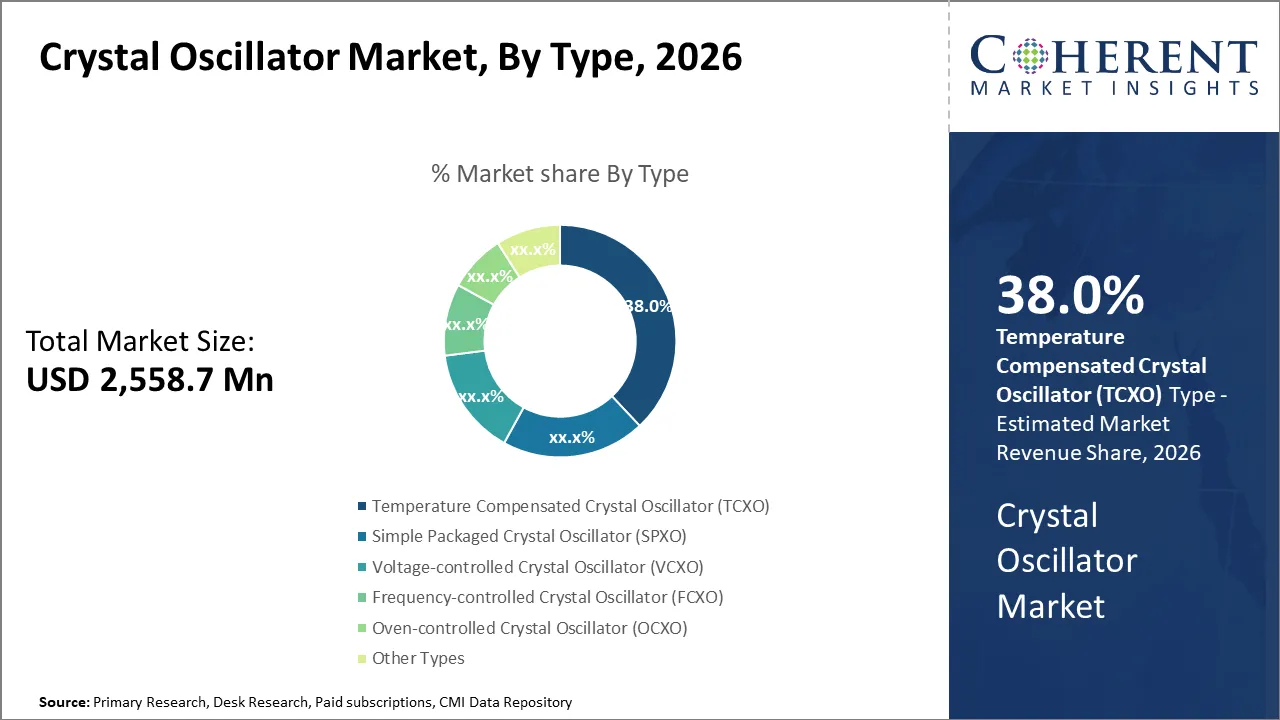
- Temperature Compensated Crystal Oscillators (TCXOs) are expected to remain the most sought-after type, accounting for a share of 38% in 2026, because of their superior frequency stability and widespread use in telecom infrastructure, smartphones, and GPS devices.
- Surface mount segment is slated to dominate the crystal oscillator industry with a share of about 80% in 2025, thanks to rising adoption in consumer electronics and IoT devices.
- Consumer electronics is anticipated to remain the leading end user industry for crystal oscillators, accounting for a revenue share of 38% in 2026.
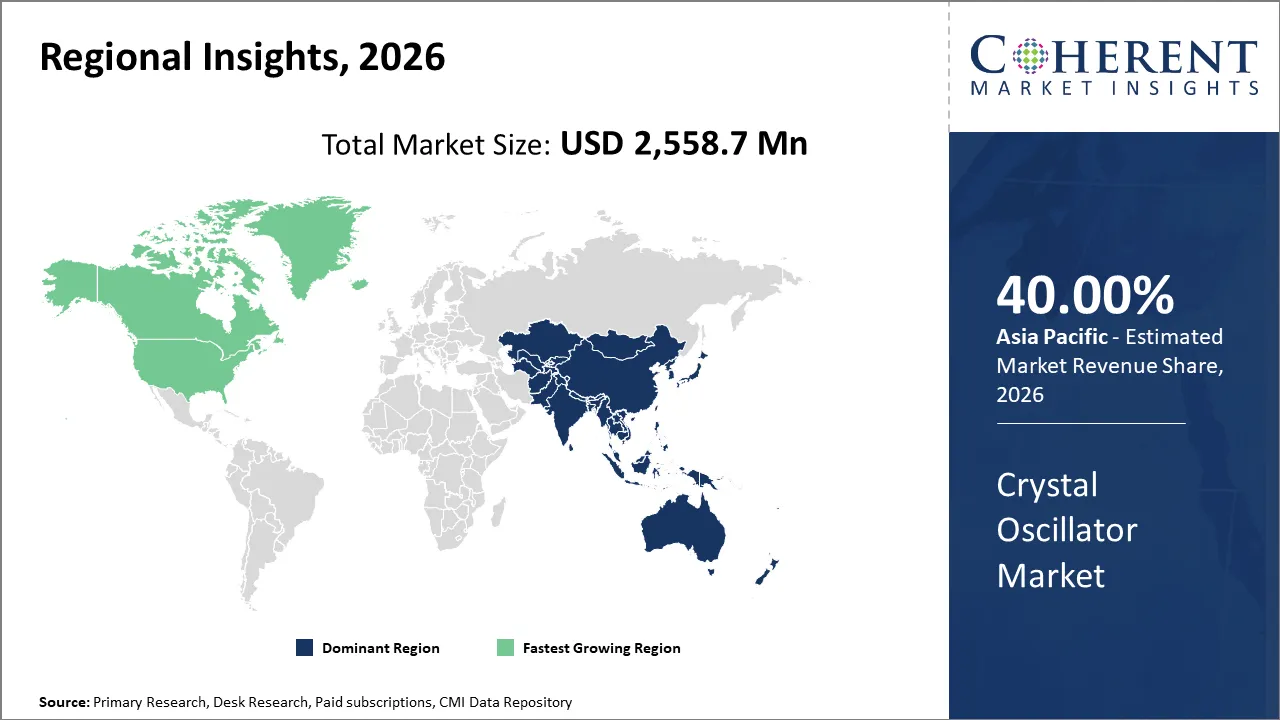
- Asia Pacific is expected to lead the global market with a share of more than 40% in 2026, owing to strong semiconductor manufacturing and high electronics production in China, Japan, South Korea, and Taiwan.
- North America, with over 26% share in 2026, is poised to create lucrative growth opportunities for crystal oscillator manufacturers during the assessment period.
Crystal Oscillator Market Overview
The global crystal oscillator market is expected to grow steadily during the forecast period. This is attributable to increasing demand for high-precision timing components in consumer electronics, telecommunications, automotive applications, and industrial automation. Furthermore, rising adoption of smartphones, wearable devices, and IoT devices is driving the need for stable and reliable frequency control solutions like crystal oscillators. Advancements in MEMS (Micro-Electro-Mechanical Systems) technology and the increasing use of autonomous vehicles are helping the crystal oscillator market grow.
A crystal oscillator is an electronic oscillator that uses a quartz crystal as a frequency-determining element. It exploits the piezoelectric properties of the crystal, where mechanical vibrations generate an electric signal at a precise frequency. The crystal’s mechanical resonance ensures high frequency stability and accuracy in the generated signal. Rising adoption of crystal oscillators across diverse industries is expected to fuel market growth during the forecast period.
Current Events and Their Impact
Current Event | Description and its Impact |
Global 5G Network Expansion and Deployment |
|
Internet of Things (IoT) and Edge Computing Proliferation |
|
Segmental Insights
- Current Industry Events of 2026
- Market Size Estimation
- Regional Breakdown
- Competitive Landscape
- Customer Intelligence
- Segmental Analysis
- Pricing Analysis
- Key Market Drivers, Challenges & Future Trends
- Customized Insights Section
Crystal Oscillator Market Insights, By Type - TCXOs Continue to Lead as the Top-Selling Crystal Oscillator Type
Based on type, temperature compensated crystal oscillator (TCXO) segment is expected to lead the market with a revenue share of 38% in 2026. This is mostly due to rising adoption of TCXOs in applications requiring high-frequency stability, such as telecommunications, GPS modules, and IoT devices.
TCXOs offer superior performance under varying temperature conditions. This makes them essential for mobile communication systems, wearable devices, and automotive electronics. The growing need for precise timing in 5G networks and GPS devices is helping TCXOs stay the top choice in the crystal oscillator market.
Other types of crystal oscillators, like oven-controlled crystal oscillators (OCXO) and voltage-controlled crystal oscillators (VCXO), are expected to grow steadily during the forecast period. This is because they are used in specialized areas like aerospace, defense, and industrial automation, where very stable frequency performance is essential.
Crystal Oscillator Market Insights, By Mounting Type - Surface Mount Dominates Due to Compact Design and Ease of Integration
By mounting type, surface mount crystal oscillators segment is projected to account for 80% of the global market share in 2025. This is mostly due to their compact design, which allows for efficient use of PCB space, and their ease of integration into modern electronic devices such as smartphones, wearables, and IoT applications.
In addition, surface mount technology (SMT) enables automated high-volume assembly, reducing manufacturing costs and improving reliability compared to through-hole mounting. These factors make surface mount crystal oscillators the preferred choice for electronics manufacturers seeking miniaturization, high performance, and cost-effective production.
Regional Insights
Asia Pacific Remains the Largest Market for Crystal Oscillators
Asia Pacific is expected to retain its dominance over the global crystal oscillator market, capturing a share of 40% in 2026. Robust electronics manufacturing ecosystem, increasing adoption of industrial automation & IoT, and expansion of telecommunication infrastructure are some of the major factors driving growth of Asia Pacific crystal oscillator market.
Rising demand for consumer electronics like smartphones, wearables, tablets, and digital TVs in emerging nations like China, Japan, South Korea, and India is increasing crystal oscillator sales. These devices need precise timing components, so crystal oscillators are essential for stable frequency control.
Expansion of telecommunications infrastructure, especially 5G network rollouts, fuels broader deployment of crystal oscillators in base stations and networking equipment. Similarly, growth in automotive electronics, such as infotainment systems, telematics, and advanced driver assistance systems (ADAS), is expected to fuel demand for crystal oscillators in the region during the forecast period.
North America Becoming a Central Hub for Crystal Oscillator Manufacturers
North America crystal oscillator market is poised to register steady growth throughout the forecast period. This is mostly due to advanced technological innovation and the convergence of high value applications across multiple industries. The region is slated to hold over 26% share of the global crystal oscillator industry, thanks to strong demand from telecommunications, aerospace, defense, and industrial automation sectors.
One of the primary regional drivers is the wide deployment of next generation 5G networks and infrastructure upgrades. These solutions require oscillators with superior frequency stability and low phase noise to support high-speed data transmission and network synchronization. North America also benefits from substantial R&D investments and a deep ecosystem of technology innovators and semiconductor designers, especially in the United States and Canada.
In addition, the automotive industry’s move toward autonomous, connected, and electric vehicles is increasing demand for crystal oscillators in vehicle sensor suites, V2X communication modules, and high-speed data networks in cars. Complementary investment incentives through strategic policies and defense programs further support growth in high-performance oscillator segments.
Crystal Oscillator Market Outlook – Country-wise
China Crystal Oscillator Market Forecast
China remains at the epicentre of crystal oscillator market growth. This is mainly due to booming electronics manufacturing, 5G network expansion, and rising demand for smartphones, IoT devices, and electric vehicles. High domestic consumption and government support for local semiconductor and component production are key growth drivers.
China has become a top exporter of consumer electronics and semiconductors globally. In the first two months of 2026, China’s exports jumped ~22% year on year, driven strongly by global demand for semiconductors and electronics products. Semiconductor shipments alone rose over 66%, reflecting robust technology trade from the region. This is boosting crystal oscillator market value in the country.
U.S. Crystal Oscillator Market Trends
The United States crystal oscillator market is expanding steadily, driven by aerospace, defense, 5G infrastructure, and autonomous vehicle technologies. High-reliability oscillators for critical applications are in demand, and reshoring electronics manufacturing is supporting market growth. Similarly, strong presence of leading crystal oscillator companies is supporting market expansion in the nation.
Impact of AI on the Crystal Oscillator Market
AI is giving a new boost to the crystal oscillator market by improving the design, testing, and performance of timing devices. For example, TXC Corporation recently introduced its innovative Xterniti platform featuring the TimeLock™ AI‑powered OCXO, which provides an extended 24‑hour holdover solution for critical network synchronization.
Crystal Oscillator Industry News
- In January 2026, Kyocera started mass production of its X Series of differential clock crystal oscillators. These solutions will help the company meet rising demand for high-speed data communication applications, including AI servers, optical transceivers, storage systems, and automotive ADAS.
- In October 2025, Aker Technology launched the S1A Series differential crystal oscillator. These oscillators are engineered for automotive applications, providing reliable performance across demanding environments and temperature extremes.
- In September 2025, Siward launched the ultra-high frequency 312.5 MHz differential output crystal oscillator with ultra-low jitter performance. These crystal oscillator solutions are designed for high-speed and high-precision applications.
- In October 2024, Epson developed a new oven-controlled crystal oscillator (OG7050CAN) that consumes 56% less power than conventional OCXOs. It is designed for high-precision timing in communications and industrial applications.
Market Report Scope
Crystal Oscillator Market Report Coverage
| Report Coverage | Details | ||
|---|---|---|---|
| Base Year: | 2025 | Market Size in 2026: | USD 2,558.7 Mn |
| Historical Data for: | 2020 To 2024 | Forecast Period: | 2026 To 2033 |
| Forecast Period 2026 to 2033 CAGR: | 4.2% | 2033 Value Projection: | USD 3,410 Mn |
| Geographies covered: |
| ||
| Segments covered: |
| ||
| Companies covered: | Murata Manufacturing Co. Ltd, Vectron International Inc., Siward Crystal Technology Co. Ltd, Kyocera Corporation, Nihon Dempa Kogyo (NDK) Co. Ltd, Seiko Epson Corp., Daishinku Corp., Hosonic Electronic Co. Ltd, TXC Corporation, Rakon Ltd and SiTime Corporation | ||
| Growth Drivers: |
| ||
| Restraints & Challenges: |
| ||
Market Dynamics
Crystal Oscillator Market Drivers
Booming Consumer Electronics Sector Fueling Market Growth
The adoption of consumer electronics such as smartphones, tablets, wearables, and gaming consoles is increasing rapidly. For instance, according to GSMA, more than 4.3 billion people worldwide own a smartphone. This growing demand for consumer electronics is expected to drive the need for crystal oscillators, as these devices rely on them for precise frequency control and timing synchronization.
Automotive Electronics Growth Fueling Crystal Oscillator Market Demand
Modern vehicles rely heavily on electronic control units (ECUs), advanced driver-assistance systems (ADAS), infotainment systems, navigation, V2X communication, and electric powertrains. Rising adoption of these automotive electronics is driving demand for crystal oscillators, as all electronic systems require precise and stable timing. This trend is further accelerated by the growing adoption of electric vehicles (EVs) and the integration of autonomous driving technologies, which increase the complexity and number of electronic components requiring accurate timing solutions.
Crystal Oscillator Market Trends
Shift Towards Miniaturized Crystal Oscillators
The trend of miniaturization is gaining momentum in the crystal oscillator industry. End-use industries are increasingly adopting smaller, surface-mount crystal oscillators that fit into compact board spaces and support automated assembly for electronics such as wearables and IoT modules. This move toward smaller, high-performance oscillators is expected to drive growth in the crystal oscillator market during the assessment period.
Crystal Oscillator Market Trends
Technological Advancements in Crystal Oscillators
Advanced crystal oscillators, including Temperature Compensated Crystal Oscillators (TCXO), Oven Controlled Crystal Oscillators (OCXO), and Microelectromechanical Systems (MEMS) oscillators, are becoming more popular. These devices offer better frequency stability, use less power, and are more durable in harsh conditions. The development and use of these improved crystal oscillators are expected to boost growth in the market in the coming years.
Crystal Oscillator Market Opportunities
Expansion of 5G and Advanced Telecom Networks Creating Growth Prospects
Nations like China, India, Japan, and the U.S. are rapidly expanding the rollout of 5G wireless infrastructure. This expansion is boosting sales of crystal oscillators. This is because high-frequency crystal oscillators with excellent stability are essential for network synchronization and maintaining signal integrity in base stations and communication equipment.
For instance, India’s 5G network now covers 99.9 % of its districts. Telecom Service Providers (TSPs) have installed 4.69 lakh 5G Base Transceiver Stations (BTSs) across the nations as of February 28, 2025. This ongoing growth of 5G infrastructure in major markets is expected to create new opportunities for crystal oscillator manufacturers during the forecast period.
Crystal Oscillator Market Opportunities
Rising Adoption of Industrial Automation, Robotics, IoT, and Connected Devices
The growth of industrial automation and robotics is increasing demand for crystal oscillators. Machines, robots, and motion control systems rely on precise timing to work efficiently. Crystal oscillators provide stable frequency signals that reduce errors, improve performance, and ensure smooth operation in factory networks as well as automated processes.
In addition, rapid rise of IoT and connected devices is opening revenue streams for crystal oscillator companies. Smart homes, healthcare devices, and agricultural sensors need small, low-power, and highly accurate oscillators to communicate data in real time. Crystal oscillators help these devices stay synchronized, supporting reliable performance and energy-efficient operation.
Crystal Oscillator Market — Export Data to India (2025)
Metric | Value/Detail |
Total Export Shipments to India | 12,350 shipments (World→India) |
Number of Exporters | 1,029 global exporters |
Number of Indian Buyers | 486 buyers |
Top Exporting Countries (Overall) | China (35,546 shipments), Japan (5,777), Taiwan (5,394) |
HSN Codes Commonly Used | Crystal oscillators for mobile PCBs, SMD oscillators, TCXO 52 MHz, 32.768 kHz etc. |
Approx. Price Range (sample shipments) | From ~$8.83 (tiny qty CCTV oscillators) up to ~$5,099.99 (OCXO) |
Major Product Destinations within India | Electronics manufacturing, mobile assembly, CCTV modules, PCB components |
Common Applications Within the Crystal Oscillator Frequency Range
Frequency Range | Specific Frequencies | Common Applications |
Low (32 kHz to 1 MHz) | 32.768 kHz | Quartz wristwatches, Real-time clock modules |
100 kHz to 1 MHz | RFID systems, Consumer electronics | |
Intermediate (1 to 10 MHz) | 4 to 8 MHz | Microcontrollers, TV remote controls |
10 MHz | Digital circuits, Communication devices | |
High (10 to 100 MHz) | 20 to 40 MHz | Microprocessors, Wireless devices |
100 MHz | Fast digital circuits, High-speed ADCs | |
Very High (Above 100 MHz) | 125 to 200 MHz | Advanced communication systems, Ethernet |
Above 200 MHz | Radar systems, Satellite communication |
Analyst Opinion (Expert Opinion)
- Frequency stability now drives adoption more than brand legacy. In IoT modules deployed in smart meters across Europe, oscillators with ±10 ppm stability reduced timing errors by 16% compared with devices using traditional ±50 ppm components. Engineers increasingly prioritize precision over supplier reputation when designing multi-node networks.
- Using MEMS technology and advanced packaging is reshaping product choices. In Japan’s automotive radar systems, oscillators combined with MEMS filters gave 21% better signal quality compared to regular oscillators. This demonstrates that form-factor innovation, not just nominal frequency rating, is steering procurement decisions.
- Long-term reliability under harsh conditions dictates market preference. Aerospace-grade oscillators tested in high-vibration environments in the U.S. maintained 99.3% operational uptime over 18 months, compared with 95.7% for standard industrial units. System integrators increasingly judge adoption by proven endurance rather than initial cost or marketing claims.
Speak to the analyst
Want personalized insights?
Take the findings above to one of our principal consultants, or have the report rebuilt around the segments, geographies and competitors you actually track.
Market Segmentation
- By Type Insights ( Revenue, US$ Mn, 2020 - 2033)
- Temperature Compensated Crystal Oscillator (TCXO)
- Simple Packaged Crystal Oscillator (SPXO)
- Voltage-controlled Crystal Oscillator (VCXO)
- Frequency-controlled Crystal Oscillator (FCXO)
- Oven-controlled Crystal Oscillator (OCXO)
- Other Types
- By Mounting Type Insights ( Revenue, US$ Mn, 2020 - 2033)
- Surface Mount
- Thru-hole
- By End User Industry Insights ( Revenue, US$ Mn, 2020 - 2033)
- Consumer Electronics
- Automotive
- Telecom and Networking
- Aerospace and Defense
- Research and Measurement
- Industrial
- Other Applications
- By Region Insights ( Revenue, US$ Mn, 2020 - 2033)
- North America
- U.S.
- Canada
- Latin America
- Brazil
- Argentina
- Mexico
- Rest of Latin America
- Europe
- Germany
- U.K.
- Spain
- France
- Italy
- Russia
- Rest of Europe
- Asia Pacific
- China
- India
- Japan
- Australia
- South Korea
- ASEAN
- Rest of Asia Pacific
- Middle East & Africa
- GCC Countries
- Israel
- Rest of Middle East & Africa
- North America
- Key Players in the Crystal Oscillator Market
- Murata Manufacturing Co. Ltd
- Vectron International Inc.
- Siward Crystal Technology Co. Ltd
- Kyocera Corporation
- Nihon Dempa Kogyo (NDK) Co. Ltd
- Seiko Epson Corp.
- Daishinku Corp.
- Hosonic Electronic Co. Ltd
- TXC Corporation
- Rakon Ltd
- SiTime Corporation
Sources
Primary Research interviews
- Interviews with product managers of electronics OEMs
- Conversations with design engineers in telecommunications sector
- Interviews with procurement heads of industrial automation firms
- Discussions with R&D leaders at semiconductor manufacturing units
- Interviews with quality assurance teams at electronics component distributors
Databases
- IEEE Xplore Digital Library
- Scopus
- Web of Science
- Standards databases (e.g., IEC, JEDEC)
- Technical specification repositories of major semiconductor manufacturers
Magazines
- Electronic Design
- Microwave Journal
- Electronics Weekly
- EDN Network
- Electronics Product News
Journals’
- IEEE Transactions on Ultrasonics, Ferroelectrics, and Frequency Control
- Journal of Electronic Materials
- International Journal of RF and Microwave Computer‑Aided Engineering
- Sensors and Actuators A: Physical
- Microelectronics International
Newspapers
- The Economic Times – Technology Section
- Financial Times – Tech & Electronics Coverage
- The Hindu – Business and Technology
- Times of India – Innovation & Gadgets
- Hindustan Times – Science & Tech
Associations
- IEEE (Institute of Electrical and Electronics Engineers)
- IPC (Association Connecting Electronics Industries)
- SEMI (Semiconductor Equipment and Materials International)
- IEC (International Electrotechnical Commission)
- JEDEC (Joint Electron Device Engineering Council)
Public Domain sources
- Government export/import trade statistics (e.g., UN Comtrade)
- Patents from USPTO and WIPO databases
- Country‑level electronics manufacturing policy documents
- Public filings and annual reports of electronics manufacturers
- Technical standards and whitepapers from public standards bodies
Proprietary Elements
- CMI Data Analytics Tool
- Proprietary CMI Existing Repository of information for last 8 years
Get access to 250+ pages report
Every segment, forecast, competitor profile and data table behind the analysis above — available for instant download.
- ESOMAR Member
- ISO 9001:2015 Certified
- D-U-N-S Registered
- GDPR & CCPA Compliant
Missing comfort of reading report in your local language? Find your preferred language:
Transform your Strategy with Exclusive Trending Reports
Frequently Asked Questions
The global market is estimated to be valued at US$ 2,558.7 Mn in 2026.
The global Crystal Oscillator Market value is expected to reach US$ 3,410 Mn by 2033.
The global market is poised to exhibit a CAGR of 4.2% from 2026 to 2033.
Rising adoption of crystal oscillators in electronic, telecommunication, automotive, and other industries is a major growth factor.
High product costs and lack of new improvements.
TCXO, with about 38% market share in 2026, is expected to remain the most popular type.
Some major companies in the Crystal Oscillator Market include Murata Manufacturing Co. Ltd, Vectron International Inc., Siward Crystal Technology Co. Ltd, Kyocera Corporation, Nihon Dempa Kogyo (NDK) Co. Ltd, Seiko Epson Corp., Daishinku Corp., Hosonic Electronic Co. Ltd, TXC Corporation, Rakon Ltd and SiTime Corporation.