

Avascular Necrosis Market Size and Share Analysis - 2026 To 2033
The global avascular necrosis market size is expected to reach USD 809.5 Mn in 2026 and is projected to grow at a CAGR of 6.0% during the forecast period (2026-2033), surpassing USD 1,216.9 Mn by 2033. This growth is attributable to rising prevalence of risk factors such as long-term corticosteroid use, excessive alcohol consumption, trauma-related bone injuries, and chronic diseases that impair blood supply to bones.
Key Takeaways from the Avascular Necrosis Market Report
- Non-steroidal anti-inflammatory drugs are expected to lead the market with a share of 38% in 2026. This is because NSAIDs remain the first-line pharmacological option for pain and inflammation management in AVN patients. The availability of over-the-counter and prescription NSAIDs, including ibuprofen and naproxen, supports their widespread use for pain management in patients with avascular necrosis.
- Oral segment is projected to account for the largest market share of 68% in 2026 due to its convenience, high patient compliance as well as cost-effectiveness and suitability for long-term management of pain and inflammation associated with avascular necrosis.
- North America is expected to lead the global avascular necrosis industry, accounting a share of 39% in 2026, owing to advanced diagnostic capabilities, high healthcare expenditure as well as strong reimbursement systems and greater awareness of AVN treatment options. For example, U.S. healthcare spending reached US$5.3 trillion in 2024, supporting broad access to AVN diagnosis and care.
- Asia Pacific is poised to emerge as the fastest growing market for avascular necrosis drugs during the forecast period, holding a share of 24% in 2026, thanks to rising orthopedic disorders, expanding healthcare, higher healthcare spending, and better access to advanced treatments in China and India. In 2021, China reported approximately 85.0 Mn cases of other musculoskeletal disorders, representing a 20% increase compared with 1990.
Avascular Necrosis Market Overview
The global avascular necrosis market is projected to register steady growth during the forecast period. This growth is primarily driven by increasing incidence of avascular necrosis due to trauma-related injuries, osteoporosis, sickle cell disease, autoimmune disorders, and long-term corticosteroid use. In addition, growing awareness of early diagnosis, advancements in MRI and other imaging technologies for accurate disease detection, and increasing adoption of minimally invasive and joint-preserving treatment approaches are supporting market expansion.
Avascular necrosis (AVN), also known as osteonecrosis, is the death of bone tissue caused by a loss of blood supply. It most commonly affects the ends of long bones, especially the hip, a major weight-bearing joint, but it can also occur in the shoulder, knee, ankle, and wrist. Common forms include hip avascular necrosis, shoulder avascular necrosis, knee avascular necrosis, ankle avascular necrosis, and wrist avascular necrosis.
Common symptoms of avascular necrosis include joint pain in the early stages, worsening pain as the disease progresses and the bone begins to collapse, and a reduced range of motion due to pain and joint damage. The condition is diagnosed using imaging techniques such as X-rays, magnetic resonance imaging (MRI), computed tomography (CT) scans, and nuclear bone scans. MRI is particularly effective for detecting avascular necrosis in its early stages.
Increasing long-term use of high-dose corticosteroids, heavy alcohol consumption, trauma cases, sickle cell disease, systemic lupus erythematosus (SLE), organ transplantation, and certain cancer therapies are contributing to a larger AVN patient population. Reviews indicate that corticosteroid use and excessive alcohol consumption together account for up to 80% of non-traumatic AVN cases, making them the leading drivers of disease incidence. This, in turn, is boosting demand for avascular necrosis drugs.
Segmental Insights
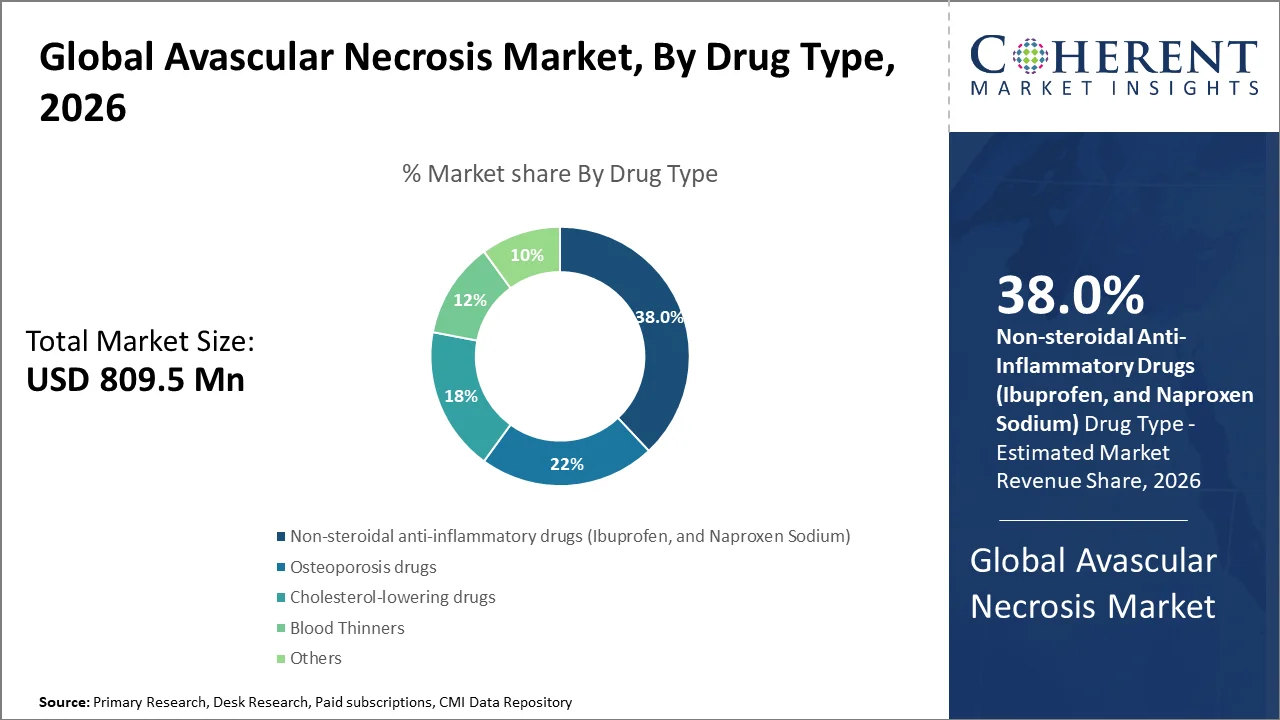
Which Drug Type Leads the Global Avascular Necrosis Market?
NSAIDs Lead the Market with Nearly Two-Fifths Share in 2026
Based on drug type, non-steroidal anti-inflammatory drugs segment is set to lead the global avascular necrosis market, accounting for a revenue share of 38% in 2026. This dominance can be attributed to widespread use of NSAIDs like Ibuprofen as the first-line treatment for managing pain and inflammation associated with avascular necrosis.
NSAIDs help reduce joint pain, improve mobility, and enhance patients' quality of life, particularly during the early stages of the disease. Their broad availability, affordability as well as ease of administration make them the preferred treatment option before surgical intervention becomes necessary.
Clinical guidance recommends NSAIDs such as ibuprofen and naproxen for pain relief during conservative management of avascular necrosis. In addition, the growing number of avascular necrosis cases caused by corticosteroid use, trauma, and chronic diseases is increasing demand for NSAIDs as part of routine symptom management.
- Current Industry Events of 2026
- Market Size Estimation
- Regional Breakdown
- Competitive Landscape
- Customer Intelligence
- Segmental Analysis
- Pricing Analysis
- Key Market Drivers, Challenges & Future Trends
- Customized Insights Section
What Makes Oral Avascular Necrosis Drugs Popular in the Market?
Convenience and High Patient Compliance Drive Their Popularity
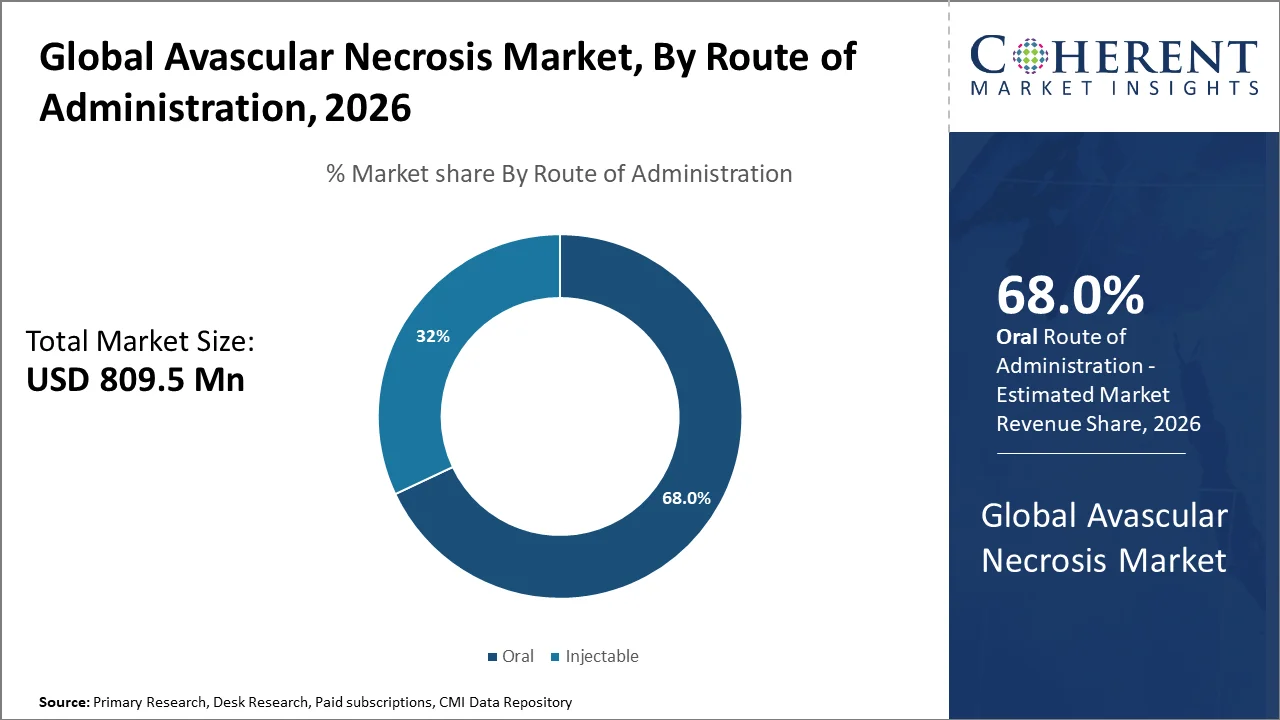
By route of administration, oral segment is set to account for the largest market share of 68% in 2026. This is mostly due to the convenience of oral medications, which can be taken at home without the need for injections or hospital visits.
The use of oral drugs helps to increase patient adherence especially when dealing with long-term pain and inflammatory problems that accompany avascular necrosis. Oral drugs are also commonly used because of their simplicity in terms of administration, cost-effectiveness and accessibility, making them the ideal choice for most patients who have just developed the disease.
Medication non-adherence affects 20–50% of patients receiving chronic therapy, and studies consistently show that treatments that are easy to self-administer improve adherence. This supports the widespread use of oral medications for the conservative management of avascular necrosis.
Avascular Necrosis Market Growth Drivers
Rising Prevalence of Avascular Necrosis
Increasing prevalence of avascular necrosis is driving market growth. The number of avascular necrosis cases is rising globally, particularly femoral head avascular necrosis, which is the most common form of the disease. For instance, it is estimated that 300,000 to 600,000 people worldwide are affected by femoral head avascular necrosis. This growing disease burden is expected to increase demand for avascular necrosis treatments during the forthcoming period.
Avascular Necrosis Market Opportunities
Advancements in Diagnostic Technologies
Increasing awareness among clinicians and the wider availability of advanced imaging technologies, particularly MRI, are enabling earlier diagnosis of avascular necrosis (AVN) before femoral head collapse. Early detection allows timely use of joint-preserving treatments, such as core decompression and pharmacological therapy, which are most effective in the early stages of the disease. It also expands the pool of patients eligible for treatment, increasing demand for diagnostic services, therapeutics, and surgical interventions. These factors are expected to create significant growth opportunities for the avascular necrosis market during the forecast period.
Avascular Necrosis Market Trends
Rising Clinical Research On Disease-Modifying Therapies
There is a growing interest in developing disease-modifying therapies for avascular necrosis (AVN) that can delay disease progression and preserve the femoral head, rather than simply managing pain and inflammation. Companies, research institutions, and healthcare organizations are increasingly investigating regenerative treatment approaches, including mesenchymal stem cell therapy, bone morphogenetic proteins (BMPs), biologics, and cell-based therapies in combination with core decompression to promote bone regeneration and improve clinical outcomes. This is expected to bode well for the avascular necrosis market during the forecast period.
Current Events and Their Impact on the Avascular Necrosis Market
Current Event | Description and its Impact |
ARCO Publishes International Clinical Practice Guideline (2026) |
|
Clinical Trials Continue for Hyperbaric Oxygen Therapy in AVN (2025–2026) |
|
Regional Insights
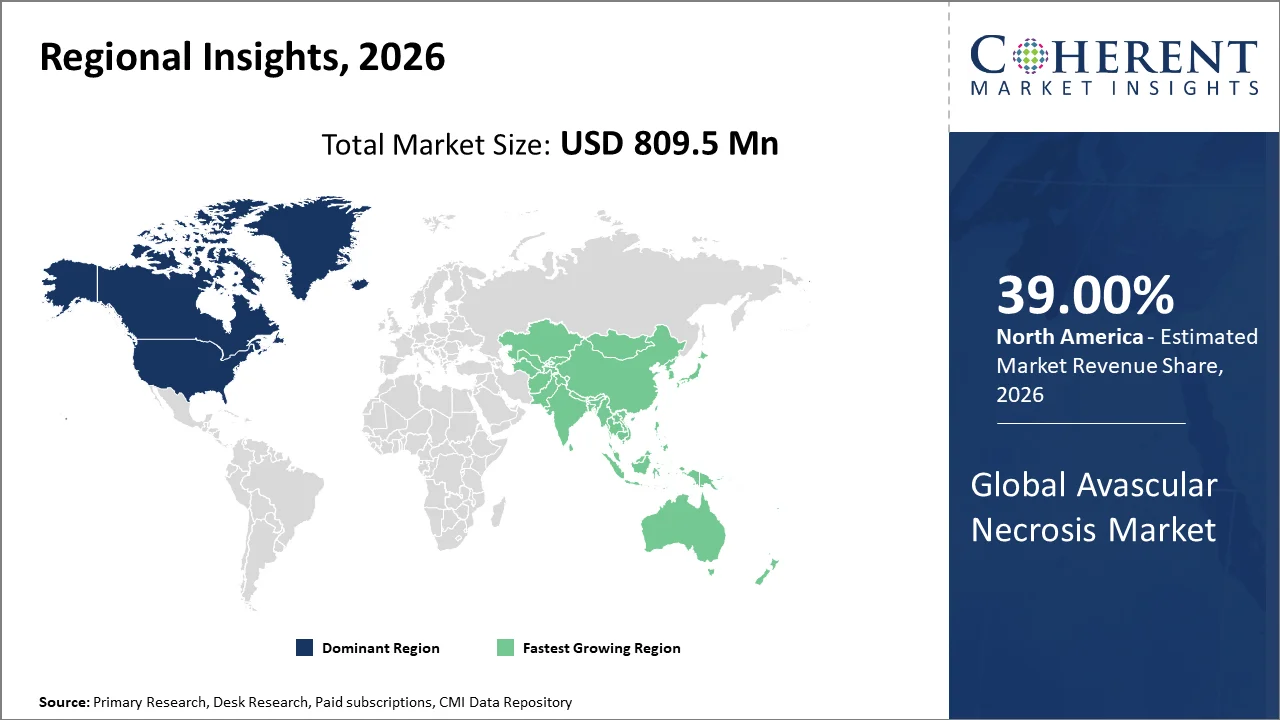
North America Remains at the Epicenter of Avascular Necrosis Market Growth
North America is expected to dominate the global osteonecrosis market with a 39% share in 2026. This is attributable to the widespread use of corticosteroids for chronic diseases, advanced diagnostic capabilities for musculoskeletal disorders, and strong access to prescription medicines through well-established healthcare systems. Increasing awareness and early diagnosis of avascular necrosis are also driving demand for drug therapies, including NSAIDs, osteoporosis drugs, and blood thinners.
Increasing use of corticosteroids for chronic inflammatory and autoimmune diseases is playing a key role in boosting North America avascular necrosis market. Long-term corticosteroid therapy is one of the leading risk factors for avascular necrosis, contributing to a growing number of cases. For instance, an estimated 10,000–20,000 new cases of avascular necrosis of the femoral head are diagnosed annually in the U.S. This rising disease burden is creating steady demand for avascular necrosis drug therapies across the region.
Asia Pacific to Become Central Hub for Industry Players
Asia Pacific is projected to emerge as a central hub for avascular necrosis drug manufacturers during the forecast period, holding a global market share of 24% in 2026. This is mostly due to expanding patient pool, increasing use of corticosteroids for chronic diseases, rising burden of sickle cell disease in several countries, improving access to orthopedic care, and growing availability of diagnostic imaging. India contributes approximately 14.5% of the global sickle cell disease (SCD) burden, with an estimated 30 million carriers and the third-highest number of annual SCD births worldwide.
The rising burden of sickle cell disease, a major cause of avascular necrosis (AVN), is supporting market growth in Asia Pacific. According to the CDC, AVN is a recognized complication of sickle cell disease caused by reduced blood flow to bones. Studies show that 10%–30% of people with sickle cell disease develop AVN. As more patients need long-term pain management and supportive treatment, demand for avascular necrosis drugs is expected to grow across the region.
Avascular Necrosis Market Outlook – Country-wise
U.S. Avascular Necrosis Market Trends
The United States is expected to remain a leading market for avascular necrosis treatment during the forecast period. This is mainly due to the high prevalence of risk factors such as long-term corticosteroid use, rising cases of trauma-related bone injuries, and increasing incidence of conditions associated with AVN, including sickle cell disease and autoimmune disorders. In addition, presence of advanced diagnostic facilities, early adoption of MRI-based detection, and strong access to prescription therapies are supporting demand for AVN drugs, including NSAIDs and other supportive treatments.
China Avascular Necrosis Market Forecast
The avascular necrosis market in China is expected to grow rapidly during the assessment period. This can be attributed to growing burden of musculoskeletal disorders, increasing diagnosis of osteonecrosis cases, rising healthcare expenditure, and improving access to orthopedic care. Expansion of hospital infrastructure, greater adoption of advanced imaging techniques for early AVN detection, and increasing awareness of joint-preserving treatment options are also supporting market expansion in the nation.
Who are the Major Companies in the Avascular Necrosis Market?
Some of the major players in Avascular Necrosis Market are Teva Pharmaceutical Industries Ltd., Dr. Reddy’s Laboratories Ltd., Solara Active Pharma Sciences Limited, Bayer AG, Rochem International Inc., Alkem labs., Dwarkesh Pharmaceuticals Private Limited., Novartis AG, GSK, Pfizer, Inc.
Key Strategies Adopted by Industry Players
Leading manufacturers of avascular necrosis drugs are adopting various organic and inorganic strategies to boost their revenue as well as gain a competitive edge in the industry. These include new product launches and approvals, increasing investments in R&D, partnerships, mergers and acquisitions, and distribution agreements.
- In November 2025, Teva Pharmaceutical Industries Ltd. launched Teva Rise, an innovation platform focused on AI, digital health, biotechnology, and smart manufacturing. It aims to accelerate the development of new healthcare solutions through external collaborations.
- In September 2025, Osteopore Limited collaborated with Tan Tock Seng Hospital in Singapore to develop a 3D-printed biomimetic implant for treating hip avascular necrosis. The implant aims to support bone regeneration and develop a joint-preserving treatment option for AVN patients.
Market Report Scope
Avascular Necrosis Market Report Coverage
| Report Coverage | Details | ||
|---|---|---|---|
| Base Year: | 2025 | Market Size in 2026: | USD 809.5 Mn |
| Historical Data for: | 2020 To 2024 | Forecast Period: | 2026 To 2033 |
| Forecast Period 2026 to 2033 CAGR: | 6.0% | 2033 Value Projection: | USD 1,216.9 Mn |
| Geographies covered: |
| ||
| Segments covered: |
| ||
| Companies covered: | Teva Pharmaceutical Industries Ltd., Dr. Reddy’s Laboratories Ltd., Solara Active Pharma Sciences Limited, Bayer AG, Rochem International Inc., Alkem labs., Dwarkesh Pharmaceuticals Private Limited., Novartis AG, GSK, Pfizer, Inc. | ||
| Growth Drivers: |
| ||
| Restraints & Challenges: |
| ||
Analyst Opinion (Expert Opinion)
- Early diagnosis is becoming more important. More hospitals are using MRI scans because they can detect avascular necrosis before major bone damage occurs. This helps patients receive treatment earlier and increases demand for diagnostic imaging and early-stage therapies.
- Hip replacement operations are proof of this increasing demand for treatments. As reported by the American Academy of Orthopaedic Surgeons (AAOS), over 450,000 total hip replacements operations take place in the U.S. every year, and avascular necrosis is one of the most frequent reasons to undergo such an operation among young people. This indicates constant demand for medications, surgical products, and procedures for avascular necrosis.
- Use of regenerative medicine is increasing. Treatments such as stem cell therapy and bone grafting are being studied to preserve the joint in early-stage disease. Their growing clinical use is expected to create new opportunities for companies developing advanced biologics and regenerative therapies.
- The long-term use of corticosteroids is still a significant risk factor. Corticosteroids are commonly used for treating autoimmune disorders and asthma among other ailments, but their prolonged use results in the development of avascular necrosis. This has continued to justify the need for better monitoring, prevention, and treatment, which is fueling the market growth.
Speak to the analyst
Want personalized insights?
Take the findings above to one of our principal consultants, or have the report rebuilt around the segments, geographies and competitors you actually track.
Market Segmentation
- By Drug Type Insights ( Revenue, USD Mn, 2021 - 2033)
- Nonsteroidal anti-inflammatory drugs (Ibuprofen, Naproxen Sodium)
- Osteoporosis Drugs
- Cholesterol-lowering Drugs
- Blood Thinners
- Others
- By Route of Administration Insights ( Revenue, USD Mn, 2021 - 2033)
- Oral
- Injectable
- By Distribution Channel Insights ( Revenue, USD Mn, 2021 - 2033)
- Hospital Pharmacies
- Retail Pharmacies
- Online Pharmacies
- By Region Insights ( Revenue, USD Mn, 2021 - 2033)
- North America
- U.S.
- Canada
- Latin America
- Brazil
- Argentina
- Mexico
- Rest of Latin America
- Europe
- Germany
- U.K.
- Spain
- France
- Italy
- Russia
- Rest of Europe
- Asia Pacific
- China
- India
- Japan
- Australia
- South Korea
- ASEAN
- Rest of Asia Pacific
- Middle East
- GCC Countries
- Israel
- Rest of Middle East
- Africa
- North Africa
- South Africa
- Central Africa
- North America
Sources
Primary Research interviews
- Orthopedic surgeons
- Rheumatologists
- Radiologists
- Hospital procurement managers
- Specialty clinic physicians
- Pharmaceutical company executives
- Medical device manufacturers
- Academic researchers
- Healthcare distributors
- Key opinion leaders (KOLs)
Databases
- PubMed
- MEDLINE
- Embase
- Scopus
- ClinicalTrials.gov
- FDA Drug Database
- European Medicines Agency (EMA) Database
- WHO Global Health Observatory
- OECD Health Statistics
Magazines
- Orthopedics Today
- Bone & Joint News
- Medical Economics
- Pharmaceutical Executive
- Healthcare Business Today
Journals
- The Journal of Bone and Joint Surgery (JBJS)
- Clinical Orthopaedics and Related Research (CORR)
- The Bone & Joint Journal
- Journal of Orthopaedic Research
- Osteoporosis International
- Journal of Orthopaedic Surgery and Research
- BMC Musculoskeletal Disorders
- Arthritis Research & Therapy
Newspapers
- The Wall Street Journal
- Financial Times
- The New York Times
- The Economic Times
- Business Standard
Associations
- American Academy of Orthopaedic Surgeons (AAOS)
- American Association of Hip and Knee Surgeons (AAHKS)
- European Federation of National Associations of Orthopaedics and Traumatology (EFORT)
- International Osteoporosis Foundation (IOF)
- American College of Rheumatology (ACR)
- World Health Organization (WHO)
Public Domain sources
- U.S. Food and Drug Administration (FDA)
- European Medicines Agency (EMA)
- National Institutes of Health (NIH)
- National Center for Biotechnology Information (NCBI)
- Centers for Disease Control and Prevention (CDC)
- World Health Organization (WHO)
- Eurostat
- World Bank
- Organization for Economic Cooperation and Development (OECD)
- ClinicalTrials.gov
Proprietary Elements
- CMI Data Analytics Tool
- Proprietary CMI Existing Repository of information for last 8 years
Get access to 250+ pages report
Every segment, forecast, competitor profile and data table behind the analysis above — available for instant download.
- ESOMAR Member
- ISO 9001:2015 Certified
- D-U-N-S Registered
- GDPR & CCPA Compliant
Missing comfort of reading report in your local language? Find your preferred language:
Transform your Strategy with Exclusive Trending Reports
Frequently Asked Questions
The global market is estimated to be valued at USD 809.5 Mn in 2026.
The global Avascular Necrosis Market value is expected to reach USD 1,216.9 Mn by 2033.
The global market is poised to exhibit a CAGR of 6.0% from 2026 to 2033.
Major growth factors include rising prevalence of steroid-induced avascular necrosis, advancements in diagnostic technologies, and new product launches and approvals.
Non-steroidal anti-inflammatory drugs are expected to lead the market with a share of 38% in 2026.
Some major companies in the Avascular Necrosis Market include Teva Pharmaceutical Industries Ltd., Dr. Reddy’s Laboratories Ltd., Solara Active Pharma Sciences Limited, Bayer AG, Rochem International Inc., Alkem labs, Dwarkesh Pharmaceuticals Private Limited., Novartis AG, GSK, Pfizer, Inc.
North America, with a 39% share in 2026, is set to lead the market during the forecast period.