

North America Portable Alcohol And Drug For Abuse Testing Equipment Market Size and Share Analysis: 2026 - 2033
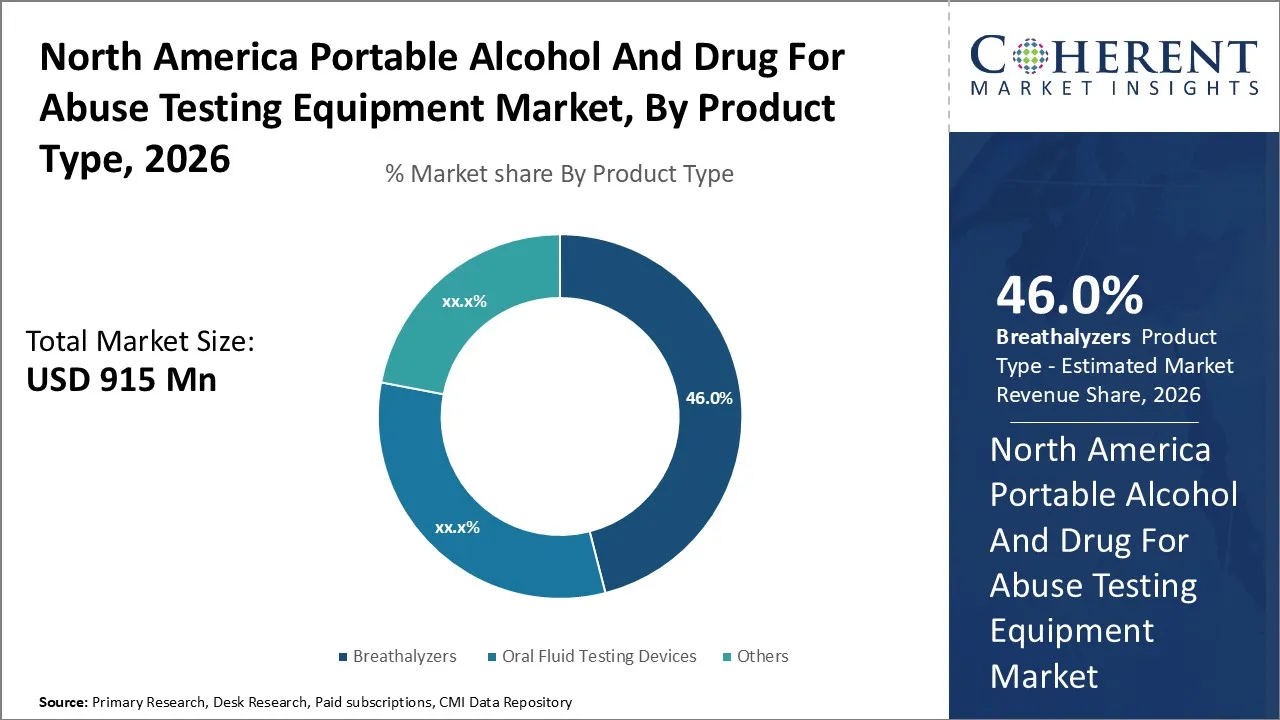
The North America portable alcohol and drug for abuse testing equipment market size is estimated to reach around USD 915 Mn in 2026 and is projected to grow at a CAGR of 6% during the forecast period (2026-2033), totaling USD 1,370 Mn by 2033.
Key Takeaways from the North America Portable Alcohol And Drug For Abuse Testing Equipment Market Report
- Breathalyzers are expected to remain the most sought-after product type, accounting for a market revenue share of 46% in 2026, thanks to their ease of use, quick results, and widespread adoption in law enforcement and workplace testing.
- By sample type, breath segment is slated to dominate the North America market during the forecast period.
- The United States is projected to lead the North America portable alcohol and drug abuse testing equipment market, accounting for an 85% share in 2026.
North America Portable Alcohol And Drug For Abuse Testing Equipment Market Overview
North America portable alcohol and drug for abuse testing equipment market is projected to grow steadily during the forecast period. This is primarily due to rising drug addiction and increasing implementation of stringent workplace safety regulations and government initiatives to curb substance abuse. Furthermore, the surge in roadside sobriety checks and employee screening programs across North America is supporting market expansion.
Rising awareness of the health risks linked to alcohol and drug consumption is helping the portable alcohol and drug for abuse testing equipment market grow in North America. Also, the increasing use of advanced testing technologies in law enforcement, healthcare, and corporate sectors is boosting market demand.
Leading companies are developing rapid and non-invasive testing solutions, such as breathalyzers and saliva-based drug detection kits, to capitalize on emerging opportunities. For instance, in July 2025, Cannabix Technologies commenced the first production of its BreathLogix Alcohol Screening Devices.
Drug abuse testing, also called Drugs of Abuse (DOA) testing, is a medical and forensic process that checks for illegal or controlled substances in a person, such as opioids, amphetamines, cannabinoids, cocaine, and benzodiazepines. Common biological samples tested include urine, saliva, blood, hair, or sweat. Governments and organizations advocate DOA testing for public safety, workplace compliance, rehabilitation monitoring, and clinical purposes.
Increasing government initiatives are expected to drive market growth over the forecast period. Initiatives by various government organizations to reduce the incidence of driving under the influence of drugs and alcohol are anticipated to increase demand for alcohol breathalyzers and drug testing equipment. For example, the National Institute on Alcohol Abuse and Alcoholism (NIAAA) carries out and supports research on alcohol abuse and related issues in the U.S., while the National Consortium on Alcohol and Neurodevelopment in Adolescence (NCANDA) studies how alcohol use affects adolescent brain development.
Current Events and Their Impact on the North America Portable Alcohol And Drug For Abuse Testing Equipment Market
Current Event | Description and its Impact |
Regulatory and Policy Changes |
|
Technological Advancements and Innovation |
|
Segmental Insights
- Current Industry Events of 2026
- Market Size Estimation
- Regional Breakdown
- Competitive Landscape
- Customer Intelligence
- Segmental Analysis
- Pricing Analysis
- Key Market Drivers, Challenges & Future Trends
- Customized Insights Section
North America Portable Alcohol And Drug For Abuse Testing Equipment Market Insights, By Product Type - Breathalyzers Remain Top-Selling Product Type
Based on product type, breathalyzers segment is expected to dominate the North American market, with a revenue share of about 46% in 2026. This is mostly due to widespread adoption of semiconductor based breathalyzers, infrared based breathalyzers, and fuel cell based breathalyzers in law enforcement, workplace safety programs, and personal use.
Breathalyzers are favored because of their ease of use, rapid results, and increasing accuracy due to technological advancements such as digital sensors and smartphone connectivity. Moreover, growing awareness about DUI (driving under the influence) laws and workplace compliance regulations is significantly fueling demand for portable breath alcohol testing devices like breathalyzers across North America.
North America Portable Alcohol And Drug For Abuse Testing Equipment Market Insights, By Sample Type - Breath Testing Dominates Sample Type Segment
By sample type, breath segment is slated to hold a dominant position in North America market over the forecast period. This is due to the widespread use of breath‐based testing technologies (especially for alcohol detection), their non-invasive nature, rapid results, and strong adoption by law enforcement and public safety agencies.
Breath testing is being increasingly used for detecting alcohol consumption, especially in roadside and workplace screenings. It provides quick, non-invasive, and reliable results, making it the preferred choice for law enforcement and safety authorities across the United States and Canada.
Country Insights
North America Portable Alcohol And Drug For Abuse Testing Equipment Market Outlook – Country-wise
United States Remains at the Epicenter of Market Growth
The U.S. is expected to remain the market leader, accounting for a share of about 85% in 2026. This is mostly due to stringent workplace safety regulations, widespread enforcement of DUI/DWI laws, and high adoption of point-of-care testing devices across law enforcement, corporate, and healthcare sectors.
Increasing focus on impaired driving prevention programs and substantial investments in rapid, user-friendly diagnostic tools further support market expansion. In addition, presence of leading manufacturers and continuous technological advancements in portable breathalyzers and drug screening kits are solidifying the United States’ dominant position.
North America Portable Alcohol and Drug For Abuse Testing Equipment Industry News
- In October 2025, Cannabix Technologies was granted a patent by the USPTO for its contactless breath analysis technology. The patent covers Cannabix’s contact‑free breath analysis device and method, which can detect substances in a person’s breath without physical contact.
- In April 2025, Dräger launched the Alcotest 7000, an innovative alcohol screening device designed to support DUI prevention, DOT compliance, and workplace safety initiatives. The device delivers reliable, accurate results tailored to the needs of both law enforcement and safety-sensitive industries.
- In October 2025, Cannabix Technologies delivered its BreathLogix alcohol screening device to an oilfield transportation services company in northern Alberta, Canada. The BreathLogix system performs rapid, unmanned breath alcohol testing and can send results to managers in real time.
Market Report Scope
North America Portable Alcohol And Drug For Abuse Testing Equipment Market Report Coverage
| Report Coverage | Details | ||
|---|---|---|---|
| Base Year: | 2025 | Market Size in 2026: | USD 915 Mn |
| Historical Data for: | 2020 To 2024 | Forecast Period: | 2026 To 2033 |
| Forecast Period 2026 to 2033 CAGR: | 6% | 2033 Value Projection: | USD 1,370 Mn |
| Geographies covered: |
| ||
| Segments covered: |
| ||
| Companies covered: | Lifeloc Technologies, Inc., Lion Laboratories Limited, Quest Products, Inc., Intoximeters, Inc., BACtrack, Alcolizer Pty Ltd., Drägerwerk AG & Co. KGaA, C4 Development Ltd., Randox Laboratories Ltd., and Abbott Laboratories | ||
| Growth Drivers: |
| ||
| Restraints & Challenges: |
| ||
North America Portable Alcohol And Drug For Abuse Testing Equipment Market Drivers
Rising Substance Abuse and Public Safety Awareness
Alcohol-impaired driving and drug abuse are on the rise in countries like the United States. This is creating a growing demand for reliable screening solutions, such as breathalyzers, in law enforcement, workplaces, schools, and community safety programs. Public health campaigns and employer safety initiatives are also encouraging adoption.
According to the National Centre for Drug Abuse Statistics (NCDAS), alcohol abuse, alcoholism, and alcohol use disorder (AUD) contribute to over 2.6 million deaths globally each year. In the U.S., about 178,307 Americans die annually from alcohol-related causes. Moreover, nearly 1 in 10 Americans aged 12 and older have Alcohol Use Disorder. These trends are expected to support growth in the North American portable alcohol and drug abuse testing market during the forecast period.
North America Portable Alcohol And Drug For Abuse Testing Equipment Market Drivers
Stringent Government and Law Enforcement Regulations
Strong DUI laws and regulatory mandates in the U.S. and Canada require alcohol and drug testing in specific settings, such as roadside enforcement and safety-sensitive workplaces. This drives demand for portable alcohol and drug abuse testing equipment. Federal and state agencies, as well as public safety programs, routinely deploy portable devices for compliance and monitoring.
Governments and healthcare organizations across North America are running awareness campaigns and increasing funding for substance abuse treatment programs. For example, the Texas Health and Human Services Commission (HHSC) started a $23.2 million public awareness campaign in March 2022 to prevent substance use disorders and improve access to addiction treatment services. These efforts are expected to support growth of the portable alcohol and drug abuse testing equipment market in North America during the forecast period.
North America Portable Alcohol And Drug For Abuse Testing Equipment Market Trends
Shift Towards Portable Testing Solutions and Non-Invasive Drug Detection
Portable, rapid testing solutions are increasingly preferred over lab-based systems due to their convenience and the immediacy of results. Non-invasive drug detection methods, such as saliva or oral fluid testing, are gaining traction as they simplify sampling and reduce discomfort compared to traditional urine or blood tests. Additionally, smart and connected devices that integrate with mobile apps or cloud platforms are trending, enabling better data management, reporting, and compliance documentation.
North America Portable Alcohol And Drug For Abuse Testing Equipment Market Opportunities
Expanding Use Across Multiple Sectors
The growing adoption of alcohol and drug testing solutions in different sectors is creating strong growth opportunities in the North American market. Law enforcement agencies, corporate safety programs, transportation authorities, and healthcare providers are using portable devices more often to carry out quick on-site screenings. Workplace drug and alcohol testing is also increasing as companies work to reduce liability and maintain safe operations. As a result, demand for portable alcohol and drug abuse testing equipment is steadily rising across the region.
Advancements in Portable Alcohol and Drug Abuse Testing Technologies
Advancements in portable alcohol and drug abuse testing technologies are making instruments more accurate, portable, and user-friendly. Devices such as fuel-cell and infrared breathalyzers, along with rapid oral fluid drug testing kits, are increasingly suitable for on-site use. These technologies are driving adoption across law enforcement, workplace safety, healthcare, and transportation sectors.
In addition, integration of portable alcohol and drug testing equipment with smartphone applications, cloud platforms, and IoT analytics enhances real-time reporting, compliance tracking, and remote monitoring. This will also encourage uptake across multiple end-use industries.
Analyst Opinion (Expert Opinion)
- Portable testers are now frontline compliance tools, not just optional devices. Law enforcement, workplaces, and transportation authorities increasingly rely on portable alcohol and drug testers for fast, on-site results. Over 65% of roadside enforcement and safety-sensitive workplaces in the U.S. use portable devices regularly, because waiting for lab-based testing is operationally and legally impractical.
- Accuracy and reliability matter most. Modern portable devices are more than just small or convenient—they must give legally defensible and workplace-compliant results. Devices with multi-substance detection and fuel-cell or oral fluid technology are preferred, as agencies see fewer false positives and negatives with these high-accuracy devices.
- Regulations shape market leaders. Agencies and employers want devices that meet federal and state standards, with traceable calibration and certification. Companies that follow these rules earn long-term contracts, while non-compliant or low-accuracy devices fall behind.
Speak to the analyst
Want personalized insights?
Take the findings above to one of our principal consultants, or have the report rebuilt around the segments, geographies and competitors you actually track.
Market Segmentation
- By Product Type Insights ( Revenue, USD Mn, 2020 - 2033)
- Breathalyzers
- Semiconductor Based Breathalyzer
- Infrared (IR) Based Breathalyzer
- Fuel Cell Based Breathalyzer
- Oral Fluid Testing Devices
- Others
- Breathalyzers
- By Sample Type Insights ( Revenue, USD Mn, 2020 - 2033)
- Breath
- Saliva
- Blood
- Others
- By End User Insights ( Revenue, USD Mn, 2020 - 2033)
- SWAT Team
- Patrol Division
- Game Warden
- School Resource Officer
- Transit/Railroad Officer
- Correctional Officer
- Sheriff
- By Region Insights ( Revenue, USD Mn, 2020 - 2033)
- U.S.
- Canada
- Key Players
- Lifeloc Technologies, Inc.
- Lion Laboratories Limited
- Quest Products, Inc.
- Intoximeters, Inc.
- BACtrack
- Alcolizer Pty Ltd.
- Drägerwerk AG & Co. KGaA
- C4 Development Ltd.
- Randox Laboratories Ltd.
- Abbott Laboratories.
Sources
Primary Research interviews
- Interviews with hospital laboratory managers and technicians
- Interviews with law enforcement agencies using portable testing equipment
- Interviews with workplace safety officers and HR compliance managers
- Discussions with manufacturers and distributors of portable alcohol and drug testing devices
Databases
- PubChem
- FDA (U.S. Food and Drug Administration) Device Databases
- CDC (Centers for Disease Control and Prevention) DataPortal
- National Highway Traffic Safety Administration (NHTSA) Crash Data
- SAMHSA (Substance Abuse and Mental Health Services Administration) Data
Magazines
- Laboratory Equipment Magazine
- MedTech Outlook
- Occupational Health & Safety Magazine
- Clinical Lab Products Magazine
Journals
- Journal of Analytical Toxicology
- Forensic Science International
- Addiction Research & Theory
- Drug and Alcohol Dependence
- Journal of Occupational and Environmental Hygiene
Newspapers
- The New York Times – Health Section
- The Washington Post – Science and Health
- USA Today – Health and Safety
- Local/regional newspapers covering DUI and workplace safety incidents
Associations
- American Association for Clinical Chemistry (AACC)
- National Safety Council (NSC)
- American College of Occupational and Environmental Medicine (ACOEM)
- Drug & Alcohol Testing Industry Association (DATIA)
Public Domain sources
- U.S. Government Reports on Substance Abuse
- National Institute on Drug Abuse (NIDA) Reports
- U.S. Census Bureau (for workforce and demographic data)
- OSHA (Occupational Safety and Health Administration) Guidelines and Reports
Proprietary Elements
- CMI Data Analytics Tool
- Proprietary CMI Existing Repository of information for last 8 years
Get access to 250+ pages report
Every segment, forecast, competitor profile and data table behind the analysis above — available for instant download.
- ESOMAR Member
- ISO 9001:2015 Certified
- D-U-N-S Registered
- GDPR & CCPA Compliant
Missing comfort of reading report in your local language? Find your preferred language:
Transform your Strategy with Exclusive Trending Reports
Frequently Asked Questions
The North America market is estimated to be valued at USD 915 Mn in 2026.
North America Portable Alcohol And Drug For Abuse Testing Equipment Market value is expected to surpass USD 1,370 Mn by 2033.
North America market is poised to exhibit a CAGR of 6% from 2026 to 2033.
Major growth factors include rising prevalence of drunk and drive cases and drug addiction, and increasing government initiatives.
Inaccurate and false results of breath analyzers.
Lifeloc Technologies, Inc., Lion Laboratories Limited, Quest Products, Inc., Intoximeters, Inc., BACtrack, Alcolizer Pty Ltd., Drägerwerk AG & Co. KGaA, C4 Development Ltd., Randox Laboratories Ltd., and Abbott Laboratories are the major players.